

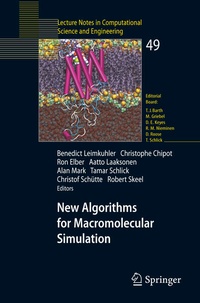
New Algorithms for Macromolecular Simulation
Published on 20. December 2005
Book
Paperback/Softback
XVI, 367 pages
978-3-540-25542-0 (ISBN)
Description
Molecular simulation is a widely used tool in biology, chemistry, physics and engineering. This book contains a collection of articles by leading researchers who are developing new methods for molecular modelling and simulation. Topics addressed here include: multiscale formulations for biomolecular modelling, such as quantum-classical methods and advanced solvation techniques; protein folding methods and schemes for sampling complex landscapes; membrane simulations; free energy calculation; and techniques for improving ergodicity. The book is meant to be useful for practitioners in the simulation community and for those new to molecular simulation who require a broad introduction to the state of the art.
More details
Series
Edition
2006 ed.
Language
English
Place of publication
Berlin
Germany
Publishing group
Springer Berlin
Target group
Professional and scholarly
Research
Illustrations
77 s/w Abbildungen, 8 farbige Abbildungen
XVI, 367 p. 85 illus., 8 illus. in color.
Dimensions
Height: 235 mm
Width: 155 mm
Thickness: 24 mm
Weight
651 gr
ISBN-13
978-3-540-25542-0 (9783540255420)
DOI
10.1007/3-540-31618-3
Schweitzer Classification
Other editions
Additional editions
Benedict Leimkuhler | Christophe Chipot | Ron Elber
New Algorithms for Macromolecular Simulation
E-Book
03/2006
1st Edition
Springer
€149.79
Available for download
Persons
Benedict Leimkuhler, University of Leicester, United Kingdom / Christophe Chipot, Université Henri Poincaré, Vandoeuvre-lès-Nancy, France / Ron Elber, Cornell University, Ithaca, NY, USA / Aatto Laaksonen, Stockholm University, Sweden / Alan Mark, University of Groningen, The Netherlands / Tamar Schlick, New York University, NY, USA / Christoph Schütte, Freie Universität Berlin, Germany / Robert Skeel, Purdue University, West Lafayette, IN, USA
Content
Macromolecular Models: From Theories to Effective Algorithms.- Membrane Protein Simulations: Modelling a Complex Environment.- Modeling and Simulation Based Approaches for Investigating Allosteric Regulation in Enzymes.- Exploring the Connection Between Synthetic and Natural RNAs in Genomes: A Novel Computational Approach.- Learning to Align Sequences: A Maximum-Margin Approach.- Minimization of Complex Molecular Landscapes.- Overcoming Energetic and Time Scale Barriers Using the Potential Energy Surface.- The Protein Folding Problem.- Dynamical and Stochastic-Dynamical Foundations for Macromolecular Modelling.- Biomolecular Sampling: Algorithms, Test Molecules, and Metrics.- Approach to Thermal Equilibrium in Biomolecular Simulation.- The Targeted Shadowing Hybrid Monte Carlo (TSHMC) Method.- The Langevin Equation for Generalized Coordinates.- Metastability and Dominant Eigenvalues of Transfer Operators.- Computation of the Free Energy.- Free Energy Calculations in Biological Systems. How Useful Are They in Practice?.- Numerical Methods for Calculating the Potential of Mean Force.- Replica-Exchange-Based Free-Energy Methods.- Fast Electrostatics and Enhanced Solvation Models.- Implicit Solvent Electrostatics in Biomolecular Simulation.- New Distributed Multipole Metdhods for Accurate Electrostatics in Large-Scale Biomolecular Simulations.- Quantum-Chemical Models for Macromolecular Simulation.- Towards Fast and Reliable Quantum Chemical Modelling of Macromolecules.- Quantum Chemistry Simulations of Glycopeptide Antibiotics.- Panel Discussion.