

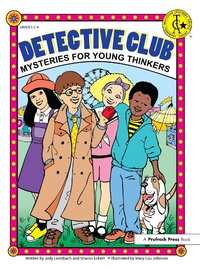
Detective Club
Mysteries for Young Thinkers (Grades 2-4)
1st Edition
Published on 1. February 2005
Book
Paperback/Softback
66 pages
978-1-59363-065-2 (ISBN)
Description
Looking for a fast, easy way to turn your students into advanced problem solvers?
Young students become members of the Detective Club by solving a series of short introductory puzzles. Primary students love working along with the young detectives in the book to solve six different mysteries. While solving the mysteries, students will gather information through decoding the message, sorting information, solving logic puzzles, and using inferential thinking. In order to reach conclusions, students will practice the following skills: organizing clues, combining and analyzing the information presented, using deductive reasoning, and using the process of elimination. Each of the six mysteries includes a teacher's guide with complete instructions for the teacher and answers to the puzzles. All mysteries are presented on attractive reproducible worksheets that include entertaining dialogue and clues needed to solve the mystery. This is a motivating format for teaching thinking while working on reading comprehension.
Have your students solve even more mysteries with Mystery Disease, Mystery Science, Crime Scene Detective, and The Great Chocolate Caper.
Grades 2-4
Young students become members of the Detective Club by solving a series of short introductory puzzles. Primary students love working along with the young detectives in the book to solve six different mysteries. While solving the mysteries, students will gather information through decoding the message, sorting information, solving logic puzzles, and using inferential thinking. In order to reach conclusions, students will practice the following skills: organizing clues, combining and analyzing the information presented, using deductive reasoning, and using the process of elimination. Each of the six mysteries includes a teacher's guide with complete instructions for the teacher and answers to the puzzles. All mysteries are presented on attractive reproducible worksheets that include entertaining dialogue and clues needed to solve the mystery. This is a motivating format for teaching thinking while working on reading comprehension.
Have your students solve even more mysteries with Mystery Disease, Mystery Science, Crime Scene Detective, and The Great Chocolate Caper.
Grades 2-4
Reviews / Votes
This teaching aid for second through fourth graders emphasizes deductive reasoning skills in a fun way. The reader can become a member of the Detective Club while boosting reading and logic skills. To sustain the challenges, the problems get progressively more difficult. An excellent teacher resource.,Parent Council, 1/1/07More details
Language
English
Place of publication
Oxford
United States
Publishing group
Taylor & Francis Inc
Target group
Professional and scholarly
Professional Practice & Development
Product notice
Paperback (trade)
Unsewn / adhesive bound
Dimensions
Height: 276 mm
Width: 216 mm
Thickness: 5 mm
Weight
195 gr
ISBN-13
978-1-59363-065-2 (9781593630652)
Copyright in bibliographic data and cover images is held by Nielsen Book Services Limited or by the publishers or by their respective licensors: all rights reserved.
Schweitzer Classification
Other editions
Additional editions
E-Book
09/2021
1st Edition
Routledge
€18.49
Available for download
E-Book
09/2021
1st Edition
Routledge
€18.49
Available for download
Persons
Judy Leimbach received her master's degree in Instructional Strategies in Gifted Education from National-Louis University. She has 14 years of experience teaching in regular classrooms, kindergarten through fifth grade, and 14 years experience teaching gifted students in grades 1-5. In addition, she has spent 5 years supervising groups of student teachers at Wheaton College.
When she first started teaching in a gifted program, there were few materials available for gifted students in primary grades, so Leimbach began writing her own and had several books published. Having previously taught in the regular classroom, she also was very aware of the need for high quality, easy-to-use materials for regular classroom teachers to use for their gifted students in both primary and intermediate grades. She began working with other teachers, including her daughter, a middle school math teacher, to develop materials to meet that need.
Sharon Eckert has devoted her teaching career of 35 years to the education of primary students. She has taught kindergarten through third grade. However, second grade was her favorite, and she chose to teach at that level for 30 years.
During her years of service in School District 89 in Glen Ellyn, IL, Eckert has served on district curriculum committees in language arts, math, and social studies; district committees for report cards, textbook adoptions, and teacher-in-service; and numerous building committees. Her interest in photography has led her to record various events and social functions throughout the district. Eckert earned her bachelor's degree in education and master's degree in education from Illinois State University.
When she first started teaching in a gifted program, there were few materials available for gifted students in primary grades, so Leimbach began writing her own and had several books published. Having previously taught in the regular classroom, she also was very aware of the need for high quality, easy-to-use materials for regular classroom teachers to use for their gifted students in both primary and intermediate grades. She began working with other teachers, including her daughter, a middle school math teacher, to develop materials to meet that need.
Sharon Eckert has devoted her teaching career of 35 years to the education of primary students. She has taught kindergarten through third grade. However, second grade was her favorite, and she chose to teach at that level for 30 years.
During her years of service in School District 89 in Glen Ellyn, IL, Eckert has served on district curriculum committees in language arts, math, and social studies; district committees for report cards, textbook adoptions, and teacher-in-service; and numerous building committees. Her interest in photography has led her to record various events and social functions throughout the district. Eckert earned her bachelor's degree in education and master's degree in education from Illinois State University.
Content
Introduction Using a gRid to Solve Logic Puzzles Teacher's Guide Student Pages The Detective Club Most Creative Costume Biggest Fish Championship Baseball Team Detective Log Sheet The case of the Mystery Valentine Student Pages Teacher's Guide The Case of the Lost Backpack Student Pages Teacher's Guide THe Case of the Missing Ribbon Student Pages Teacher's Guide The Case of Willie's Wallet Student Pages Teacher's Guide Student Pages Teacher's Guide The Case of the Boys Only Club Student Pages Teacher's Guide The Case of Santa's Gift List Student Pages Teacher's Guide Certificate