

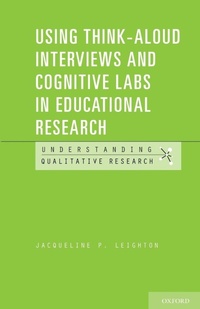
Using Think-Aloud Interviews and Cognitive Labs in Educational Research
Published on 9. March 2017
Book
Paperback/Softback
216 pages
978-0-19-937290-4 (ISBN)
Description
The field of education is rife with calls to action and for research to improve higher-level thinking and learning outcomes in primary, secondary, and tertiary education. With the No Child Left Behind Act and even more recently the Every Student Succeeds Act, policymakers are acknowledging the need for accountability and for an education system that works for everyone. Thankfully, psychologists and educators are coming together to share best methods for how to design better learning environments, assessments and tests, but are also probing learners for how they process the content material with which they are faced.
Jacqueline P. Leighton's Using Think-Aloud Interviews and Cognitive Labs in Educational Research provides the first volume focused on distinguishing related - but specific - methods for probing these distinct forms of student cognition.
Unlike volumes focused on interview techniques for questionnaire design and analysis, this book builds on the seminal 1993 work of psychologists K. Anders Ericsson and Herbert A. Simon for using think-aloud and protocol analysis to generate evidence of student problem solving in education, while also distinguishing this work from cognitive interviews used to generate evidence of human understanding comprehension within the educational and psychological settings. Here, Leighton not only presents the theoretical basis for the two interview and analytical techniques, but also advances how to use cognitive models in the planning of interviews, collecting data, training those who work with this data, and generating evidence for claims about higher-level thinking and learning.
Using Think-Aloud Interviews and Cognitive Labs in Educational Research includes sample instructions, cautions, and schematic visuals to help readers identify these distinct procedures, while also integrating the work with established standards such as the 2014 Standards for Educational and Psychological Testing published by the American Educational Research Association, the National Council on Measurement in Education, and the American Psychological Association.
Jacqueline P. Leighton's Using Think-Aloud Interviews and Cognitive Labs in Educational Research provides the first volume focused on distinguishing related - but specific - methods for probing these distinct forms of student cognition.
Unlike volumes focused on interview techniques for questionnaire design and analysis, this book builds on the seminal 1993 work of psychologists K. Anders Ericsson and Herbert A. Simon for using think-aloud and protocol analysis to generate evidence of student problem solving in education, while also distinguishing this work from cognitive interviews used to generate evidence of human understanding comprehension within the educational and psychological settings. Here, Leighton not only presents the theoretical basis for the two interview and analytical techniques, but also advances how to use cognitive models in the planning of interviews, collecting data, training those who work with this data, and generating evidence for claims about higher-level thinking and learning.
Using Think-Aloud Interviews and Cognitive Labs in Educational Research includes sample instructions, cautions, and schematic visuals to help readers identify these distinct procedures, while also integrating the work with established standards such as the 2014 Standards for Educational and Psychological Testing published by the American Educational Research Association, the National Council on Measurement in Education, and the American Psychological Association.
More details
Series
Language
English
Place of publication
New York
United States
Target group
Professional and scholarly
Dimensions
Height: 216 mm
Width: 140 mm
Thickness: 12 mm
Weight
276 gr
ISBN-13
978-0-19-937290-4 (9780199372904)
Copyright in bibliographic data and cover images is held by Nielsen Book Services Limited or by the publishers or by their respective licensors: all rights reserved.
Schweitzer Classification
Other editions
Additional editions
Jacqueline P. Leighton
Using Think-Aloud Interviews and Cognitive Labs in Educational Research
E-Book
01/2017
1st Edition
OUP eBook
€40.99
Available for download
Jacqueline P. Leighton
Using Think-Aloud Interviews and Cognitive Labs in Educational Research
E-Book
01/2017
1st Edition
OUP eBook
€40.99
Available for download
Person
Jacqueline P. Leighton is a registered psychologist who has pursued the design, development, and implementation of fair student educational testing in her career. Her research in the psychology of learning has provided her with insights into how individuals demonstrate their knowledge, skills and how they react to evaluative processes. Her research has focused on methods for interviewing test-takers to enhance test design and the psychology of making and learning from mistakes to enhance learning.
Content
Chapter 1: What is the Problem to be Solved?
Chapter 2: Think-Aloud Interview Procedures: Measuring Problem Solving Response Processes
Chapter 3: Cognitive Laboratory Interview Procedures: Measuring Comprehension and Understanding
Chapter 4: Think-Aloud Interview Procedures: Analyzing and Generating Inferences from Verbal Report Data
Chapter 5: Cognitive Laboratory Interview Procedures: Analyzing and Generating Inferences from Verbal Report Data
Chapter 2: Think-Aloud Interview Procedures: Measuring Problem Solving Response Processes
Chapter 3: Cognitive Laboratory Interview Procedures: Measuring Comprehension and Understanding
Chapter 4: Think-Aloud Interview Procedures: Analyzing and Generating Inferences from Verbal Report Data
Chapter 5: Cognitive Laboratory Interview Procedures: Analyzing and Generating Inferences from Verbal Report Data