

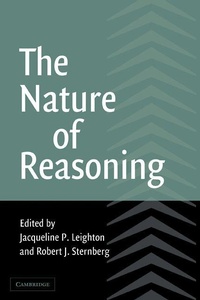
The Nature of Reasoning
Published on 3. November 2003
Book
Paperback/Softback
488 pages
978-0-521-00928-7 (ISBN)
Description
We are bombarded with information - press releases, television news, internet websites, and office memos, just to name a few - on a daily basis. However, the important conclusions that may or need to be inferred from such information are typically not provided. We must draw the conclusions by ourselves. How do we draw these conclusions? This 2004 book addresses how we reason to reach sensible conclusions. The purpose of this book is to organise in one volume what is known about reasoning, such as its structural prerequisites, its mechanisms, its susceptibility to pragmatic influences, its pitfalls, and the bases for its development. Given that reasoning underlies so many of our intellectual activities - when we learn, criticise, analyse, judge, infer, evaluate, optimise, apply, discover, imagine, devise, and create - we stand to gain a great deal if we can learn to define, operate, apply, and nurture our reasoning.
Reviews / Votes
"This handy, one-volume compendium of current theory and research on the psychology of reasoning not only presents the state of the science of reasoning but also charts new directions. Covering everything from how to define reasoning... to the brain functions that subserve reasoning... the book's contributors...create a comprehensive account of what is known about reasoning in psychology and cognitive science. The editors and contributors are all well-known and highly regarded researchers in the field.... Highly recommended." ChoiceMore details
Language
English
Place of publication
Cambridge
United Kingdom
Target group
Professional and scholarly
Product notice
Paperback (trade)
Illustrations
12 Tables, unspecified; 25 Line drawings, unspecified
Dimensions
Height: 229 mm
Width: 152 mm
Thickness: 29 mm
Weight
785 gr
ISBN-13
978-0-521-00928-7 (9780521009287)
Copyright in bibliographic data and cover images is held by Nielsen Book Services Limited or by the publishers or by their respective licensors: all rights reserved.
Schweitzer Classification
Persons
Content
1. Defining and describing reason; 2. Reasoning and brain function; 3. Working memory and reasoning; 4. The role of prior belief in reasoning; 5. Task understanding; 6. Strategies and knowledge representation; 7. Mental models and reasoning; 8. Mental-logic theory: what it proposes and reasons to take this proposal seriously; 9. Heuristics and reasoning: making deduction simple; 10. Cognitive heuristics: reasoning the fast and frugal way; 11. The assessment of logical reasoning; 12. The development of deductive reasoning; 13. The evolution of reasoning; 14. Individual differences in thinking, reasoning, and decision making; 15. Teaching reasoning; 16. What do we know about the nature of reasoning?