

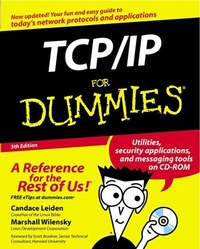
TCP/IP For Dummies
5th Edition
Published on 3. January 2003
Book
Paperback/Softback
XVIII, 390 pages
978-0-7645-1760-0 (ISBN)
Description
The latest edition of this bestseller clearly explains the fundamentals of TCP/IP (Transmission Control Protocol/Internet Protocol), the core standard behind many common Internet and network services. It covers the latest TCP/IP protocol standards and developments, including virtual LANs, SANs, peer-to-peer applications, Web services, mobile IP, and VPNs.
Reviews / Votes
"...a definitive learners' guide, an amusing one...a great starter kit..." (IT Training, June 2003)More details
Edition
5., Auflage
Language
English
Place of publication
Foster City
United States
Publishing group
John Wiley & Sons Inc
Target group
Professional and scholarly
Edition type
Revised edition
Illustrations
illustrations
Dimensions
Height: 23.3 cm
Width: 18.8 cm
Weight
634 gr
ISBN-13
978-0-7645-1760-0 (9780764517600)
Schweitzer Classification
Other editions
New editions
Candace Leiden | Marshall Wilensky
TCP/IP For Dummies
Book
08/2009
6th Edition
Wiley
€32.50
Shipment within 10-20 days
Persons
Candace Leiden is the Chief Technologist at Cardinal Software Group, a training and consulting corporation.
Marshall Wilensky is a Solutions Architect with the ISV Consulting team at Lotus Development Corporation.
Marshall Wilensky is a Solutions Architect with the ISV Consulting team at Lotus Development Corporation.
Content
Foreword.
Introduction.
Part I: TCP/IP Basics and Buzzwords.
Chapter 1: Understanding TCP/IP Basics.
Chapter 2: What You Need to Know about Networks.
Chapter 3: Internetworking Technologies: Client/Server, P2P, and Grid.
Chapter 4: TCP/IP and Internets, Intranets, and Extranets.
Part II: Getting Technical with Protocols and Addresses.
Chapter 5: Introducing the TCP/IP Model and the Protocols.
Chapter 6: Nice Names and Agonizing Addresses.
Chapter 7: Not Enough Addresses? Try Subnets, DHCP, CIDR, NAT.
Chapter 8: Configuring TCP/IP.
Chapter 9: IPv6 IP on Steroids.
Part III: Using and Configuring TCP/IP Services.
Chapter 10: Resolving Names and Addresses with DNS.
Chapter 11: E-Mail and Other Communication Services.
Chapter 12: Getting Started with Web Clients and Servers.
Chapter 13: Sharing Files with FTP and rcp.
Chapter 14: Sharing Compute Power across a Network.
Chapter 15: Mobile IP, Dialup Networking, and IP Telephony.
Part IV: Network Hardware and Security.
Chapter 16: The Dreaded Hardware Chapter.
Chapter 17: Troubleshooting Connectivity Problems Step by Step.
Chapter 18: Protecting and Monitoring Network Security.
Chapter 19: Securing E-Mail and Other TCP/IP Applications.
Chapter 20: Advanced Security.
Part V: The Part of Tens.
Chapter 21: Ten Strange but Real TCP/IP Network Devices (No Kidding!).
Chapter 22: Watch Your Back Ten Practical Security Tips.
Chapter 23: Ten Ways to Get RFCs.
Appendix: About the CD.
Index.
Introduction.
Part I: TCP/IP Basics and Buzzwords.
Chapter 1: Understanding TCP/IP Basics.
Chapter 2: What You Need to Know about Networks.
Chapter 3: Internetworking Technologies: Client/Server, P2P, and Grid.
Chapter 4: TCP/IP and Internets, Intranets, and Extranets.
Part II: Getting Technical with Protocols and Addresses.
Chapter 5: Introducing the TCP/IP Model and the Protocols.
Chapter 6: Nice Names and Agonizing Addresses.
Chapter 7: Not Enough Addresses? Try Subnets, DHCP, CIDR, NAT.
Chapter 8: Configuring TCP/IP.
Chapter 9: IPv6 IP on Steroids.
Part III: Using and Configuring TCP/IP Services.
Chapter 10: Resolving Names and Addresses with DNS.
Chapter 11: E-Mail and Other Communication Services.
Chapter 12: Getting Started with Web Clients and Servers.
Chapter 13: Sharing Files with FTP and rcp.
Chapter 14: Sharing Compute Power across a Network.
Chapter 15: Mobile IP, Dialup Networking, and IP Telephony.
Part IV: Network Hardware and Security.
Chapter 16: The Dreaded Hardware Chapter.
Chapter 17: Troubleshooting Connectivity Problems Step by Step.
Chapter 18: Protecting and Monitoring Network Security.
Chapter 19: Securing E-Mail and Other TCP/IP Applications.
Chapter 20: Advanced Security.
Part V: The Part of Tens.
Chapter 21: Ten Strange but Real TCP/IP Network Devices (No Kidding!).
Chapter 22: Watch Your Back Ten Practical Security Tips.
Chapter 23: Ten Ways to Get RFCs.
Appendix: About the CD.
Index.