

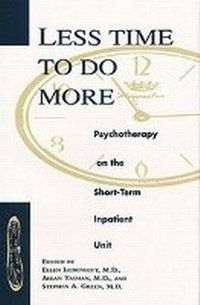
Less Time to Do More
Psychotherapy on the Short-Term Inpatient Unit
Published on 31. October 1993
Book
Hardback
321 pages
978-0-88048-512-8 (ISBN)
Description
Will psychotherapy survive to be a vital part of inpatient
treatment in the future? Will inpatient units themselves survive, or will
they be replaced by partial hospital programs complemented by supervised
housing arrangements? Will average length of inpatient stay continue to
decrease, or has it reached its lowest possible level?
Less Time to
Do More: Psychotherapy on the Short-Term Inpatient Unit examines the
implications of shorter stays for the practice of inpatient psychotherapy.
The contributors describe techniques that inpatient psychotherapists can use
to remain therapeutically effective despite increased pressure from managed
care companies and the threat of malpractice suits. This book utilizes over
20 years of research on techniques and strategies to bring the reader the
most up-to-date methods as well as the traditional models of inpatient
treatment.
"How can inpatient psychotherapists respond to the
realities of modern hospital practice? Each of these chapters describes one
facet of how the therapist can adapt his or her goals and techniques to
treat seriously ill patients effectively in the limited time
available."-Ellen Leibenluft, M.D., From the Afterword
treatment in the future? Will inpatient units themselves survive, or will
they be replaced by partial hospital programs complemented by supervised
housing arrangements? Will average length of inpatient stay continue to
decrease, or has it reached its lowest possible level?
Less Time to
Do More: Psychotherapy on the Short-Term Inpatient Unit examines the
implications of shorter stays for the practice of inpatient psychotherapy.
The contributors describe techniques that inpatient psychotherapists can use
to remain therapeutically effective despite increased pressure from managed
care companies and the threat of malpractice suits. This book utilizes over
20 years of research on techniques and strategies to bring the reader the
most up-to-date methods as well as the traditional models of inpatient
treatment.
"How can inpatient psychotherapists respond to the
realities of modern hospital practice? Each of these chapters describes one
facet of how the therapist can adapt his or her goals and techniques to
treat seriously ill patients effectively in the limited time
available."-Ellen Leibenluft, M.D., From the Afterword
Reviews / Votes
Less Time to Do More is a telling review of currentapproaches to inpatient psychiatry; one in which insurers ask us to treat
patients as objects to be cleverly and quickly maneuvered into conforming
behavior and to overlook the possibility that they may be interesting
persons overwhelmed by futile attempts to deal with conflicts beyond their
abilities to manage. * The New England Journal of Medicine * The book has been well-edited so that there is little
redundancy across chapters. Both the novice clinician and the experienced
hospital psychiatrist will find a good deal of clinical wisdom on the pages
of this fine new volume, and it will serve equally well as a text for
residents assigned to inpatient rotations and as a reference book for the
busy inpatient clinician. * American Journal of Psychiatry * This is a quality book, useful for psychotherapeutically
disciplined trainees as an overview of philosophy and techniques that offer
enhanced treatment effectiveness. * Doody's Journal *
More details
Language
English
Place of publication
VA
United States
Target group
College/higher education
Professional and scholarly
US School Grade: College Graduate Student and over
Product notice
With printed dust jacket
Illustrations
Not illustrated
Dimensions
Height: 236 mm
Width: 162 mm
Thickness: 29 mm
Weight
630 gr
ISBN-13
978-0-88048-512-8 (9780880485128)
Copyright in bibliographic data and cover images is held by Nielsen Book Services Limited or by the publishers or by their respective licensors: all rights reserved.
Schweitzer Classification
Persons
Ellen Leibenluft, M.D., is Medical Officer in the
Clinical Psychobiology Branch, National Institute of Mental Health, and
Clinical Associate Professor of Psychiatry at Georgetown University School
of Medicine in Washington, DC.
Allen Tasman, M.D., is Professor
and Chair of the Department of Psychiatry at the University of Louisville
School of Medicine, Louisville, Kentucky.
Stephen A. Green,
M.D., is Clinical Professor of Psychiatry at Georgetown University
School of Medicine, Washington, DC.
Clinical Psychobiology Branch, National Institute of Mental Health, and
Clinical Associate Professor of Psychiatry at Georgetown University School
of Medicine in Washington, DC.
Allen Tasman, M.D., is Professor
and Chair of the Department of Psychiatry at the University of Louisville
School of Medicine, Louisville, Kentucky.
Stephen A. Green,
M.D., is Clinical Professor of Psychiatry at Georgetown University
School of Medicine, Washington, DC.
Content
The Modalities. Application of therapeutic community
principles in short-stay units. Integrating somatic and psychological
treatment in inpatient settings. Individual psychodynamic psychotherapy.
Family treatment during brief hospitalization. Group psychotherapy.
Inpatient cognitive-behavior therapy of depression. Special
Populations. Inpatient psychotherapy with chronically mentally ill
patients. Inpatient psychotherapy with alcoholic patients. Patients with
eating disorders. Treating concurrent medical and psychiatric illness.
Adolescent inpatient psychotherapy. Geriatric patients. Patients with severe
personality disorders. Residency training in psychotherapy on acute
inpatient treatment services. Afterword.
principles in short-stay units. Integrating somatic and psychological
treatment in inpatient settings. Individual psychodynamic psychotherapy.
Family treatment during brief hospitalization. Group psychotherapy.
Inpatient cognitive-behavior therapy of depression. Special
Populations. Inpatient psychotherapy with chronically mentally ill
patients. Inpatient psychotherapy with alcoholic patients. Patients with
eating disorders. Treating concurrent medical and psychiatric illness.
Adolescent inpatient psychotherapy. Geriatric patients. Patients with severe
personality disorders. Residency training in psychotherapy on acute
inpatient treatment services. Afterword.