


Theory Of Knowledge
1st Edition
Published on 29. March 1990
Book
Paperback/Softback
224 pages
978-0-8133-0571-4 (ISBN)
Description
In this important new text, Keith Lehrer introduces students to the major traditional and contemporary accounts of knowing. Beginning with the traditional definition of knowledge as justified true belief, Lehrer explores the truth, belief, and justification conditions on the way to a thorough examination of foundationalism and modern coherence theories, as well as recent reliabilist and causal theories.The text also smoothly integrates several new lines that will interest scholars, including a new account of the authors coherence theory of undefeated justification. A special feature is Lehrers notion of a justification game played between a knowledge claimant and a skeptic, with the justification of the claim in the balance.Distinguished by clarity of structure, accessible writing, and an elegant mix of traditional material, contemporary ideas, and well-motivated innovation, this book will immediately take its place in the front rank of texts on the theory of knowledge. In this important new text, Keith Lehrer introduces students to the major traditional and contemporary accounts of knowing.
Beginning with the traditional definition of knowledge as justified true belief, Lehrer explores the truth, belief, and justification conditions on the way to a thorough examination of foundation theories of knowledge, externalism and naturalized epistemologies, and internalism and modern coherence theories as well as recent reliabilist and causal theories. Lehrer gives all views careful examination and concludes that external factors must be matched by appropriate internal factors to yield knowledge. This match of internal and external factors follows from Lehrers new coherence theory of undefeated justification.In addition to doing justice to the living epistemological traditions, the text smoothly integrates several new lines that will interest scholars. Lehrer argues, for example, that acceptance should replace the traditional belief condition and that knowledge can ultimately be understood as undefeated justification and truth as a consequence of a justification remaining undefeated. A feature of special interest is Lehrers concept of a justification game.
Lehrer explains justification in terms of a game between a claimant and a skeptic: The claimant wins and the knowledge claim is justified when he or she can beat or neutralize the moves of the skeptic.Readers of Professor Lehrers earlier book, Knowledge, will want to know that this text adopts the framework of that classic. But Theory of Knowledge is a thoroughly revised and up-dated version, containing several completely new chapters, that has been simplified throughout for student use.Written by a well-known scholar and contributor to modern epistemology, this text is distinguished by clarity of structure, accessible writing, and an elegant mix of traditional material, contemporary ideas, and well-motivated innovation. It will immediately take its place in the front rank of texts on the theory of knowledge.
Beginning with the traditional definition of knowledge as justified true belief, Lehrer explores the truth, belief, and justification conditions on the way to a thorough examination of foundation theories of knowledge, externalism and naturalized epistemologies, and internalism and modern coherence theories as well as recent reliabilist and causal theories. Lehrer gives all views careful examination and concludes that external factors must be matched by appropriate internal factors to yield knowledge. This match of internal and external factors follows from Lehrers new coherence theory of undefeated justification.In addition to doing justice to the living epistemological traditions, the text smoothly integrates several new lines that will interest scholars. Lehrer argues, for example, that acceptance should replace the traditional belief condition and that knowledge can ultimately be understood as undefeated justification and truth as a consequence of a justification remaining undefeated. A feature of special interest is Lehrers concept of a justification game.
Lehrer explains justification in terms of a game between a claimant and a skeptic: The claimant wins and the knowledge claim is justified when he or she can beat or neutralize the moves of the skeptic.Readers of Professor Lehrers earlier book, Knowledge, will want to know that this text adopts the framework of that classic. But Theory of Knowledge is a thoroughly revised and up-dated version, containing several completely new chapters, that has been simplified throughout for student use.Written by a well-known scholar and contributor to modern epistemology, this text is distinguished by clarity of structure, accessible writing, and an elegant mix of traditional material, contemporary ideas, and well-motivated innovation. It will immediately take its place in the front rank of texts on the theory of knowledge.
More details
Language
English
Place of publication
United States
Publishing group
Taylor & Francis Inc
Target group
College/higher education
Professional and scholarly
Dimensions
Height: 229 mm
Width: 152 mm
ISBN-13
978-0-8133-0571-4 (9780813305714)
Copyright in bibliographic data is held by Nielsen Book Services Limited or its licensors: all rights reserved.
Schweitzer Classification
Other editions
New editions
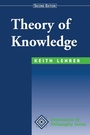
Book
09/2000
2nd Edition
Westview Press Inc
€72.60
Shipment within 10-20 days
Additional editions
Keith Lehrer
Theory Of Knowledge
Book
04/1990
1st Edition
Westview Press Inc
€126.28
Article exhausted; check for reprint
Content
The Analysis of Knowledge; Truth and Acceptance; The Foundation Theory: Infallible Foundationalism; Fallible Foundations; The Explanatory Coherence Theory; Internal Coherence and Personal Justification; Coherence, Truth, and Undefeated Justification; Externalism and Epistemology Naturalized; Skepticism.