

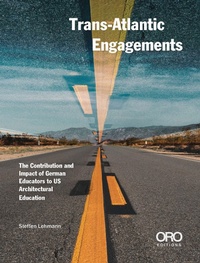
Trans-Atlantic Engagements
The Contribution and Impact of German Educators to US Architectural Education
Published on 17. March 2021
Book
Paperback/Softback
240 pages
978-1-951541-48-4 (ISBN)
Description
This book takes a critical look at the influence of German educators. It is a publication that explores the history of pedagogical concepts of German-born professors of architecture at schools in the United States. The research and book publication are structured in three parts; it aims to make a significant contribution to the understanding of architectural education in the United States and its historical cross-fertilisation with German educational concepts at large, with research outcomes responding directly to current and future educational and societal challenges.
The ideals of the Bauhaus school shaped more than just design and architecture around the world; these guiding principles and pedagogy also transformed teaching. The project examines the post-Bauhaus influence on these German-born educators today and how the Bauhaus model has evolved over the last 50 years. There are currently over 30 German-born educators, active in shaping architectural and design education in the US, influencing thousands of students as the next generation of future architects in this country. Compared to other professions, succeeding in studies of architecture is known as a long endeavor that requires a strong commitment and dedication from the student. The task for the educators is to shape the next generation of architects as well as possible and, at the same time, turn it into a positive experience and fun to be part of this demanding profession. The book features interviews (conversations) with selected professors and explores how the Bauhaus legacy of Gropius and Mies van der Rohe is still relevant for their educational strategies and design teaching today.
The Bauhaus aimed to unite all creative arts through direct field and workshop experience in the crafts with a concentration on modern materials, industrial techniques and mass production. It was initially a school of design which included architecture, and not a school of architecture per se. Gropius resigned in 1928, and it was largely under the directorship of Ludwig Mies van der Rohe from 1930 to 1933 that the Bauhaus developed into a school of architecture with subsidiary art and workshop departments.
The pedagogical experiments of the Bauhaus, imported by Gropius, Mies, Hilberseimer, Albers and others to the US system, challenged traditional Beaux-Arts thinking and played a crucial role in shaping modern architectural education. Historically, the German architectural training has always been different from the French tradition. These new interdisciplinary and technology-focused modes of teaching architecture and design had long-lasting impact, however, are now again transformed by the educators currently active in reshaping curricula. The conversations reveal the critical and independent thinking of this group and how they make a meaningful contribution to the discourse of architectural education appropriate to the 21st century.
Authored by an internationally recognised scholar with personal insight into the topic, the six selected educators profiled in this volume render visible a broad array of discursive pedagogical strategies that partially build on the seminal educational model of the Bauhaus; they have transformed it to a new contemporary pedagogical model. The study provides insight into the ways in which these German-trained educators influence architectural and design education in the United States to this day.
The ideals of the Bauhaus school shaped more than just design and architecture around the world; these guiding principles and pedagogy also transformed teaching. The project examines the post-Bauhaus influence on these German-born educators today and how the Bauhaus model has evolved over the last 50 years. There are currently over 30 German-born educators, active in shaping architectural and design education in the US, influencing thousands of students as the next generation of future architects in this country. Compared to other professions, succeeding in studies of architecture is known as a long endeavor that requires a strong commitment and dedication from the student. The task for the educators is to shape the next generation of architects as well as possible and, at the same time, turn it into a positive experience and fun to be part of this demanding profession. The book features interviews (conversations) with selected professors and explores how the Bauhaus legacy of Gropius and Mies van der Rohe is still relevant for their educational strategies and design teaching today.
The Bauhaus aimed to unite all creative arts through direct field and workshop experience in the crafts with a concentration on modern materials, industrial techniques and mass production. It was initially a school of design which included architecture, and not a school of architecture per se. Gropius resigned in 1928, and it was largely under the directorship of Ludwig Mies van der Rohe from 1930 to 1933 that the Bauhaus developed into a school of architecture with subsidiary art and workshop departments.
The pedagogical experiments of the Bauhaus, imported by Gropius, Mies, Hilberseimer, Albers and others to the US system, challenged traditional Beaux-Arts thinking and played a crucial role in shaping modern architectural education. Historically, the German architectural training has always been different from the French tradition. These new interdisciplinary and technology-focused modes of teaching architecture and design had long-lasting impact, however, are now again transformed by the educators currently active in reshaping curricula. The conversations reveal the critical and independent thinking of this group and how they make a meaningful contribution to the discourse of architectural education appropriate to the 21st century.
Authored by an internationally recognised scholar with personal insight into the topic, the six selected educators profiled in this volume render visible a broad array of discursive pedagogical strategies that partially build on the seminal educational model of the Bauhaus; they have transformed it to a new contemporary pedagogical model. The study provides insight into the ways in which these German-trained educators influence architectural and design education in the United States to this day.
More details
Language
English
Place of publication
San Rafael
United States
Product notice
Paperback (trade)
Unsewn / adhesive bound
Illustrations
180 Illustrations, color
Dimensions
Height: 229 mm
Width: 177 mm
Thickness: 15 mm
Weight
608 gr
ISBN-13
978-1-951541-48-4 (9781951541484)
Copyright in bibliographic data and cover images is held by Nielsen Book Services Limited or by the publishers or by their respective licensors: all rights reserved.
Schweitzer Classification
Persons
Dr. Steffen Lehmann is a full Professor of Architecture and immediate past Director of the School of Architecture at the University of Nevada, Las Vegas (UNLV). He is Director of the Future Cities Leadership Institute. Dr. Alexander Eisenschmidt is an architectural theorist and Associate Professor of the School of Architecture, at the University of Illinois at Chicago.
Peter Bosselmann is a Professor of the Graduate School in Architecture, City and Regional Planning, Landscape Architecture and Urban Design at the College of Environmental Design, University of California, Berkeley.
Peter Bosselmann is a Professor of the Graduate School in Architecture, City and Regional Planning, Landscape Architecture and Urban Design at the College of Environmental Design, University of California, Berkeley.
Content
Part I. Early German Influences, Immigration and Assimilation
1. Drawing from two different European systems of architectural education 29
2. The development of German architectural education in the 19th century 36
3. Modest beginnings: The first US departments and curricula of architecture 41
4. Other German influences 47
5. The legacy of Gropius and Mies and the influential Bauhaus methods 49
6. The Bauhaus movement's transformative pedagogical ideals 53
Appendix Part I. The Historical Cases and a Timeline of 200 Years 61
Biographies of 52 recognised 19th and 20th century German-speaking architects in the US
Part II. Consolidation of the Modernist Approach in US Architectural Education
1. Leaving Germany, embracing new challenges: First to the UK, then coming
to America 86
2. Gropius's power struggles at the GSD at Harvard 91
3. The lasting legacy of Mies van der Rohe at the IIT in Chicago 98
4. Teaching Mies: The Miesian step-by-step approach to learning 100
5. Critcal reflection on Gropius and Mies 107
6. The language of space: Other places, where the Bauhaus pedagogy blossomed 110
7. The Bauhaus pedagogy reflected back to Europe through Hoesli at the ETH 115
8. Consolidation of the Modernist approach in 1950s US architectural education 116
9. The banality of Modernism and the end of the Modernist doctrine of Functionalism 118
Appendix Part II. The Current Context and a Map 124
A contemporary overview: short biographies of 39 immigrated educators
currently active in the US
Part III. Trans-Atlantic Engagements Today: German Educators Currently at
US Schools of Architecture
1. Examining the current context: a diversity of pedagogical positions 135
2. Immigration and positive assimilation into American society 139
3. Why teaching? On the attractiveness of being an educator and writer 145
4. German educators influencing contemporary architectural education and
future practice 150
5. The dilemma of research and scholarship in architectural education 155
6. An impact-driven and research-based curriculum for 21st-century
architectural education? 162
Appendix Part III. The Interviews with Current Educators 167
Conversations with the Author: Six German-trained Educators
Conversation with Professor Martin Bechthold, Cambridge 169
Conversation with Professor Peter Bosselmann, Berkeley 174
Conversation with Professor Ulrike Heine, Clemson 179
Conversation with Professor Barbara Klinkhammer, Philadelphia 184 Conversation with Professor Mark Mueckenheim, San Francisco 189
Conversation with Professor Antje Steinmuller, San Francisco 194
1. Drawing from two different European systems of architectural education 29
2. The development of German architectural education in the 19th century 36
3. Modest beginnings: The first US departments and curricula of architecture 41
4. Other German influences 47
5. The legacy of Gropius and Mies and the influential Bauhaus methods 49
6. The Bauhaus movement's transformative pedagogical ideals 53
Appendix Part I. The Historical Cases and a Timeline of 200 Years 61
Biographies of 52 recognised 19th and 20th century German-speaking architects in the US
Part II. Consolidation of the Modernist Approach in US Architectural Education
1. Leaving Germany, embracing new challenges: First to the UK, then coming
to America 86
2. Gropius's power struggles at the GSD at Harvard 91
3. The lasting legacy of Mies van der Rohe at the IIT in Chicago 98
4. Teaching Mies: The Miesian step-by-step approach to learning 100
5. Critcal reflection on Gropius and Mies 107
6. The language of space: Other places, where the Bauhaus pedagogy blossomed 110
7. The Bauhaus pedagogy reflected back to Europe through Hoesli at the ETH 115
8. Consolidation of the Modernist approach in 1950s US architectural education 116
9. The banality of Modernism and the end of the Modernist doctrine of Functionalism 118
Appendix Part II. The Current Context and a Map 124
A contemporary overview: short biographies of 39 immigrated educators
currently active in the US
Part III. Trans-Atlantic Engagements Today: German Educators Currently at
US Schools of Architecture
1. Examining the current context: a diversity of pedagogical positions 135
2. Immigration and positive assimilation into American society 139
3. Why teaching? On the attractiveness of being an educator and writer 145
4. German educators influencing contemporary architectural education and
future practice 150
5. The dilemma of research and scholarship in architectural education 155
6. An impact-driven and research-based curriculum for 21st-century
architectural education? 162
Appendix Part III. The Interviews with Current Educators 167
Conversations with the Author: Six German-trained Educators
Conversation with Professor Martin Bechthold, Cambridge 169
Conversation with Professor Peter Bosselmann, Berkeley 174
Conversation with Professor Ulrike Heine, Clemson 179
Conversation with Professor Barbara Klinkhammer, Philadelphia 184 Conversation with Professor Mark Mueckenheim, San Francisco 189
Conversation with Professor Antje Steinmuller, San Francisco 194