

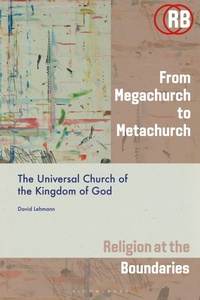
From Megachurch to Metachurch
The Universal Church of the Kingdom of God
Will be published approx. on 3. September 2026
Book
Hardback
248 pages
978-1-350-61000-2 (ISBN)
Description
Building on thirty years accompanying the church's growth, this book is the first to treat the Universal Church of the Kingdom of God (UCKG) as a global organization and the first to balance the devotional and ritual life of the church with its impact on politics and the media.
Based in Brazil, the UCKG claims to have 17,000 bishops and pastors, 12,300 places of worship and 10 million followers in 135 countries. Within a lifetime of fifty years it has become a model for neo-Pentecostalism worldwide epitomized by its mammoth 'Temple of Solomon' in Sao Paulo.
Drawing on ethnographic research in 13 countries from Brazil and Spanish America to Europe, North America and Israel, David Lehmann demonstrates how the church's practices, and those of Pentecostalism in general, are reshaping contemporary concepts of ritual and the supernatural. It further argues that the Church's use of social media to spread its teachings, and its leader Edir Macedo's extensive political, business and mediatic interests, have paved the way to a fusion of religious and secular domains.
The church's bishops, pastors and assistants mobilize their followers by age and gender and channel their commitment into activities ranging from fundraising to seniors' gatherings to prison and hospital visiting. Gender emerges repeatedly as a central theme, expressed in the phenomenon of the childless pastoral couple, gendered self-improvement networks, the church's messaging on relationships, 'love therapy' and even the provision of dating apps for the faithful.
Exceeding previous work in scope and theoretical range, this book opens completely new perspectives on Pentecostalism worldwide.
Based in Brazil, the UCKG claims to have 17,000 bishops and pastors, 12,300 places of worship and 10 million followers in 135 countries. Within a lifetime of fifty years it has become a model for neo-Pentecostalism worldwide epitomized by its mammoth 'Temple of Solomon' in Sao Paulo.
Drawing on ethnographic research in 13 countries from Brazil and Spanish America to Europe, North America and Israel, David Lehmann demonstrates how the church's practices, and those of Pentecostalism in general, are reshaping contemporary concepts of ritual and the supernatural. It further argues that the Church's use of social media to spread its teachings, and its leader Edir Macedo's extensive political, business and mediatic interests, have paved the way to a fusion of religious and secular domains.
The church's bishops, pastors and assistants mobilize their followers by age and gender and channel their commitment into activities ranging from fundraising to seniors' gatherings to prison and hospital visiting. Gender emerges repeatedly as a central theme, expressed in the phenomenon of the childless pastoral couple, gendered self-improvement networks, the church's messaging on relationships, 'love therapy' and even the provision of dating apps for the faithful.
Exceeding previous work in scope and theoretical range, this book opens completely new perspectives on Pentecostalism worldwide.
Reviews / Votes
David Lehmann's study of the Universal Church of the Kingdom of God doesn't only cast an overdue light on the complexity of its cultural, political, economic, symbolic and mediatic ecosystem. It also opens up a broader perspective on the emergence of a way of 'being in the world' that is distinctively Pentecostal and is reconfiguring established conceptions of the religious and the secular. * Daniele Hervieu-Leger, Ecole des Hautes Etudes en Sciences Sociales, France * In From Megachurch to Metachurch, Lehmann examines the profound transformations that have occurred across the Americas and globally in connection with the expansion of Pentecostalism. As a prominent scholar, he offers a rigorous and nuanced analysis of this phenomenon through a detailed case study of the Universal Church of the Kingdom of God, whose founding in the 1970s marked the emergence of a new model for the global expansion of Christianity. Lehmann situates this development within a broader framework that encompasses Edir Macedo's strategic vision, as well as key issues such as theology, ritual practice, scandals, religious intolerance, power dynamics, politics, finance, and market forces. The result is a compelling and indispensable contribution to the field * Christina Vital da Cunha, Universidade Federal Fluminense, Brazil *More details
Series
Language
English
Place of publication
London
United Kingdom
Publishing group
Bloomsbury Publishing PLC
Target group
Professional and scholarly
Product notice
sewn/stitched
Cloth over boards
With dust jacket
Illustrations
6 bw illus
Dimensions
Height: 234 mm
Width: 156 mm
Thickness: 25 mm
Weight
454 gr
ISBN-13
978-1-350-61000-2 (9781350610002)
Copyright in bibliographic data and cover images is held by Nielsen Book Services Limited or by the publishers or by their respective licensors: all rights reserved.
Schweitzer Classification
Person
David Lehmann is Emeritus Professor of Social Science at the University of Cambridge, UK. He is author of the pioneering Struggle for the Spirit (1996) and After the Decolonial (2022). He is also a former Director for the Centre of Latin American Studies at the University of Cambridge, UK
Content
List of Illustrations
Acknowledgements
Glossary
Introduction: Setting the Stage
1. The Holy Spirit
2. The Apparatus
3. The Pastoral Couple: Backbone of the Universal Church
4. Love Therapy on the Steps of the Templo
5. Gender and Its Performance
6. Ritual and the Supernatural
7. Reciprocity, Prosperity and Sincerity
8. Politics
9. Biblical Telenovelas and the Ecosystem
Conclusion: Reconfiguration of Religion
Bibliography
Index
Acknowledgements
Glossary
Introduction: Setting the Stage
1. The Holy Spirit
2. The Apparatus
3. The Pastoral Couple: Backbone of the Universal Church
4. Love Therapy on the Steps of the Templo
5. Gender and Its Performance
6. Ritual and the Supernatural
7. Reciprocity, Prosperity and Sincerity
8. Politics
9. Biblical Telenovelas and the Ecosystem
Conclusion: Reconfiguration of Religion
Bibliography
Index