

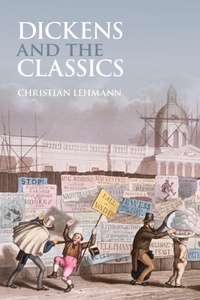
Dickens and the Classics
Will be published approx. on 25. June 2026
Book
Hardback
288 pages
978-1-350-54844-2 (ISBN)
Description
This book examines Charles Dickens's underappreciated engagement with Classical knowledge and its role in his cultural commentary. By treating his novels as collaborations with illustrators, particularly Phiz, it explores how Dickens drew on Ancient Greek and Roman myths, history and art to engage with 19th-century debates. Through detailed analysis of both text and illustrations, the book reveals the complexity of Dickens's Classical references and their significance in shaping broader cultural conversations.
Each chapter pairs novels such as David Copperfield, Bleak House and A Tale of Two Cities with Dickens's journalism, letters and short fiction, supported by analysis of a range of illustrations. Christian Lehmann challenges the notion that Victorian Classics were the preserve of an elite, showing instead how Dickens adapted a demotic Classicism rooted in burlesque, satire, architecture and popular culture. He argues that Dickens's Classical allusions, often dismissed as superficial, form an integral part of his literary output. These references are examined alongside historical developments in the ideology of scientific racism, evolving views on sexual violence, and critiques of imperialism, demonstrating how Dickens reshaped Classical traditions to reflect and critique the cultural and political dynamics of his era.
Each chapter pairs novels such as David Copperfield, Bleak House and A Tale of Two Cities with Dickens's journalism, letters and short fiction, supported by analysis of a range of illustrations. Christian Lehmann challenges the notion that Victorian Classics were the preserve of an elite, showing instead how Dickens adapted a demotic Classicism rooted in burlesque, satire, architecture and popular culture. He argues that Dickens's Classical allusions, often dismissed as superficial, form an integral part of his literary output. These references are examined alongside historical developments in the ideology of scientific racism, evolving views on sexual violence, and critiques of imperialism, demonstrating how Dickens reshaped Classical traditions to reflect and critique the cultural and political dynamics of his era.
Reviews / Votes
A provocative argument, lucidly presented. The author makes exceptional use of visual evidence, combined with detailed discussion of individual novels. Engagingly written, this should appeal to a wide readership inside academia and beyond. * Lorna Hardwick, Open University, United Kingdom * This is an insightful, illuminating analysis of a subject that has until now not received adequate coverage. Lehmann's astute close readings of illustrations and texts are consistently revelatory. Essential reading for all Dickens scholars and enthusiasts. * Natalie McKnight, Boston University, USA *More details
Series
Language
English
Place of publication
London
United Kingdom
Publishing group
Bloomsbury Publishing PLC
Target group
Professional and scholarly
Product notice
sewn/stitched
Cloth over boards
With dust jacket
Illustrations
80 bw illus & 10 colour illus
Dimensions
Height: 234 mm
Width: 156 mm
Thickness: 28 mm
Weight
503 gr
ISBN-13
978-1-350-54844-2 (9781350548442)
Copyright in bibliographic data and cover images is held by Nielsen Book Services Limited or by the publishers or by their respective licensors: all rights reserved.
Schweitzer Classification
Other editions
Additional editions
Christian Lehmann
Dickens and the Classics
E-Book
05/2026
Bloomsbury Academic
€94.49
Available for download
Christian Lehmann
Dickens and the Classics
E-Book
05/2026
Bloomsbury Academic
€94.49
Available for download
Person
Christian Lehmann is Assistant Professor of Literature at Bard High School Early College, Cleveland, USA.
Content
Introduction
Chapter One: Barnaby Rudge
Chapter Two: David Copperfield
Chapter Three: Bleak House
Chapter Four: Little Dorrit
Chapter Five: Tale of Two Cities
Coda
Notes
Bibliography
Index
Chapter One: Barnaby Rudge
Chapter Two: David Copperfield
Chapter Three: Bleak House
Chapter Four: Little Dorrit
Chapter Five: Tale of Two Cities
Coda
Notes
Bibliography
Index