

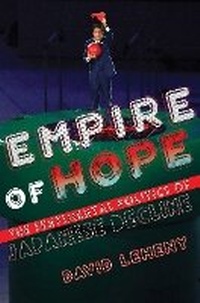
Empire of Hope
The Sentimental Politics of Japanese Decline
Published on 15. November 2018
Book
Hardback
246 pages
978-1-5017-2907-2 (ISBN)
Description
Empire of Hope asks how emotions become meaningful in political life. In a diverse array of cases from recent Japanese history, David Leheny shows how sentimental portrayals of the nation and its global role reflect a durable story of hopefulness about the country's postwar path. From the medical treatment of conjoined Vietnamese children, victims of Agent Orange, the global promotion of Japanese popular culture, a tragic maritime accident involving a US Navy submarine, to the 2011 tsunami and nuclear disaster, this story has shaped the way in which political figures, writers, officials, and observers have depicted what the nation feels.
Expressions of national emotion do several things: they construct the boundaries of the national body, they inform and discipline appropriate expression, and they depoliticize messy problems that threaten to produce divisive questions about winners and losers. Most important, they work because they appear to be natural, simple and expected expressions of how the nation shares feeling, even when they paper over the extraordinary divergence in how the nation's citizens experience each incident. In making its arguments, Empire of Hope challenges how we read the relations between emotion and politics by arguing-unlike those who build from the neuroscientific turn in the social sciences or those developing affect theory in the humanities-that the focus should be on emotional representation rather than on emotion itself.
Expressions of national emotion do several things: they construct the boundaries of the national body, they inform and discipline appropriate expression, and they depoliticize messy problems that threaten to produce divisive questions about winners and losers. Most important, they work because they appear to be natural, simple and expected expressions of how the nation shares feeling, even when they paper over the extraordinary divergence in how the nation's citizens experience each incident. In making its arguments, Empire of Hope challenges how we read the relations between emotion and politics by arguing-unlike those who build from the neuroscientific turn in the social sciences or those developing affect theory in the humanities-that the focus should be on emotional representation rather than on emotion itself.
Reviews / Votes
Leheny provides readers with rich case studies to explore contentious national collective sentiment and identity.- Youngmi Lim, Musashi University (Crosscurrents) Empire of Hope should be essential reading for anyone interested in the study of hope, emotions, or contemporary Japan. A most welcome and much needed recasting of the lost decades, the book demonstrates with great cogency how narratives of hopefulness have been embedded in the complicated emotional and political life of contemporary Japan. And it acknowledges feelings and experiences of precarity, without telling a reductive story of despair or reifying the sense that all that was good has been lost. Empire of Hope reminds us that 30 years hence, the notion of a lost Japan may very well prove to be as outdated and obsolete as that of a miraculous Japan that could be number one.
(Journal of Japanese Studies) Empire of Hope should be read above all by those international relations scholars who focus primarily on power. It will challenge their assumptions and enrich their understanding of Japan in ways few other studies have in recent years.
(PACIFIC AFFAIRS)
More details
Language
English
Place of publication
Ithaca
United States
Product notice
Paper over boards
Illustrations
7 b&w halftones - 7 Halftones, black and white
Dimensions
Height: 229 mm
Width: 152 mm
Thickness: 24 mm
Weight
907 gr
ISBN-13
978-1-5017-2907-2 (9781501729072)
Copyright in bibliographic data and cover images is held by Nielsen Book Services Limited or by the publishers or by their respective licensors: all rights reserved.
Schweitzer Classification
Other editions
Additional editions
E-Book
11/2018
Cornell University Press
€34.49
Available for download
Person
David Leheny is Professor in the Graduate School of Asia-Pacific Studies at Waseda University. He is the author of Think Global, Fear Local: Sex, Violence, and Anxiety in Contemporary Japan and Rules of Play: National Identity and the Shaping of Japanese Leisure.
Content
Acknowledgments
Conventions
1. Maybe They Will Smile Back
2. Souls of the Ehime Maru
3. Cheer Up, Vietnam
4. Cool Optimism
5. Staging The Empire of Light
6. The Peripheral U-Turn
7. Everything Sinks
Notes
Index
Conventions
1. Maybe They Will Smile Back
2. Souls of the Ehime Maru
3. Cheer Up, Vietnam
4. Cool Optimism
5. Staging The Empire of Light
6. The Peripheral U-Turn
7. Everything Sinks
Notes
Index