

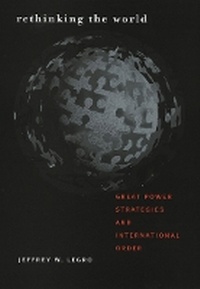
Rethinking the World
Great Power Strategies and International Order
Published on 29. August 2005
Book
Hardback
272 pages
978-0-8014-4272-8 (ISBN)
Description
Stunning shifts in the worldviews of states mark the modern history of international affairs: how do societies think about-and rethink-international order and security? Japan's "opening," German conquest, American internationalism, Maoist independence, and Gorbachev's "new thinking" molded international conflict and cooperation in their eras. How do we explain such momentous changes in foreign policy-and in other cases their equally surprising absence?The nature of strategic ideas, Jeffrey W. Legro argues, played a critical and overlooked role in these transformations. Big changes in foreign policies are rare because it is difficult for individuals to overcome the inertia of entrenched national mentalities. Doing so depends on a particular nexus of policy expectations, national experience, and ready replacement ideas. In a sweeping comparative history, Legro explores the sources of strategy in the United States and Germany before and after the world wars, in Tokugawa Japan, and in the Soviet Union. He charts the likely future of American primacy and a rising China in the coming century. Rethinking the World tells us when and why we can expect changes in the way states think about the world, why some ideas win out over others, and why some leaders succeed while others fail in redirecting grand strategy.
Reviews / Votes
Rethinking the World is sure to stir up controversy. No book that reinterprets some of the most important events in world history, offers an overarching argument for all of them, and calls both realism and liberalism into question can do otherwise. One of the hallmarks of this book is caution. Legro is even-handed in his evaluation of the evidence, cognizant of the methodological problems that he faces, and reticent about claiming too much for the role of ideas. In fact, the argument is a synthetic one in which ideas, power, and domestic politics all have a place. One of Legro's key contributions is an account of how ideas, power, and domestic politics combine in explicit and predictable ways to generate outcomes.(International Studies Review) Legro makes a compelling case that strategic beliefs cannot be reduced to strategic circumstance. He ends by reflecting on the future of the Bush 'revolution' and argues that, absent further terrorist attacks, U.S. foreign policy is likely to tack back to the post-World War II mainstream.
(Foreign Affairs)
More details
Series
Language
English
Place of publication
Ithaca
United States
Target group
College/higher education
Professional and scholarly
Product notice
Paper over boards
Dimensions
Height: 235 mm
Width: 155 mm
Thickness: 22 mm
Weight
907 gr
ISBN-13
978-0-8014-4272-8 (9780801442728)
Copyright in bibliographic data and cover images is held by Nielsen Book Services Limited or by the publishers or by their respective licensors: all rights reserved.
Schweitzer Classification
Other editions
Additional editions
E-Book
12/2016
Cornell University Press
€25.49
Available for download
Person
Jeffrey W. Legro is Professor of Politics at the University of Virginia. He is also the author of Cooperation under Fire: Anglo-German Restraint during World War II and Rethinking the World: Great Power Strategies and International Order, both from Cornell.
Content
1. Great Power Ideas and Change
2. Explaining Change and Continuity
3. The Ebb and Flow of American Internationalism
4. Germany, from Outsider to Insider
5. Overhaul of Orthodoxy in Tokugawa Japan and the Soviet Union
6. The Next Century
2. Explaining Change and Continuity
3. The Ebb and Flow of American Internationalism
4. Germany, from Outsider to Insider
5. Overhaul of Orthodoxy in Tokugawa Japan and the Soviet Union
6. The Next Century