

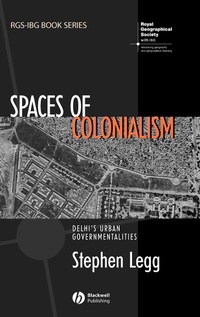
Spaces of Colonialism
Delhi's Urban Governmentalities
1st Edition
Published on 29. May 2007
Book
Hardback
272 pages
978-1-4051-5633-2 (ISBN)
Description
Examines the residential, policed, and infrastructural landscapes of New and Old Delhi under British Rule.
The first book of its kind to present a comparative history of New and Old Delhi
Draws on the governmentality theories and methodologies presented in Michel Foucault's lecture courses
Looks at problems of social and racial segregation, the policing of the cities, and biopolitical needs in urban settings
Undertakes a critique of colonial governmentality on the basis of the lived spaces of everyday life
The first book of its kind to present a comparative history of New and Old Delhi
Draws on the governmentality theories and methodologies presented in Michel Foucault's lecture courses
Looks at problems of social and racial segregation, the policing of the cities, and biopolitical needs in urban settings
Undertakes a critique of colonial governmentality on the basis of the lived spaces of everyday life
Reviews / Votes
"Profound." (Progress in Human Geography, February 2010)"The breadth of scholarship is impressive, and anyone wishing to learn about colonial Delhi will find this book a valuable source. What Legg ultimately delivers is a critique of liberal government, showing how colonial power works in illiberal ways to assert the domination of the British over the native population." (American Journal of Sociology, July 2009)
"The main strength of this book is its conceptual rigour. Legg draws on Foucault's recently translated 1978 lecture series.... The book provides a detailed, theoretically informed analysis of three landscapes of ordering in Delhi, Old and New.... Spaces of colonialism rewards persistence, and will be required reading for scholars of urban governmentality, and of considerable interest to post-colonial and urban geographers more generally." (Area, March 2009)
"Legg has mined and marshaled his written sources superbly and his extrapolations of Foucault are lucid and provocative." (Planning Perspectives, January 2009)
"Legg uses these (Foucault's) well-tried concepts to extremely good effect in interpreting some fascinating archival material.... [The book] also has new things to say about New Delhi and colonial urbanism generally." (Comparative Studies in Society and History, December 2008)
"Writers have long recognised that social rules are at a premium in urban areas, and many discussions of governmentality have taken cities as their subject. Spaces of Colonialism, a case study of Delhi in the first half of the twentieth century that is published in the RGS-IBG book series, makes a significant contribution to such debates." (Journal of Historical Geography)
More details
Series
Language
English
Place of publication
Hoboken
United Kingdom
Publishing group
John Wiley and Sons Ltd
Target group
Professional and scholarly
Edition type
Annotated edition
Product notice
sewn/stitched
Paper over boards
Dimensions
Height: 240 mm
Width: 161 mm
Thickness: 19 mm
Weight
577 gr
ISBN-13
978-1-4051-5633-2 (9781405156332)
Copyright in bibliographic data and cover images is held by Nielsen Book Services Limited or by the publishers or by their respective licensors: all rights reserved.
Schweitzer Classification
Other editions
Additional editions
E-Book
07/2011
Wiley-Blackwell
€25.99
Available for download
E-Book
09/2008
Wiley-Blackwell
€61.99
Available for download
Book
05/2007
1st Edition
Wiley
€39.00
Shipment within 3-4 weeks
Person
Stephen Legg received his doctorate at the University of Cambridge and now lectures at the University of Nottingham.
Content
Preface. Abbreviations.
Archival references.
1. Imperial Delhi.
1.1 New Delhi: Showcase of Sovereignty.
1.2 Colonial Governmentality.
2. Residential and Racial Segregation: a Spatial Archaeology.
2.1 The Spatial Administration of Precedence.
2.2 The Spatial Dissolution of Order.
3. Disciplining Delhi.
3.1 New Delhi: Policing the Heart of Empire.
3.2 Anti-colonial nationalism and urban order.
3.3 "Religious Nationalism" and Urban Diagrams.
4. Biopolitics and the Urban Environment.
4.1 Population expansion and urban disorder.
4.2 Congestion relief, calculation, and the "intensity map".
4.3 The Western Extension, protest, and failed relief.
4.4 Slum clearance and the strictures of imperial finance.
5. Conclusions: within and beyond the city.
5.1 Interlinked landscapes of ordering.
5.2 Beyond colonial Delhi.
Notes.
References.
Index
Archival references.
1. Imperial Delhi.
1.1 New Delhi: Showcase of Sovereignty.
1.2 Colonial Governmentality.
2. Residential and Racial Segregation: a Spatial Archaeology.
2.1 The Spatial Administration of Precedence.
2.2 The Spatial Dissolution of Order.
3. Disciplining Delhi.
3.1 New Delhi: Policing the Heart of Empire.
3.2 Anti-colonial nationalism and urban order.
3.3 "Religious Nationalism" and Urban Diagrams.
4. Biopolitics and the Urban Environment.
4.1 Population expansion and urban disorder.
4.2 Congestion relief, calculation, and the "intensity map".
4.3 The Western Extension, protest, and failed relief.
4.4 Slum clearance and the strictures of imperial finance.
5. Conclusions: within and beyond the city.
5.1 Interlinked landscapes of ordering.
5.2 Beyond colonial Delhi.
Notes.
References.
Index