


Optimality Theoretic Syntax, Semantics, and Pragmatics
From Uni- to Bidirectional Optimization
Published on 12. April 2018
Book
Paperback/Softback
384 pages
978-0-19-880895-4 (ISBN)
Description
This book investigates the morphosyntactic, semantic, and pragmatic properties of language, and the interactions between them, from the perspective of Optimality Theory. It integrates optimization processes into the formal and functional study of grammar, interpreting optimization as the result of conflicting, violable ranked constraints.
Unlike previous work on the topic, this book also takes into account the question of directionality of grammar. A model of grammar in which optimization processes interact bidirectionally allows both language generation-the process of selecting the optimal form of a given meaning-and language interpretation-the process of optimal interpretation of a given form-to be taken into account. Chapters in this volume explore the consequences of both symmetric (unidirectional) and asymmetric (bidirectional) versions of Optimality Theory, investigating the syntax-semantics interface, first language acquisition, and sequential bilingual grammars.
The volume presents cutting edge research in Optimality-Theoretic syntax and semantics, as well as demonstrating how optimization processes as modelled in this formalism serve as a viable approach for linguists and scholars in related fields.
Unlike previous work on the topic, this book also takes into account the question of directionality of grammar. A model of grammar in which optimization processes interact bidirectionally allows both language generation-the process of selecting the optimal form of a given meaning-and language interpretation-the process of optimal interpretation of a given form-to be taken into account. Chapters in this volume explore the consequences of both symmetric (unidirectional) and asymmetric (bidirectional) versions of Optimality Theory, investigating the syntax-semantics interface, first language acquisition, and sequential bilingual grammars.
The volume presents cutting edge research in Optimality-Theoretic syntax and semantics, as well as demonstrating how optimization processes as modelled in this formalism serve as a viable approach for linguists and scholars in related fields.
More details
Series
Language
English
Place of publication
Oxford
United Kingdom
Target group
Professional and scholarly
Dimensions
Height: 233 mm
Width: 155 mm
Thickness: 21 mm
Weight
566 gr
ISBN-13
978-0-19-880895-4 (9780198808954)
Copyright in bibliographic data and cover images is held by Nielsen Book Services Limited or by the publishers or by their respective licensors: all rights reserved.
Schweitzer Classification
Other editions
Additional editions
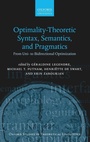
Geraldine Legendre | Michael T. Putnam | Henriette de Swart
Optimality Theoretic Syntax, Semantics, and Pragmatics
From Uni- to Bidirectional Optimization
Book
03/2016
Oxford University Press
€150.80
Shipment within 15-20 days
Persons
Geraldine Legendre is Professor of Linguistics and Cognitive Science at Johns Hopkins University. She co-developed, with Paul Smolensky, the soft constraint-based precursor to Optimality Theory and has played a major role in the development of OT in syntax since the early 1990s, focussing particularly on comparative studies of phenomena in syntax and at the syntax-semantics interface and on the modelling of early child syntax and code-switching. She is co-author of The Harmonic Mind (with Paul Smolensky; MIT Press, 2006) and co-editor of Optimality-Theoretic Syntax (with Jane Grimshaw and Sten Vikner; MIT Press, 2001).
Michael T. Putnam is Associate Professor of German and Linguistics at Penn State University. His work focuses on gaining a better understanding of the cognitive architecture underlying the language faculty at the intersection of culture, grammar, and performance biases, and he has published widely on comparative Germanic linguistics, the morphosyntax-semantics interface, and bilingualism. He is the author of The Structural Design of Language (with Thomas S. Stroik; CUP, 2013) and editor of Studies in German-Language Islands (Benjamins, 2011).
Henriette de Swart is Professor of French Linguistics and Semantics at Utrecht University. Her research is concerned with cross-linguistic variation at the syntax-semantics-pragmatic interface, looking specifically at tense and aspect, negation, indefinites, genericity, and bare nominals. Her publications include Introduction to Natural Language Semantics (University of Chicago Press, 1998), The Semantics of Incorporation (with Donka Farkas; CSLI, 2003), and Conflicts in Interpretation (with Petra Hendriks, Helen de Hoop, and Irene Kraemer; Equinox, 2010).
Erin Zaroukian is a postdoctoral fellow in the Human Research and Engineering Directorate of the US Army Research Laboratory, where her primary research is in human-computer collaboration. Her PhD work focused on formal semantics of approximation and hedging, which she continued, with an experimental focus, as a postdoctoral researcher in the Laboratoire de Sciences Cognitives et Psycholinguistique (Ecole Normale Superieure, PSL Research University, CNRS).
Michael T. Putnam is Associate Professor of German and Linguistics at Penn State University. His work focuses on gaining a better understanding of the cognitive architecture underlying the language faculty at the intersection of culture, grammar, and performance biases, and he has published widely on comparative Germanic linguistics, the morphosyntax-semantics interface, and bilingualism. He is the author of The Structural Design of Language (with Thomas S. Stroik; CUP, 2013) and editor of Studies in German-Language Islands (Benjamins, 2011).
Henriette de Swart is Professor of French Linguistics and Semantics at Utrecht University. Her research is concerned with cross-linguistic variation at the syntax-semantics-pragmatic interface, looking specifically at tense and aspect, negation, indefinites, genericity, and bare nominals. Her publications include Introduction to Natural Language Semantics (University of Chicago Press, 1998), The Semantics of Incorporation (with Donka Farkas; CSLI, 2003), and Conflicts in Interpretation (with Petra Hendriks, Helen de Hoop, and Irene Kraemer; Equinox, 2010).
Erin Zaroukian is a postdoctoral fellow in the Human Research and Engineering Directorate of the US Army Research Laboratory, where her primary research is in human-computer collaboration. Her PhD work focused on formal semantics of approximation and hedging, which she continued, with an experimental focus, as a postdoctoral researcher in the Laboratoire de Sciences Cognitives et Psycholinguistique (Ecole Normale Superieure, PSL Research University, CNRS).
Editor
Professor of Linguistics and Cognitive ScienceProfessor of Linguistics and Cognitive Science, Johns Hopkins University
Associate Professor of German and LinguisticsAssociate Professor of German and Linguistics, Penn State University
Professor of French Linguistics and SemanticsProfessor of French Linguistics and Semantics, Utrecht University
Human Research and Engineering Directorate, US Army Research LaboratoryHuman Research and Engineering Directorate, US Army Research Laboratory, Postdoctoral fellow
Content
1: Geraldine Legendre, Michael T. Putnam, Henriette de Swart, and Erin Zaroukian: Introduction
PART I: Issues in Optimality-Theoretic Syntax
2: Marc van Oostendorp, Michael T. Putnam, and Laura Catharine Smith: Intersecting constraints: Why certain constraint-types overlap while others don't
3: Ralf Vogel: Optimal constructions
4: Fabian Heck and Gereon Mueller: On accelerating and decelerating movement: From Minimalist preference principles to harmonic serialism
5: Ellen Woolford: Two types of portmanteau agreement: Syntactic and morphological
6: Hans Broekhuis: Feature inheritance versus extended projections
7: Joshua Bousquette, Michael T. Putnam, Joseph Salmons, Benjamin Frey, and DRDaniel Nuetzel: Multiple grammars, dominance, and optimization
PART II: Issues in Optimality-Theoretic Semantics and Pragmatics
8: Sander Lestrade, Geertje van Bergen, and Peter de Swart: On the origin of constraints
9: Lotte Hogeweg: Optimality Theory and lexical interpretation and selection
10: Jet Hoek and Helen de Hoop: On the optimal interpretation of yes and no in Dutch
11: Henriette de Swart: Telicity features of bare nominals
12: Geraldine Legendre, Paul Smolensky, and Jennifer Culbertson: Blocking effects at the lexicon/semantics interface and bidirectional optimization in French
13: Petra Hendriks: Unfaithful conduct: A competence-based explanation of asymmetries between production and comprehension
References
Index
PART I: Issues in Optimality-Theoretic Syntax
2: Marc van Oostendorp, Michael T. Putnam, and Laura Catharine Smith: Intersecting constraints: Why certain constraint-types overlap while others don't
3: Ralf Vogel: Optimal constructions
4: Fabian Heck and Gereon Mueller: On accelerating and decelerating movement: From Minimalist preference principles to harmonic serialism
5: Ellen Woolford: Two types of portmanteau agreement: Syntactic and morphological
6: Hans Broekhuis: Feature inheritance versus extended projections
7: Joshua Bousquette, Michael T. Putnam, Joseph Salmons, Benjamin Frey, and DRDaniel Nuetzel: Multiple grammars, dominance, and optimization
PART II: Issues in Optimality-Theoretic Semantics and Pragmatics
8: Sander Lestrade, Geertje van Bergen, and Peter de Swart: On the origin of constraints
9: Lotte Hogeweg: Optimality Theory and lexical interpretation and selection
10: Jet Hoek and Helen de Hoop: On the optimal interpretation of yes and no in Dutch
11: Henriette de Swart: Telicity features of bare nominals
12: Geraldine Legendre, Paul Smolensky, and Jennifer Culbertson: Blocking effects at the lexicon/semantics interface and bidirectional optimization in French
13: Petra Hendriks: Unfaithful conduct: A competence-based explanation of asymmetries between production and comprehension
References
Index