

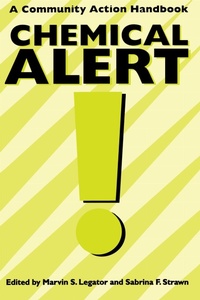
Chemical Alert!
A Community Action Handbook
Published on 1. March 1993
Book
Paperback/Softback
254 pages
978-0-292-74676-3 (ISBN)
Description
In the 1978 Love Canal toxic waste crisis, concerned citizens "did a far better job of evaluating the health of the community than did the professionals of the New York Health Department," asserts Marvin Legator. In Chemical Alert! A Community Action Handbook, he and coeditor Sabrina Strawn offer a step-by-step guide that can be used by any lay person or citizens' group to determine whether a health risk exists in their area.
Writing for the general reader with no scientific expertise, environmental, medical, and legal professionals instruct communities on the organizational and investigative techniques that will produce a valid, scientific case study. With these tools, citizens living near petrochemical plants or waste disposal areas-or who may have simply noticed a high incidence of certain health problems in their community-can determine for themselves whether a problem really exists and seek remediation. Given the reality that government agencies often lack the resources-or the will-to detect health hazards before they affect a community, an informed citizenry should be its own best environmental watchdog.
Writing for the general reader with no scientific expertise, environmental, medical, and legal professionals instruct communities on the organizational and investigative techniques that will produce a valid, scientific case study. With these tools, citizens living near petrochemical plants or waste disposal areas-or who may have simply noticed a high incidence of certain health problems in their community-can determine for themselves whether a problem really exists and seek remediation. Given the reality that government agencies often lack the resources-or the will-to detect health hazards before they affect a community, an informed citizenry should be its own best environmental watchdog.
More details
Language
English
Place of publication
Austin, TX
United States
Target group
Professional and scholarly
Product notice
Paperback (trade)
Dimensions
Height: 229 mm
Width: 150 mm
Thickness: 16 mm
Weight
404 gr
ISBN-13
978-0-292-74676-3 (9780292746763)
Copyright in bibliographic data and cover images is held by Nielsen Book Services Limited or by the publishers or by their respective licensors: all rights reserved.
Schweitzer Classification
Persons
Marvin Legator was Professor of Preventive Medicine and Community Health at the University of Texas Medical Branch in Galveston.
Content
Acknowledgements
Introduction. Marvin S. Legator, Sabrina F. Strawn, and Barbara L. Harper
1. You Can Do It Too: Identification of Health Hazards by Nonprofessionals. Marvin S. Legator
2. Join Together: Organizing Your Community. Lois Marie Gibbs
3. Do You Suspect a Problem? Known Exposures, Known Effects. Barbara L. Harper
4. What Are Appropriate Tests? Enhancing Health Care. Marvin S. Legator
5. What You Need to Know before You Start: Introduction to Experimental Design. Michael J. Scott
6. What Information Do You Need? Questionnaire Design, Administration, and Limitations. Barbara L. Harper and Mary C. Lowery
7. How to Get the Information: The Questionnaire, Question Discussion, and Tabulation. Barbara L. Harper, Mary C. Lowery, Michael J. Scott, and Paul Mills
8. Lots of Information: What to Do with It, Statistics for Nonstatisticians. Michael J. Scott and Barbara L. Harper
9. Where Do You Go from Here? Exploring Options for Further Study and Further Action. Ellen K. Silbergeld
10. What Kind of Evidence Do You Need? Legal Implications of Acute and Chronic Effects. William E. Townsley
11. Resource Guide. Sabrina F. Strawn
Appendix: Rates of Cancer and Birth Defects. Barbara L. Harper
References Cited in the Text and Additional Suggested Reading
Index
Introduction. Marvin S. Legator, Sabrina F. Strawn, and Barbara L. Harper
1. You Can Do It Too: Identification of Health Hazards by Nonprofessionals. Marvin S. Legator
2. Join Together: Organizing Your Community. Lois Marie Gibbs
3. Do You Suspect a Problem? Known Exposures, Known Effects. Barbara L. Harper
4. What Are Appropriate Tests? Enhancing Health Care. Marvin S. Legator
5. What You Need to Know before You Start: Introduction to Experimental Design. Michael J. Scott
6. What Information Do You Need? Questionnaire Design, Administration, and Limitations. Barbara L. Harper and Mary C. Lowery
7. How to Get the Information: The Questionnaire, Question Discussion, and Tabulation. Barbara L. Harper, Mary C. Lowery, Michael J. Scott, and Paul Mills
8. Lots of Information: What to Do with It, Statistics for Nonstatisticians. Michael J. Scott and Barbara L. Harper
9. Where Do You Go from Here? Exploring Options for Further Study and Further Action. Ellen K. Silbergeld
10. What Kind of Evidence Do You Need? Legal Implications of Acute and Chronic Effects. William E. Townsley
11. Resource Guide. Sabrina F. Strawn
Appendix: Rates of Cancer and Birth Defects. Barbara L. Harper
References Cited in the Text and Additional Suggested Reading
Index