

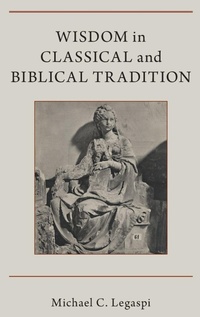
Wisdom in Classical and Biblical Tradition
Published on 27. September 2018
Book
Hardback
328 pages
978-0-19-088512-0 (ISBN)
Description
Wisdom in Classical and Biblical Tradition begins with the recognition that modern culture emerged from a synthesis of the legacies of ancient Greek civilization and the theological perspectives of Jewish and Christian scriptures. Part of what made this synthesis possible was a shared outlook: a common aspiration toward wholeness of understanding that refused to separate knowledge from goodness, virtue from happiness, cosmos from polis, and divine authority from human responsibility. This wholeness of understanding, or wisdom, features prominently in both classical and biblical literatures as an ultimate good.
Wisdom in Classical and Biblical Tradition has two central aims. The first is to explain in formal terms what wisdom is. Though wisdom involves matters of practical judgment affecting the life of the individual and the social sphere, it has also been identified with an understanding of the world and of the ultimate realities that give meaning to human thought and action. Michael Legaspi explains how, in its traditional form, wisdom was understood to govern intellectual, social, and ethical endeavors. Legaspi's second aim is to analyze figures and texts that have yielded and shaped the traditional understanding of wisdom. This book examines accounts of wisdom from foundational texts that range from the period of Homer to the destruction of the Second Temple, and explains why the search for wisdom remains an important but problematic endeavor today.
Wisdom in Classical and Biblical Tradition has two central aims. The first is to explain in formal terms what wisdom is. Though wisdom involves matters of practical judgment affecting the life of the individual and the social sphere, it has also been identified with an understanding of the world and of the ultimate realities that give meaning to human thought and action. Michael Legaspi explains how, in its traditional form, wisdom was understood to govern intellectual, social, and ethical endeavors. Legaspi's second aim is to analyze figures and texts that have yielded and shaped the traditional understanding of wisdom. This book examines accounts of wisdom from foundational texts that range from the period of Homer to the destruction of the Second Temple, and explains why the search for wisdom remains an important but problematic endeavor today.
Reviews / Votes
...this text would be an excellent resource for advanced undergraduate and graduate classes in either Biblical Studies or Classics. * Stephen A. Long, Providence College, Religious Studies Review * In Wisdom in Classical and Biblical Tradition, Legaspi provides an expansive view of the roots of wisdom and its development in biblical and classical cultures... His work is a valuable resource for those seeking to bridge that gap. * Patricia Vesely, Memphis Theological Seminary , Horizons in Biblical Theology * Overall, this is a rich and indeed wise portrait of wisdom, with real insight for philosophers, theologians, and biblical scholars. * Richard S. Briggs, Journal for the Study of the Old Testament * The idea of 'metaphysical vulnerability' (see especially pp. 105-7) that Legaspi employs to interpret Job and the Hebrew bible is particularly striking. Placing Socrates in the midst of Jewish and Christian religious writings, and foregrounding the religious nature of Socrates' teaching (111) may well be unfamiliar to many classicists but allow us to look at some of Plato's dialogues in a new light. * Stuart R. Thomson, Classics for all * This superb monograph is an important contribution to our understanding of wisdom in the ancient world. * Bradley C. Gregory, The Catholic Biblical Quarterly * Wisdom in Classical and Biblical Tradition succeeds in illustrating several facets of wisdom, a concept that is notoriously difficult to define. Legaspi's definition of wisdom as "a program for life" is refreshing and opens new avenues for research, instead of being mired with the perennial-and non-productive-question of defining wisdom as a genre or category of literature. * Elisa Uusimaeki, Helsinki Collegium for Advanced Studies, Reading Religion * Summing up: Recommended * CHOICE *More details
Language
English
Place of publication
New York
United States
Target group
Professional and scholarly
Dimensions
Height: 240 mm
Width: 161 mm
Thickness: 22 mm
Weight
661 gr
ISBN-13
978-0-19-088512-0 (9780190885120)
Copyright in bibliographic data and cover images is held by Nielsen Book Services Limited or by the publishers or by their respective licensors: all rights reserved.
Schweitzer Classification
Other editions
Additional editions
Michael C. Legaspi
Wisdom in Classical and Biblical Tradition
E-Book
08/2018
OUP eBook
€52.49
Available for download
Michael C. Legaspi
Wisdom in Classical and Biblical Tradition
E-Book
08/2018
OUP eBook
€40.49
Available for download
Person
William Legaspi is Associate Professor of Classics and Ancient Mediterranean Studies at Penn State University, and the author of The Death of Scripture and the Rise of Biblical Studies.
Content
Introduction
Chapter 1. Homer and the Wisdom of the Hero
Chapter 2. Wisdom and Knowledge in the Hebrew Bible
Chapter 3. Job the True Sage
Chapter 4. Piety and Wisdom in Socrates
Chapter 5. A Nation of Philosophers
Chapter 6. The School of Solomon
Chapter 7. An End to Wisdom
Conclusion
Bibliography
Chapter 1. Homer and the Wisdom of the Hero
Chapter 2. Wisdom and Knowledge in the Hebrew Bible
Chapter 3. Job the True Sage
Chapter 4. Piety and Wisdom in Socrates
Chapter 5. A Nation of Philosophers
Chapter 6. The School of Solomon
Chapter 7. An End to Wisdom
Conclusion
Bibliography