

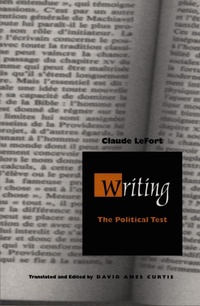
Writing
The Political Test
Will be published approx. on 4. July 2000
Book
Hardback
360 pages
978-0-8223-2484-3 (ISBN)
Description
Writing involves risks-the risk that one will be misunderstood, the risk of being persecuted, the risks of being made a champion for causes in which one does not believe, this risk of inadvertently supporting a reader's prejudices, to name a few. In trying to give expression to what is true, the writer must "clear a passage within the agitated world of passions," an undertaking that always to some extent fails: writers are never the master of their own speech.
In Writing: The Political Test, France's leading political philosopher, Claude Lefort, illuminates the process by which writers negotiate difficult path to free themselves from the ideological and contextual traps that would doom their attempts to articulate a new vision. Lefort examines writers whose works provide special insights into this problem of risk, both literary artists and political philosophers. Among them are Salman Rushdie, Sade, Tocqueville,m Machiavelli, Leo Strauss, Orwell, Kant, Robespierre, Guizot, and Pierre Clastres. In Tocqueville, for example, Lefort finds that the author's improvisatory and open-ended expression represents the character of the democratic experience. Orwell's work on totalitarianism shows up the totalitarian subject's complicity in this political regime. And Rushdie is remarkable for his solid attack on relativism. With the character and fate of the political forms of modernity, democracy, and totalitarianism a central theme, Lefort concludes with some reflections on the collapse of the Soviet Union.
This intriguing and accessible exploration of literature's political aspects and political philosophy's literary ones will be welcomed by those who have been stymied by current efforts to bridge these two fields. Taken together, the essays in this volume also stand as an intellectual autobiography of Lefort, making it an excellent introduction to his work for less experience students of political theory or philosophy.
In Writing: The Political Test, France's leading political philosopher, Claude Lefort, illuminates the process by which writers negotiate difficult path to free themselves from the ideological and contextual traps that would doom their attempts to articulate a new vision. Lefort examines writers whose works provide special insights into this problem of risk, both literary artists and political philosophers. Among them are Salman Rushdie, Sade, Tocqueville,m Machiavelli, Leo Strauss, Orwell, Kant, Robespierre, Guizot, and Pierre Clastres. In Tocqueville, for example, Lefort finds that the author's improvisatory and open-ended expression represents the character of the democratic experience. Orwell's work on totalitarianism shows up the totalitarian subject's complicity in this political regime. And Rushdie is remarkable for his solid attack on relativism. With the character and fate of the political forms of modernity, democracy, and totalitarianism a central theme, Lefort concludes with some reflections on the collapse of the Soviet Union.
This intriguing and accessible exploration of literature's political aspects and political philosophy's literary ones will be welcomed by those who have been stymied by current efforts to bridge these two fields. Taken together, the essays in this volume also stand as an intellectual autobiography of Lefort, making it an excellent introduction to his work for less experience students of political theory or philosophy.
Reviews / Votes
"Many people have become painfully aware of the detachment of a 'worldless textualism' from anything resembling political reality, a reality to be distinguished from grandiose political pronouncements. Lefort's Writing offers a philosophical reflection deeply embeded within the political."-Bernard Flynn, New School for Social ResearchMore details
Series
Language
English
Place of publication
North Carolina
United States
Target group
Professional and scholarly
Product notice
Cloth over boards
Dimensions
Height: 236 mm
Width: 157 mm
Thickness: 36 mm
Weight
885 gr
ISBN-13
978-0-8223-2484-3 (9780822324843)
Copyright in bibliographic data and cover images is held by Nielsen Book Services Limited or by the publishers or by their respective licensors: all rights reserved.
Schweitzer Classification
Persons
Claude Lefort is the Director of Studies Emeritus at the Ecole des Hautes Etudes en Sciences Sociales. He was formerly a Researcher at the Centre National de la Recherche Scientifique and a Professor at the University of SAo Paolo in Brazil, at the Sorbonne, and at the University of Caen. A former student and collaborator of the French phenomenologist Maurice Mereleau-Ponty, Lefort was a cofounder of Socialisme ou Barbarie. David Ames Curtis is a freelance translator, editor, and writer who was nominated for the French-American Foundation Translation Prize in 1996.
Content
Translator's Foreword vii
Author's Preface xxxix
The Interposed Body: George Orwell's Ninetenn Eighty-Four 1
Humanism and Anti-Humanism: Homage to Salman Rushdie 20
Tocqueville: Democracy and the Art of Writing 35
An Exploration of the Flesh of the Social: Note on Democracy in America 35
A Thinkng of Contraries: Note on The Old Regime and the Revolution 49
Sade: The Boudoir and the City 67
Guizot: Polemical LIberalism 85
Machiavelli and the Verita Effetuale 109
The Idea of Humanity and the Project of Universal Peace 142
The Revolution as New Religion 159
Three Notes on Leo Strauss 172
Dialogue with Pierre Clastres 207
Philospher? 236
Reflections on the Present 252
Decomposition of Totalitarianism 252
Rebirth of Democracy 256
The Test of Truth 273
Index 281
Author's Preface xxxix
The Interposed Body: George Orwell's Ninetenn Eighty-Four 1
Humanism and Anti-Humanism: Homage to Salman Rushdie 20
Tocqueville: Democracy and the Art of Writing 35
An Exploration of the Flesh of the Social: Note on Democracy in America 35
A Thinkng of Contraries: Note on The Old Regime and the Revolution 49
Sade: The Boudoir and the City 67
Guizot: Polemical LIberalism 85
Machiavelli and the Verita Effetuale 109
The Idea of Humanity and the Project of Universal Peace 142
The Revolution as New Religion 159
Three Notes on Leo Strauss 172
Dialogue with Pierre Clastres 207
Philospher? 236
Reflections on the Present 252
Decomposition of Totalitarianism 252
Rebirth of Democracy 256
The Test of Truth 273
Index 281