

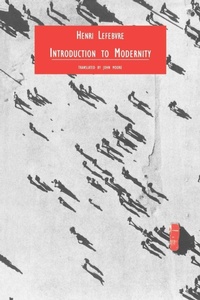
Introduction to Modernity
Twelve Preludes, September 1959-May 1961
Published on 17. August 1995
Book
Paperback/Softback
414 pages
978-1-85984-056-6 (ISBN)
Description
Appearing for the first time in an English translation, Introduction to Modernity is one of Henri Lefebvre's greatest works. Published in 1962, when Lefebvre was beginning his career as a lecturer in sociology at the University of Strasbourg, it established his position in the vanguard of a movement which was to culminate in the events of May 1968. It is a book which supersedes the conventional divisions between academic disciplines. With dazzling skill, Lefebvre moves from philosophy to sociology, from literature to history, to present a profound analysis of the social, political and cultural forces at work in France and the world in the aftermath of Stalin's death-an analysis in which the contours of our own "postmodernity" appear with startling clarity.
Lefebvre's lectures have become legendary, and something of his charismatic presence and delivery is captured in this book, which he intended "to be understood in the mind's ear ... and not simply to be read." With its mercurial shifts of tone, now intensely poetic, now conversational, it not only explores modernity, it exemplifies it. Equally experimental in conception is the book's remarkable structure, twelve "preludes" through which a range of recurrent themes are interwoven in free-form counterpoint: irony as a critical tool, utopianism, nature and culture, the Stalinization of Marxism, the alienation of everyday life, the cybernetic society ... What gradually emerges is not only a series of original concepts about humanity and culture, but an extraordinary invocation of the complexity of social contradictions.
Yet the fragmented structure of the book is not left to float free. Its shifting and eclectic melodies and leitmotifs have a solid ground basis: the wish to rehabilitate the Marxist dialectic as a method for understanding and transforming the modern world. This program is at the heart of the book, and gives it its underlying coherence, making Introduction to Modernity not only essential reading for all students of European cultural history, but also a key text for Marxism in the post-communist world of the late twentieth century.
Lefebvre's lectures have become legendary, and something of his charismatic presence and delivery is captured in this book, which he intended "to be understood in the mind's ear ... and not simply to be read." With its mercurial shifts of tone, now intensely poetic, now conversational, it not only explores modernity, it exemplifies it. Equally experimental in conception is the book's remarkable structure, twelve "preludes" through which a range of recurrent themes are interwoven in free-form counterpoint: irony as a critical tool, utopianism, nature and culture, the Stalinization of Marxism, the alienation of everyday life, the cybernetic society ... What gradually emerges is not only a series of original concepts about humanity and culture, but an extraordinary invocation of the complexity of social contradictions.
Yet the fragmented structure of the book is not left to float free. Its shifting and eclectic melodies and leitmotifs have a solid ground basis: the wish to rehabilitate the Marxist dialectic as a method for understanding and transforming the modern world. This program is at the heart of the book, and gives it its underlying coherence, making Introduction to Modernity not only essential reading for all students of European cultural history, but also a key text for Marxism in the post-communist world of the late twentieth century.
More details
Language
English
Place of publication
London
United Kingdom
Target group
College/higher education
Professional and scholarly
Dimensions
Height: 229 mm
Width: 152 mm
Thickness: 25 mm
Weight
669 gr
ISBN-13
978-1-85984-056-6 (9781859840566)
Copyright in bibliographic data and cover images is held by Nielsen Book Services Limited or by the publishers or by their respective licensors: all rights reserved.
Schweitzer Classification
Other editions
New editions
Book
01/2012
Verso Books
€24.00
Shipment within 3-4 weeks
Persons
Henri Lefebvre (1901-1991), former resistance fighter and Professor of Sociology at Strasbourg and Nanterre, was a member of the French Communist Party from 1928 until his expulsion in 1957. He was the author of sixty books on philosophy, sociology, politics, architecture and urbanism.