


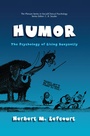
Humor
The Psychology of Living Buoyantly
Published on 31. October 2012
Book
Paperback/Softback
XII, 208 pages
978-1-4613-6923-3 (ISBN)
Description
In his earlier work the author has studied stress and the personality characteristics that protect us from its effects on health and well-being. In this new book he places humor firmly within the literatures of coping processes, the moderation of stressful experiences, and health by showing how humor can help create and encourage feelings of community, closeness, and control. Lefcourt blends empirical research with anecdotal reports in this thoughtful volume.
More details
Series
Edition
Softcover reprint of the original 1st ed. 2001
Language
English
Place of publication
New York
United States
Target group
Professional and scholarly
Research
Illustrations
XII, 208 p.
Dimensions
Height: 235 mm
Width: 155 mm
Thickness: 13 mm
Weight
347 gr
ISBN-13
978-1-4613-6923-3 (9781461369233)
DOI
10.1007/978-1-4615-4287-2
Schweitzer Classification
Other editions
Additional editions
Book
01/2001
1st Edition
Plenum Publishing Co.,N.Y.
€106.99
Shipment within 10-15 days
Content
1 The Changing Concerns of Psychology.- My Personal Odyssey.- Turning Psychology to the Study of Positive Assets.- The Introduction of Humor into Research on Resilience.- 2 Experiencing Humor in Everyday Life.- An Intuitive Approach to Understanding Humor.- Can We Truly Understand the Roots of Humor?.- Conclusion.- 3 Early Conceptions of Humor in Religion, Medicine, Philosophy, and Psychology.- Conclusion.- 4 The Pervasiveness of Humor.- Is Humor Universal in the Human Species ?.- Are Humans Alone in the Use of Humor and Joking?.- Are There Universals in the Form and Content of Humor?.- Conclusion.- 5 The Many Faces of Humor: Variations in the Types and Definitions of Humor.- Freud's Contributions to the Literature on Humor.- Other Dimensions of Humor.- Cruel and Hostile Humor.- Humor.- 6 The Development of Humor: Accounting for Individual Differences.- Research with Normative Samples.- Sources of Individual Differences in Humor.- Humor as a Coping Tool among Professional Comedians.- 7 The Effects of Stress on Emotion and Health.- Illness and Stress: The Physiological Connections.- Is There a Way out of the Vicious Circle of Arousal and Deterioration?.- Humor as a Moderator of Stress.- What May We Conclude from These Data?.- 8 Humor as a Coping Strategy.- Humor as a Moderator of Stressful Experiences: An Update.- 9 Humor as a Means of Retaining Social Cohesion and Support.- Membership in Social Groups.- Social Support as a Moderator of Stressful Life Experiences.- Humor as an Enhancer of Social Belonging.- 10 Sense of Humor and Physiological Stress Responses.- Humor and Autonomic Nervous System Activity.- Humor and Immune System Activity.- Conclusions.- 11 Sex and Humor: Interactive Predictors of Health?.- Possible Sources of Sex Differences in Humor Usage.-Conclusion.- 12 Summing Up.- Appendixes.- A. The Coping Humor Scale (CHS).- Guide for Scoring of the CHS.- B. The Situational Humor Response Questionnaire (SHRQ).- C. Bibliography of Research with CHS and SHRQ.- References.- Author Index.