

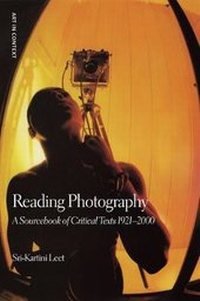
Reading Photography
A Sourcebook of Critical Texts
Published on 28. November 2011
Book
Hardback
408 pages
978-0-85331-976-4 (ISBN)
Description
The relatively new medium of photography has generated, from its inception, intense debate over its merits as an art form. (It was not until late in the twentieth century, for example, that colour photography was accepted in the canon of art historical scholarship.)
In Reading Photography, Sri-Kartini Leet brings together over 100 extracts from writings on different themes in the medium to explore the art of photography. Beginning with the historical origins of photography, she charts the changes from daguerrotype and formal portraits to the everyday and the emergence of modernism. By the 1920s well-known surrealist artists were using the photograph to develop experimental techniques. Colour, frequently sidelined in early photography, is considered in its various incarnations of advertising, amateur pictures and its adoption in the 1960s as an expressive media. The concept of the photo as a commodifying practice, blurring the boundaries between the artistic and the prosaic, is discussed. Photography was included in the post-modernist movement to question traditional notions of what constitutes art, and several authors have been selected to illustrate this development. Landscape and the city are juxtaposed to demonstrate how location was used in the representation of political, social and psychological states. The role of the individual in these settings is expressed in a chapter on identity and photography. Preceeded by a discussion of its means of rendering the subject an object, a chapter on anthropological photography demonstrates the unattainable desire to achieve an objective view of the different natures of man. Equally, the nature of photography enables artists to dismember the body and thereby dehumanise it. Feminism and the role of the female photographer are implicated in this chapter. The final section considers the impact of the digital age.
Sri-Kartini Leet's judicious selection of articles introduces the reader to a broad and enriching range of art historical comment engendered by the photograph, and makes Reading Photography an indispensable aid to the study of photography.
In Reading Photography, Sri-Kartini Leet brings together over 100 extracts from writings on different themes in the medium to explore the art of photography. Beginning with the historical origins of photography, she charts the changes from daguerrotype and formal portraits to the everyday and the emergence of modernism. By the 1920s well-known surrealist artists were using the photograph to develop experimental techniques. Colour, frequently sidelined in early photography, is considered in its various incarnations of advertising, amateur pictures and its adoption in the 1960s as an expressive media. The concept of the photo as a commodifying practice, blurring the boundaries between the artistic and the prosaic, is discussed. Photography was included in the post-modernist movement to question traditional notions of what constitutes art, and several authors have been selected to illustrate this development. Landscape and the city are juxtaposed to demonstrate how location was used in the representation of political, social and psychological states. The role of the individual in these settings is expressed in a chapter on identity and photography. Preceeded by a discussion of its means of rendering the subject an object, a chapter on anthropological photography demonstrates the unattainable desire to achieve an objective view of the different natures of man. Equally, the nature of photography enables artists to dismember the body and thereby dehumanise it. Feminism and the role of the female photographer are implicated in this chapter. The final section considers the impact of the digital age.
Sri-Kartini Leet's judicious selection of articles introduces the reader to a broad and enriching range of art historical comment engendered by the photograph, and makes Reading Photography an indispensable aid to the study of photography.
Reviews / Votes
'It is a brave editor who undertakes to compile - as Sri-Kartini Leet has done - a serviceable anthology of writings on the medium (of photography). Reading Photography stands as the most ambitious and comprehensive attempt to date. (It) introduces and presents its material in a thoughtful and accessible manner.' CassoneMore details
Language
English
Place of publication
London
United Kingdom
Dimensions
Height: 234 mm
Width: 156 mm
ISBN-13
978-0-85331-976-4 (9780853319764)
Copyright in bibliographic data and cover images is held by Nielsen Book Services Limited or by the publishers or by their respective licensors: all rights reserved.
Schweitzer Classification
Person
Sri-Kartini Leet is Senior Lecturer in Photography and Media at the University of Northampton, UK.
Content
Contents: Introduction; Chronology; Selected Bibliographies; Acknowledgements; Section 1: Photography as Art; Section 2: Modernist Visions: Avant-garde Photography; Section 3: Photography and Surrealism; Section 4: The Renaissance of Colour; Section 5: Critical Readings: Reflections on Photography; Section 6: Photography and Postmodernism; Section 7: Negotiating Identities: The Portrait as Representation; Section 8: Observations of the 'Other' - Contemporary Cultural Interventions; Section 9: The Body and the Gaze; Section 10: Photography, Time and Narrative; Section 11: On Memory; Section 12: Photography as a Commercial Practice; Section 13: The Idea of the Everyday; Section 14: Landscape; Section 15: Photography and the City; Section 16: The Photograph as a Cultural Document; Section 17: Shooting War; Section 18: Photography Beyond the Darkroom; Index