

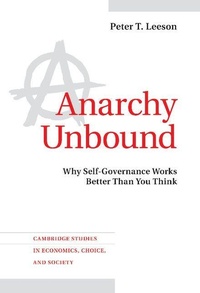
Anarchy Unbound
Why Self-Governance Works Better Than You Think
Published on 14. April 2014
Book
Hardback
270 pages
978-1-107-02580-6 (ISBN)
Description
In Anarchy Unbound, Peter T. Leeson uses rational choice theory to explore the benefits of self-governance. Relying on experience from the past and present, Professor Leeson provides evidence of anarchy 'working' where it is least expected to do so and explains how this is possible. Provocatively, Leeson argues that in some cases anarchy may even outperform government as a system of social organization, and demonstrates where this may occur. Anarchy Unbound challenges the conventional self-governance wisdom. It showcases the incredible ingenuity of private individuals to secure social cooperation without government and how their surprising means of doing so can be superior to reliance on the state.
Reviews / Votes
'In the best tradition of Coase, Peter Leeson shows how, in the most surprising times and places, individuals managed to organize their lives and affairs cooperatively without any help from government. The history in this book is fascinating; the economics is powerful; and the writing is beautiful.' Andrei Shleifer, Harvard University, Massachusetts 'With compelling arguments and examples from many different times and societies, Leeson shows how bottom-up institutions of governance work and why their results are often better than what governments achieve. The book is fascinating reading for all economists, and will be an eye-opener to many.' Avinash Dixit, Princeton University, author of Lawlessness and Economics 'A lively, insightful, and masterly work. In taking aim at Thomas Hobbes' view that governments are invariably essential, Leeson invokes historical examples such as the institution of Caribbean pirates and sociological concepts such as social distance. It is rare for an economist to offer riches to social scientists of every stripe.' Robert C. Ellickson, Meyer Professor of Property Law, Yale Law School 'Persuasive arguments for a state of anarchy.' Morning StarMore details
Series
Language
English
Place of publication
Cambridge
United Kingdom
Target group
Professional and scholarly
Illustrations
5 Tables, unspecified; 4 Line drawings, unspecified
Dimensions
Height: 235 mm
Width: 157 mm
Thickness: 21 mm
Weight
593 gr
ISBN-13
978-1-107-02580-6 (9781107025806)
Copyright in bibliographic data and cover images is held by Nielsen Book Services Limited or by the publishers or by their respective licensors: all rights reserved.
Schweitzer Classification
Other editions
Additional editions
E-Book
04/2014
1st Edition
Cambridge University Press
€26.49
Available for download
Book
04/2014
Cambridge University Press
€36.70
Shipment within 15-20 days
E-Book
04/2014
Cambridge University Press
€20.99
Available for download
Person
Peter T. Leeson is a Professor of Economics and BB&T Professor for the Study of Capitalism at George Mason University, Virginia. He is also the North American editor of Public Choice. Previously, he was a Visiting Professor of Economics at the University of Chicago, the F. A. Hayek Fellow at the London School of Economics and Political Science, and a Visiting Fellow in Political Economy at Harvard University, Massachusetts. Professor Leeson is the author of The Invisible Hook: The Hidden Economics of Pirates (2009) and a recipient of the Fund for the Study of Spontaneous Order's Hayek Prize, which he received for his research on self-governance.
Content
1. Anarchy unbound; Part I. Self-Governance and the Problem of Social Diversity: 2. Social distance and self-enforcing exchange; 3. The laws of lawlessness; Part II. Self-Governance and the Problem of Violence: 4. Trading with bandits; 5. Efficient plunder; Part III. Social-Governance and the Problem of 'Bad Apples': 6. Pirates' private order; 7. Criminal constitutions; Part IV. Self-Governance as Superior to the State: 8. Efficient anarchy; 9. Better off stateless; 10. An argument for anarchy in LDCs; 11. A future for thinking about self-governance.