

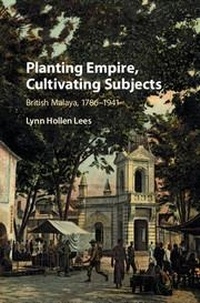
Planting Empire, Cultivating Subjects
British Malaya, 1786-1941
Published on 21. December 2017
Book
Hardback
374 pages
978-1-107-03840-0 (ISBN)
Description
Planting Empire, Cultivating Subjects examines the stories of ordinary people to explore the internal workings of colonial rule. Chinese, Indians, and Malays learned about being British through the plantations, towns, schools, and newspapers of a modernizing colony. Yet they got mixed messages from the harsh, racial hierarchies of sugar and rubber estates, and cosmopolitan urban societies. Empire meant mobility, fluidity, and hybridity, as well as the enactment of racial privilege and rigid ethnic differences. Using sources ranging from administrative files, court transcripts and oral interviews to periodicals and material culture, Professor Lees explores the nature and development of colonial governance, and the ways in which Malayan residents experienced British rule in towns and plantations. This is an innovative study demonstrating how empire brought with it both oppression and economic opportunity, shedding new light on the shifting nature of colonial subjecthood and identity, as well as the memory and afterlife of empire.
Reviews / Votes
'Originally conceived as two separate manuscripts, Lees' monograph uses Ho Enseng's earlier notion of empires as hybrid spaces as a launching point to compare rural and urban lifeworlds under colonialism. Employing British Malaya as a case study to interrogate the 'internal workings' of colonial power, the author convincingly demonstrates that relationships between rulers and the ruled were as complex as they were conflicted. ... The questions she asks will interest social historians working on imperialism, urbanization, migration, labour, and commodity production: questions regarding the extent to which colonialism nurtured social mobility, cross-cultural learning, and new belongings within diasporas.' Geoffrey K. Pakiam, Sojourn: Journal of Social Issues in Southeast Asia 'Planting Empire, Cultivating Subjects is a rich and valuable history of colonial Malaya.' Sanjay Krishnan, Victorian Studies 'Lees's Planting Empire, Cultivating Subjects is a rich and valuable contribution to the historiography of British colonization in Southeast Asia ... This monograph is a must-read for scholars interested in British colonial rule in Southeast Asia and the nature of British subjecthood.' Raymond Hyser, H-EnvironmentMore details
Language
English
Place of publication
Cambridge
United Kingdom
Target group
College/higher education
Product notice
sewn/stitched
Cloth over boards
Dimensions
Height: 241 mm
Width: 164 mm
Thickness: 24 mm
Weight
721 gr
ISBN-13
978-1-107-03840-0 (9781107038400)
Copyright in bibliographic data and cover images is held by Nielsen Book Services Limited or by the publishers or by their respective licensors: all rights reserved.
Schweitzer Classification
Other editions
Additional editions
Book
07/2019
Cambridge University Press
€50.00
Shipment within 15-20 days
E-Book
12/2017
Cambridge University Press
€24.49
Available for download
E-Book
11/2017
Cambridge University Press
€29.49
Available for download
Person
Lynn Hollen Lees is co-director of the Joseph H. Lauder Institute of Management and International Studies at the University of Pennsylvania. Her research centers on European cities, their social organization, and their welfare institutions, with recent publications including Global Society: The World since 1900 (2013), with Pamela K. Crossley and John W. Servos. She is the recipient of fellowships from the Guggenheim Foundation, the American Council of Learned Societies, the National Endowment for the Humanities, and the Rotary Foundation. She has also spent time as an exchange professor at University College London, Catholic University of Leuven, Belgium, and the University of Diponegoro in Indonesia.
Content
Introduction; Part I. Nineteenth-Century Foundations: 1. The birth of plantation colonialism; 2. Body politics in a plural society; 3. New towns on the Malayan frontier; 4. Urban civil society; Part II. The Early Twentieth Century: 5. Rubber reconstructs Malaya; 6. Cosmopolitan modernism in Malayan towns; 7. Managing Malayan towns; 8. Multiple allegiances in a cosmopolitan colony; 9. Epilogue: remembering empire; 10. Bibliography.