

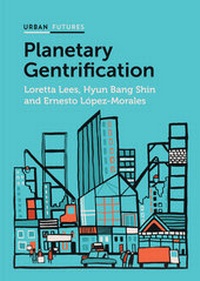
Planetary Gentrification
Published on 22. January 2016
Book
Hardback
248 pages
978-0-7456-7164-2 (ISBN)
Description
This is the first book in Polity's new 'Urban Futures' series.
At the beginning of the twenty-first century, proclamations rang out that gentrification had gone global. But what do we mean by 'gentrification' today? How can we compare 'gentrification' in New York and London with that in Shanghai, Johannesburg, Mumbai and Rio de Janeiro? This book argues that gentrification is one of the most significant and socially unjust processes affecting cities worldwide today, and one that demands renewed critical assessment.
Drawing on the 'new' comparative urbanism and writings on planetary urbanization, the authors undertake a much-needed transurban analysis underpinned by a critical political economy approach. Looking beyond the usual gentrification suspects in Europe and North America to non-Western cases, from slum gentrification to mega-displacement, they show that gentrification has unfolded at a planetary scale, but it has not assumed a North to South or West to East trajectory - the story is much more complex than that.
Rich with empirical detail, yet wide-ranging, Planetary Gentrification unhinges, unsettles and provincializes Western notions of urban development. It will be invaluable to students and scholars interested in the future of cities and the production of a truly global urban studies, and equally importantly to all those committed to social justice in cities.
Reviews / Votes
"This is an exciting and illuminating documentation of the ideologies and practices of gentrification in different parts of the globalizing world. Theoretically inspirational and empirically comprehensive, this book provides an excellent role model to show how critical comparative studies can be done for fruitful knowledge production. It makes a timely contribution that will be highly appreciated by all from the global North and South, East and West." George C. S. Lin, Hong Kong University "The authors are leading urban scholars from three continents, who advance the thesis of global gentrification and its attendant injustices through the informative lens of comparative urbanism. In doing so, they critically engage with 'both academic globalization and the globalization of capital'." David Ley, University of British Columbia "This book profoundly extends the scope of gentrification from its London-based origins to a globalizing urban world. Using a comparative perspective, the authors examine urban restructuring and displacement not as the spread of Western social-spatial forms, but as a process of planetary globalization. This book is the most lucid, nuanced and theoretically coherent treatment of gentrification and its manifestation to date." Fulong Wu, University College LondonMore details
Series
Edition
1. Auflage
Language
English
Place of publication
Oxford
United Kingdom
Publishing group
John Wiley and Sons Ltd
Target group
Professional and scholarly
Product notice
sewn/stitched
Cloth over boards
Dimensions
Height: 216 mm
Width: 154 mm
Thickness: 27 mm
Weight
495 gr
ISBN-13
978-0-7456-7164-2 (9780745671642)
Schweitzer Classification
Other editions
Additional editions
Loretta Lees | Hyun Bang Shin | Ernesto López-Morales
Planetary Gentrification
E-Book
05/2016
1st Edition
Wiley
€19.99
Available for download
Loretta Lees | Hyun Bang Shin | Ernesto López-Morales
Planetary Gentrification
E-Book
03/2016
Polity Press
€19.99
Available for download
Loretta Lees | Hyun Bang Shin | Ernesto López-Morales
Planetary Gentrification
Book
01/2016
Polity Press
€24.00
Shipment within 15-20 days
Persons
Loretta Lees is Professor of Human Geography at the University of Leicester.
Hyun Bang Shin is Associate Professor of Geography and Urban Studies at the London School of Economics and Political Science.
Ernesto López-Morales is Associate Professor of Urban Planning at the University of Chile.
Content
1. Introduction
2. New Urbanizations
3. New Economics
4. Global Gentrifiers: Class, Capital, State
5. A Global Gentrification Blueprint?
6. Slum Gentrification
7. Mega-Gentrification and Displacement
8. Conclusion
References