

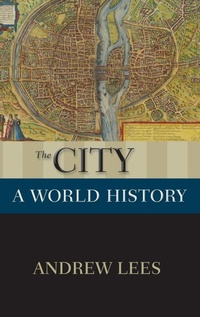
The City
A World History
Published on 19. November 2015
Book
Hardback
160 pages
978-0-19-985952-8 (ISBN)
Description
The City: A World History tells the story of the rise and development of urban centers from ancient times to the twenty-first century. It begins with the establishment of the first cities in the Near East in the fourth millennium BCE, and goes on to examine urban growth in the Indus River Valley in India, as well as Egypt and areas that bordered the Mediterranean Sea. Athens, Alexandria, and Rome stand out both politically and culturally. With the fall of the Roman Empire in the West, European cities entered into a long period of waning and deterioration. But elsewhere, great cities-among them, Constantinople, Baghdad, Chang'an, and Tenochtitlan-thrived. In the late Middle Ages and the Early Modern period, urban growth resumed in Europe, giving rise to cities like Florence, Paris, and London. This urban growth also accelerated in parts of the world that came under European control, such as Philadelphia in the nascent United States.
As the Industrial Revolution swept through in the nineteenth century, cities grew rapidly. Their expansion resulted in a slew of social problems and political disruptions, but it was accompanied by impressive measures designed to improve urban life. Meanwhile, colonial cities bore the imprint of European imperialism. Finally, the book turns to the years since 1914, guided by a few themes: the impact of war and revolution; urban reconstruction after 1945; migration out of many cities in the United States into growing suburbs; and the explosive growth of "megacities" in the developing world.
As the Industrial Revolution swept through in the nineteenth century, cities grew rapidly. Their expansion resulted in a slew of social problems and political disruptions, but it was accompanied by impressive measures designed to improve urban life. Meanwhile, colonial cities bore the imprint of European imperialism. Finally, the book turns to the years since 1914, guided by a few themes: the impact of war and revolution; urban reconstruction after 1945; migration out of many cities in the United States into growing suburbs; and the explosive growth of "megacities" in the developing world.
Reviews / Votes
[Lees'] greatly successful and accessible work on this massive subject is critical ... Readers will greatly appreciate the illustrations and maps, as well as the accompanying chronology, further reading, and websites. Squarely aimed at undergraduates, general readers also certainly would profit from the book's broad sweep and fascinating examples ... Highly recommended. * J. Rogers, CHOICE *More details
Series
Language
English
Place of publication
New York
United States
Target group
College/higher education
Illustrations
23 illustrations
Dimensions
Height: 240 mm
Width: 161 mm
Thickness: 13 mm
Weight
411 gr
ISBN-13
978-0-19-985952-8 (9780199859528)
Copyright in bibliographic data and cover images is held by Nielsen Book Services Limited or by the publishers or by their respective licensors: all rights reserved.
Schweitzer Classification
Other editions
Additional editions
Book
10/2015
Oxford University Press Inc
€37.00
Shipment within 15-20 days
Person
Distinguished Professor of History, Rutgers University - Camden
Content
Editors' Preface ; Chapter 1 Origins and Locations of Early Cities, 3000-500 BCE ; Chapter 2 Great Cities, 500 BCE-300 CE ; Chapter 3 Decline and Development, 300-1500 ; Chapter 4 Capitals, Culture, Colonization, and Revolution, 1500-1800 ; Chapter 5 Urban Growth and Its Consequences in an Age of Industrialization, 1800-1914 ; Chapter 6 Colonial Cities, 1800-1914 ; Chapter 7 Destruction and Reconstruction, 1914-1960 ; Chapter 8 Urban Decline and Urban Growth, 1950-2013 ; Chronology ; Notes ; Further Reading ; Websites ; Index