

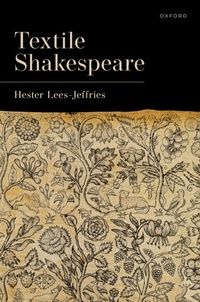
Textile Shakespeare
Published on 11. November 2025
Book
Hardback
416 pages
978-0-19-886113-3 (ISBN)
Description
Textile Shakespeare argues for the vital presence of the 'textile imagination' in the works of Shakespeare and his contemporaries, as it explores the economic, cultural, and social centrality of textiles to life in early modern England.
Cloth, broadly interpreted, could function as a form of knowledge, skill, and expertise, of power, status, and control; it was a means of both storing and displaying wealth. Cloth, especially in the layered forms of early modern dress, furnished ways of imagining the body and the body politic, the community, the city, the nation, and the self; it was also central to thinking about language, rhetoric, literature, and the act of writing. In chapters based around different materials (linen, leather, wool, silk) and processes (sewing, cutting, folding), Textile Shakespeare recovers this textile liveliness, giving a comprehensive and immersive account of the place of textiles in early modern life and thought, and exploring and animating Shakespeare's plays in ways that have become largely invisible. Grounded in careful and illuminating close reading, it explores the entire range of Shakespeare's works, on the page and in performance in both the early modern theatre and on the contemporary stage.
Richly illustrated, it includes detailed descriptions of surviving early modern garments and textiles, based on first-hand experience, and amasses and comprehensively reassesses the evidence for costuming and other staging in Shakespeare's time. It pays attention to textile labour, especially by women, and through its careful and original readings of Shakespeare's plays, it recovers the emotional and physical impact of clothing and other textiles on the lives and experiences of early modern people.
Cloth, broadly interpreted, could function as a form of knowledge, skill, and expertise, of power, status, and control; it was a means of both storing and displaying wealth. Cloth, especially in the layered forms of early modern dress, furnished ways of imagining the body and the body politic, the community, the city, the nation, and the self; it was also central to thinking about language, rhetoric, literature, and the act of writing. In chapters based around different materials (linen, leather, wool, silk) and processes (sewing, cutting, folding), Textile Shakespeare recovers this textile liveliness, giving a comprehensive and immersive account of the place of textiles in early modern life and thought, and exploring and animating Shakespeare's plays in ways that have become largely invisible. Grounded in careful and illuminating close reading, it explores the entire range of Shakespeare's works, on the page and in performance in both the early modern theatre and on the contemporary stage.
Richly illustrated, it includes detailed descriptions of surviving early modern garments and textiles, based on first-hand experience, and amasses and comprehensively reassesses the evidence for costuming and other staging in Shakespeare's time. It pays attention to textile labour, especially by women, and through its careful and original readings of Shakespeare's plays, it recovers the emotional and physical impact of clothing and other textiles on the lives and experiences of early modern people.
More details
Language
English
Place of publication
Oxford
United Kingdom
Target group
Professional and scholarly
College/higher education
Illustrations
16pp colour plate section and 4 black and white images
Dimensions
Height: 164 mm
Width: 241 mm
Thickness: 33 mm
Weight
804 gr
ISBN-13
978-0-19-886113-3 (9780198861133)
Copyright in bibliographic data and cover images is held by Nielsen Book Services Limited or by the publishers or by their respective licensors: all rights reserved.
Schweitzer Classification
Person
Hester Lees-Jeffries is Associate Professor in the Faculty of English, Cambridge University, and a Fellow of St Catharine's College. Her previous publications include England's Helicon: fountains in Early Modern Literature and Culture (2007), Shakespeare and Memory (2013), and a new introduction to Romeo and Juliet (2023).
Content
1: Stuff
2: Linen
3: Leather/Wool
4: Silk
5: Inky cloak
6: Sew
7: Cut
8: Fold
9: Ruff
2: Linen
3: Leather/Wool
4: Silk
5: Inky cloak
6: Sew
7: Cut
8: Fold
9: Ruff