

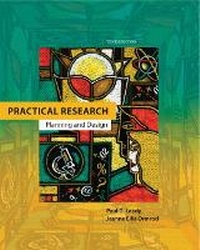
Practical Research
Planning and Design
10th Edition
Published on 16. February 2012
Book
Paperback/Softback
384 pages
978-0-13-269324-0 (ISBN)
Description
Written in uncommonly engaging and elegant prose, Practical Research: Planning and Design is a "do-it-yourself, understand-it-yourself" manual designed to help students in any discipline understand the fundamental structure of quality research and the methodical process that leads to valid and reliable results. The authors emphasize two things: 1) that quality research demands planning and design; and, 2) how research projects can be executed effectively and professionally.
This text guides the reader, step-by-step, from the selection of a problem, through the process of conducting authentic research, to the preparation of a completed report, with practical suggestions based on a solid theoretical framework and sound pedagogy. With broad coverage applicable to any discipline, Practical Research is valuable to students planning to conduct their own research projects as well as to anyone wanting to participate in thoughtful, methodical evaluation of published research reports.
This text guides the reader, step-by-step, from the selection of a problem, through the process of conducting authentic research, to the preparation of a completed report, with practical suggestions based on a solid theoretical framework and sound pedagogy. With broad coverage applicable to any discipline, Practical Research is valuable to students planning to conduct their own research projects as well as to anyone wanting to participate in thoughtful, methodical evaluation of published research reports.
Reviews / Votes
"I wanted to thank you (and Dr. Leedy) for Practical Research!Home Run!
Bravo!
Kudos!
Woo Hoo!
You have produced the BEST text ever on practical research AND writing a dissertation.
Not only will your work help graduate students understand and navigate the research process, it will also streamline the entire dissertation journey and ease the load for my committee members."
More details
Edition
10th edition
Language
English
Place of publication
United States
Publishing group
Pearson Education (US)
Target group
Professional and scholarly
College/higher education
Dimensions
Height: 276 mm
Width: 216 mm
Weight
680 gr
ISBN-13
978-0-13-269324-0 (9780132693240)
Copyright in bibliographic data and cover images is held by Nielsen Book Services Limited or by the publishers or by their respective licensors: all rights reserved.
Other editions
New editions
Book
11/2015
11th Edition
Pearson
€111.41
Article exhausted; check for reprint
Previous edition

Book
05/2009
9th Edition
Pearson
€48.27
Article exhausted; check for reprint
Persons
Paul D. Leedy is late of the American University.
Jeanne Ellis Ormrod holds a B.A. degree in psychology from Brown University and M.S. and Ph.D. degrees from The Pennsylvania State University. For more than twenty years she was a faculty member at the University of Northern Colorado, where she taught courses in learning and cognition, educational psychology, measurement, and research methods; she is currently Professor Emerita of Psychological Sciences at UNC. Dr. Ormrod has published numerous research articles but is probably best known for this textbook and several other Pearson books: Human Learning (6th ed., 2012); Educational Psychology: Developing Learners (7th ed., 2011); Essentials of Educational Psychology (3rd ed., 2012); Our Minds, Our Memories: Enhancing Thinking and Learning at All Ages (2011); and Child Development and Education (with Teresa McDevitt; 5th ed. in press).
Jeanne Ellis Ormrod holds a B.A. degree in psychology from Brown University and M.S. and Ph.D. degrees from The Pennsylvania State University. For more than twenty years she was a faculty member at the University of Northern Colorado, where she taught courses in learning and cognition, educational psychology, measurement, and research methods; she is currently Professor Emerita of Psychological Sciences at UNC. Dr. Ormrod has published numerous research articles but is probably best known for this textbook and several other Pearson books: Human Learning (6th ed., 2012); Educational Psychology: Developing Learners (7th ed., 2011); Essentials of Educational Psychology (3rd ed., 2012); Our Minds, Our Memories: Enhancing Thinking and Learning at All Ages (2011); and Child Development and Education (with Teresa McDevitt; 5th ed. in press).
Content
PART I: THE FUNDAMENTALS
Chapter 1. The Nature and Tools of Research
PART II: FOCUSING YOUR RESEARCH EFFORTS
Chapter 2. The problem: the Heart of the Research Process
Chapter 3. Review of the Related Literature
Chapter 4. Planning Your Research Project
Chapter 5. Writing the Research Proposal
PART III: QUALITATIVE RESEARCH METHODOLOGIES
Chapter 6. Qualitative Research
Chapter 7. Historical Research
PART IV: QUANTITATIVE RESEARCH METHODOLOGIES
Chapter 8. Descriptive Research
Chapter 9. Experimental, Quasi-Experimental, and Ex Post Facto Designs
Chapter 10. Mixed-Methods Research
Chapter 11. Strategies for Analyzing Quantitative Data
PART V: PREPARING THE RESEARCH REPORT
Chapter 12. Technical Details: Style, Format, and Organization of the Research Report
APPENDICES
Appendix A. Using a Spreadsheet: Microsoft Excel
Appendix B. Using SPSS
REFERENCES
Chapter 1. The Nature and Tools of Research
PART II: FOCUSING YOUR RESEARCH EFFORTS
Chapter 2. The problem: the Heart of the Research Process
Chapter 3. Review of the Related Literature
Chapter 4. Planning Your Research Project
Chapter 5. Writing the Research Proposal
PART III: QUALITATIVE RESEARCH METHODOLOGIES
Chapter 6. Qualitative Research
Chapter 7. Historical Research
PART IV: QUANTITATIVE RESEARCH METHODOLOGIES
Chapter 8. Descriptive Research
Chapter 9. Experimental, Quasi-Experimental, and Ex Post Facto Designs
Chapter 10. Mixed-Methods Research
Chapter 11. Strategies for Analyzing Quantitative Data
PART V: PREPARING THE RESEARCH REPORT
Chapter 12. Technical Details: Style, Format, and Organization of the Research Report
APPENDICES
Appendix A. Using a Spreadsheet: Microsoft Excel
Appendix B. Using SPSS
REFERENCES