

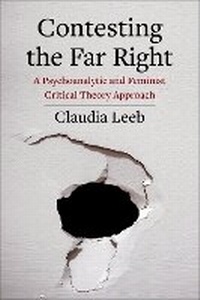
Contesting the Far Right
A Psychoanalytic and Feminist Critical Theory Approach
Published on 23. April 2024
Book
Paperback/Softback
336 pages
978-0-231-21307-3 (ISBN)
Description
Why have so many people responded to the insecurity, exploitation, alienation, and isolation of precarity capitalism by supporting the far right? In this timely book, Claudia Leeb argues that psychoanalytic and feminist critical theory illuminates how economic and psychological factors interact to produce this extreme political shift.
Contesting the Far Right examines right-wing recruitment tactics in the United States and Austria, where people discontented with the status quo have turned to far-right parties and movements that further cement capitalism's adverse effects. Leeb contends that Freudian psychoanalytic theory and early Frankfurt School Critical Theory provide analytical tools to explain this apparent contradiction in psychological terms. Living under precarity capitalism generates feelings of failure and anxiety, which people experience as non-wholeness, because it has become difficult if not impossible to live up to the fetish of economic, interpersonal, and bodily success, and the far right preys on such feelings. Its psychologically oriented propaganda tactics produce the illusion of wholeness and a positive sense of self while leaving the socioeconomic conditions that cause people's suffering intact. At the same time, they remove the inhibitions that keep people's repressed aggression and racist and sexist attitudes in check. To demonstrate the workings of this process, Leeb compares cases including Trump and the alt-right in the United States and the Freedom Party and the identitarian movement in Austria. At once theoretically rich and politically engaged, this book also offers ways to resist the far right and counter the psychological appeal of its propaganda techniques.
Contesting the Far Right examines right-wing recruitment tactics in the United States and Austria, where people discontented with the status quo have turned to far-right parties and movements that further cement capitalism's adverse effects. Leeb contends that Freudian psychoanalytic theory and early Frankfurt School Critical Theory provide analytical tools to explain this apparent contradiction in psychological terms. Living under precarity capitalism generates feelings of failure and anxiety, which people experience as non-wholeness, because it has become difficult if not impossible to live up to the fetish of economic, interpersonal, and bodily success, and the far right preys on such feelings. Its psychologically oriented propaganda tactics produce the illusion of wholeness and a positive sense of self while leaving the socioeconomic conditions that cause people's suffering intact. At the same time, they remove the inhibitions that keep people's repressed aggression and racist and sexist attitudes in check. To demonstrate the workings of this process, Leeb compares cases including Trump and the alt-right in the United States and the Freedom Party and the identitarian movement in Austria. At once theoretically rich and politically engaged, this book also offers ways to resist the far right and counter the psychological appeal of its propaganda techniques.
Reviews / Votes
A book that should be required reading for these precarious times. * Choice * Leeb's book is an incredible basis for having real conversations about adherence to right-wing politics, one that we need now and for the future. * Contemporary Political Theory * Leeb's book offers a brilliant and powerfully ethical introduction to the psychoanalytic perspective, while also responding to the field's previous criticisms by engaging with a new generation of psychosocial, feminist, antiracist, and anticolonial research. * Perspective on Politics * Claudia Leeb's latest work is an important and illuminating contribution to explaining the success of far-right leaders in attracting followers who are experiencing precarity. * Emancipations * Claudia Leeb [offers] the readers an intellectual feat of in-depth political theorizing of fascism's appeal...Contesting the Far Right makes a pertinent and original contribution to the fields of propaganda, extremism and radicalization studies, as well as to pyscho-social discussions of neo-liberalism, violent masculinity, whiteness and nationalism. * Politics, Religion & Ideology * Overall, the author succeeds in linking the conditions of the capitalist economy and way of life with a psychoanalytic approach... to help us understand the rise of the far right in the United States and Austria. * Neue Politische Literatur (New Political Literature) * Claudia Leeb's study is an important contribution to the literature that seeks to explain why right-wing populist movements and parties in Europe and the United States have been so successful in recent times. * The Review of Politics * Claudia Leeb masterfully recuperates early critical theory's fecund use of Freud to illuminate a hard-right social turn. Drawing as well on feminist and anticolonial insights, she analyzes the white male psyche forged in the crucible of neoliberal precarity. This work is an important inquiry into the psychological drive toward fascism today. -- Wendy Brown, Institute for Advanced Study Contesting the Far Right offers an essential framework for understanding and resisting the resurgence of fascist movements today. Leeb offers a combined approach that involves both psychoanalytic theory and structural analysis of capitalism, racism, and masculinity. This book should be discussed and read by all scholars and researchers seeking to understand the fascist threat today. -- Joan Braune, author of <i>Understanding and Countering Fascist Movements: From Void to Hope</i> How does precarity capitalism redefine identity? How are ideals of success our collective undoing? Drawing on the Frankfurt School, Claudia Leeb forcefully analyzes the psychological investments that hold the structures of precarity capitalism in place. With a sober assessment of the United States and Austria, Leeb explores the curious desire for wholeness that attracts many to right-wing politics. -- Nancy Luxon, University of MinnesotaMore details
Series
Language
English
Place of publication
New York
United States
Target group
Professional and scholarly
Product notice
Paperback (trade)
Dimensions
Height: 229 mm
Width: 152 mm
ISBN-13
978-0-231-21307-3 (9780231213073)
Copyright in bibliographic data and cover images is held by Nielsen Book Services Limited or by the publishers or by their respective licensors: all rights reserved.
Schweitzer Classification
Other editions
Additional editions
E-Book
04/2024
1st Edition
Columbia University Press
€33.99
Available for download
Person
Claudia Leeb is associate professor of political theory at Washington State University. Her recent books include The Politics of Repressed Guilt: The Tragedy of Austrian Silence (2018) and Power and Feminist Agency in Capitalism: Toward a New Theory of the Political Subject (2017).
Content
Acknowledgments
Introduction
1. Castration Anxiety and Capitalism
2. Psychoanalytic Concepts
3. Sleeping and Dreaming While Awake: Adorno Revisited
4. From Melancholia to Mania: The Rise of Trump
5. The Culture Industry of Jokes: The Recruitment Tactics of the Alt-Right
6. Austria's Far Right: A Failed Working-Through of the Past
7. Gratifications of Terror: The Austrian Identitarian Movement
Concluding Remarks: Suggestions for Undermining the Far Right Today
Notes
Bibliography
Index
Introduction
1. Castration Anxiety and Capitalism
2. Psychoanalytic Concepts
3. Sleeping and Dreaming While Awake: Adorno Revisited
4. From Melancholia to Mania: The Rise of Trump
5. The Culture Industry of Jokes: The Recruitment Tactics of the Alt-Right
6. Austria's Far Right: A Failed Working-Through of the Past
7. Gratifications of Terror: The Austrian Identitarian Movement
Concluding Remarks: Suggestions for Undermining the Far Right Today
Notes
Bibliography
Index