

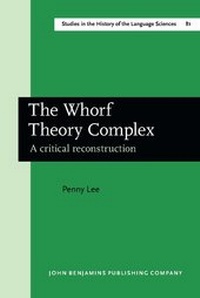
The Whorf Theory Complex
A critical reconstruction
Published on 30. June 1996
Book
Hardback
324 pages
978-90-272-4569-4 (ISBN)
Description
At last - a comprehensive account of the ideas of Benjamin Lee Whorf which not only explains the nature and logic of the linguistic relativity principle but also situates it within a larger 'theory complex' delineated in fascinating detail. Whorf's almost unknown unpublished writings (as well as his published papers) are drawn on to show how twelve elements of theory interweave in a sophisticated account of relations between language, mind, and experience. The role of language in cognition is revealed as a central concern, some of his insights having interesting affinity with modern connectionism. Whorf's gestaltic 'isolates' of experience and meaning, crucial to understanding his reasoning about linguistic relativity, are explained. A little known report written for the Yale anthropology department is used extensively and published for the first time as an appendix. With the Whorf centenary in 1997, this book provides a timely challenge to those who take pleasure in debunking his ideas without bothering to explore their subtlety or even reading them in their original form.
More details
Series
Language
English
Place of publication
Amsterdam
Netherlands
Target group
Professional and scholarly
Dimensions
Height: 245 mm
Width: 164 mm
Weight
570 gr
ISBN-13
978-90-272-4569-4 (9789027245694)
Copyright in bibliographic data and cover images is held by Nielsen Book Services Limited or by the publishers or by their respective licensors: all rights reserved.
Schweitzer Classification
Other editions
Additional editions
E-Book
06/1996
1st Edition
John Benjamins Publishing Company
€149.99
Available for download
Person
Content
1. Acknowledgments; 2. Preface; 3. Chapter 1. Introduction and Overview; 4. 1.1 The Early Work: 1924-1930; 5. 1.2 1931-1941: The Final Years; 6. 1.3 Misread, Unread, and Superficially Treated; 7. 1.4 The Theory Complex: An Overview; 8. 1.5 Elements of the Complex Summarized; 9. Chapter 2. Linguistic Thinking: Points, Pattern, Linkage, and Rapport; 10. 2.1 Patternment; 11. 2.2 Points in the Pattern; 12. 2.3 Emergent from a Field of Causes; 13. 2.4 Linguistic Thinking; 14. 2.5. Form and Substance, Process and Content: Cutting through the Dichotomies to Linguistic Thinking; 15. Chapter 3. The Logic and Development of the Linguistic Relativity Principle; 16. 3.1 The Linguistic Relativity Principle; 17. 3.2 Raw Experience; 18. 3.3 Isolates of Experience: the Nonlinguistic Configuration of Experience; 19. 3.4 A Canon of Reference, the Same for all Observers; 20. 3.5 The Biological Segmentation of Reality; 21. 3.6 Different Essentials from the Same Situation; 22. 3.7 The Yale Report and Configurative Linguistics; 23. 3.8 An Analysis of Hopi Stems: Gestalt Theory in the Service of Linguistics; 24. 3.9 Overview of the Yale Report; 25. Chapter 4. Of Covert Categories, Cryptotypes, and the Internalized Linguistic System; 26. 4.1 A Whorfian Psycholinguistics; 27. 4.2 Marking and Grammatical Classes; 28. 4.3 Terminological Anomalies; 29. 4.4 Grammatical Meaning and The Problem of Levels in Linguistic Description; 30. 4.5 The Data of Utterances; 31. Chapter 5. Abstractive Processes and the Question of Universals; 32. 5.1 Abstractive Processes in Cognition; 33. 5.2 Experiential, Conceptual, and Linguistic Universals; 34. Chapter 6. Metalinguistics: The Intercalihration of Agreement through Language Awareness; 35. 6.1 Introductory Comments; 36. 6.2 Three Kinds of Agreement; 37. 6.3 Metalinguistics; 38. 6.4 Language Awareness as an Augmentative Function in Cognition; 39. 6.5 Different Order Systems, Different Logics, and the Progress of Science; 40. Appendix: "The Yale Report"; 41. References; 42. Index of Names; 43. Index of Subjects