

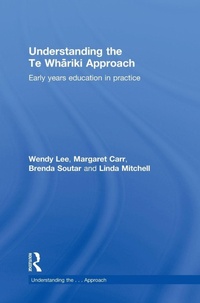
Understanding the Te Whariki Approach
Early years education in practice
1st Edition
Published on 20. December 2012
Book
Hardback
184 pages
978-0-415-61712-3 (ISBN)
Description
Understanding the Te Whariki Approach is a much-needed source of information for those wishing to extend and consolidate their understanding of the Te Whariki approach, introducing the reader to an innovative bicultural curriculum developed for early childhood services in New Zealand. It will enable the reader to analyse the essential elements of this approach to early childhood and its relationship to quality early years practice.
Providing students and practitioners with the relevant information about a key pedagogical influence on high quality early years practice in the United Kingdom, the book explores all areas of the curriculum, emphasising:
strong curriculum connections to families and the wider community;
a view of teaching and learning that focuses on responsive and reciprocal relationships with people, places and things;
a view of curriculum content as cross-disciplinary and multi-modal;
the aspirations for children to grow up as competent and confident learners and communicators, healthy in mind, body, and spirit, secure in their sense of belonging and in the knowledge that they make a valued contribution to society;
a bicultural framework in which indigenous voices have a central place.
Written to support the work of all those in the field of early years education and childcare, this is a vital text for students, early years and childcare practitioners, teachers, early years professionals, children's centre professionals, lecturers, advisory teachers, head teachers and setting managers.
Providing students and practitioners with the relevant information about a key pedagogical influence on high quality early years practice in the United Kingdom, the book explores all areas of the curriculum, emphasising:
strong curriculum connections to families and the wider community;
a view of teaching and learning that focuses on responsive and reciprocal relationships with people, places and things;
a view of curriculum content as cross-disciplinary and multi-modal;
the aspirations for children to grow up as competent and confident learners and communicators, healthy in mind, body, and spirit, secure in their sense of belonging and in the knowledge that they make a valued contribution to society;
a bicultural framework in which indigenous voices have a central place.
Written to support the work of all those in the field of early years education and childcare, this is a vital text for students, early years and childcare practitioners, teachers, early years professionals, children's centre professionals, lecturers, advisory teachers, head teachers and setting managers.
More details
Series
Language
English
Place of publication
London
United Kingdom
Publishing group
Taylor & Francis Ltd
Target group
College/higher education
Professional and scholarly
Illustrations
63 s/w Photographien bzw. Rasterbilder, 18 s/w Zeichnungen, 8 s/w Tabellen
8 Tables, black and white; 18 Line drawings, black and white; 63 Halftones, black and white
Dimensions
Height: 250 mm
Width: 175 mm
Thickness: 15 mm
Weight
510 gr
ISBN-13
978-0-415-61712-3 (9780415617123)
Copyright in bibliographic data and cover images is held by Nielsen Book Services Limited or by the publishers or by their respective licensors: all rights reserved.
Schweitzer Classification
Other editions
Additional editions
Wendy Lee | Margaret Carr | Brenda Soutar
Understanding the Te Whariki Approach
Early years education in practice
E-Book
01/2013
Routledge
€51.49
Available for download
Wendy Lee | Margaret Carr | Brenda Soutar
Understanding the Te Whariki Approach
Early years education in practice
E-Book
01/2013
Routledge
€51.49
Available for download
Wendy Lee | Margaret Carr | Brenda Soutar
Understanding the Te Whariki Approach
Early years education in practice
Book
12/2012
1st Edition
Routledge
€57.80
Shipment within 15-20 days
Persons
Wendy Lee is the Project Director of the Educational Leadership Project, which provides professional development for early childhood teachers in Aotearoa New Zealand.
Margaret Carr is Professor of Education at the University of Waikato, Aotearoa New Zealand, and was one of the Directors of the curriculum development project that developed Te Whariki.
Brenda Soutar is a Kaitiaki (Leader) at Mana Tamariki, an education setting that nurtures and teaches children from 0-17 years through total immersion in the Maori language and learning environments in their kohanga reo (early childhood setting), kura kaupapa Maori (primary school) and wharekura (secondary school).
Linda Mitchell is an Associate Professor and early childhood education policy analyst at the University of Waikato, Aotearoa New Zealand.
Margaret Carr is Professor of Education at the University of Waikato, Aotearoa New Zealand, and was one of the Directors of the curriculum development project that developed Te Whariki.
Brenda Soutar is a Kaitiaki (Leader) at Mana Tamariki, an education setting that nurtures and teaches children from 0-17 years through total immersion in the Maori language and learning environments in their kohanga reo (early childhood setting), kura kaupapa Maori (primary school) and wharekura (secondary school).
Linda Mitchell is an Associate Professor and early childhood education policy analyst at the University of Waikato, Aotearoa New Zealand.
Content
1. Acknowledgments and an Introduction; 2. Setting the Stage for Te Whariki; 3. The Development of Te Whariki; 4. Cultural Identity and Language; 5. Principle One: Nga Hononga / Relationships; 6. Principle Two: Kotahitanga / Holistic Development; 7. Principle Three: Whakamana / Empowerment; 8. Whanau Tangata / Family and Community; 9. Weaving: Documentation, Assessment and Planning; 10. Teachers as Researchers; 11. The Future