

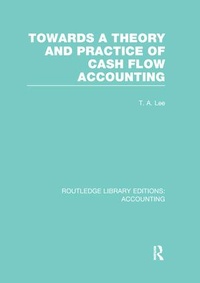
Towards a Theory and Practice of Cash Flow Accounting (RLE Accounting)
1st Edition
Published on 26. November 2015
Book
Paperback/Softback
312 pages
978-1-138-98583-4 (ISBN)
Description
This book concerns developments in the history of one accounting idea. It discusses cash flow accounting and, as such, relates what can only be described as a 'recycled' accounting problem. Cash flow accounting is the oldest form of monetary accounting, preceding the now conventional accrual and allocation-based accounting. Largely ignored in accounting literature since the early 1950s, this collection concentrates on Lee's work and provides the reader not only with a relevant selection of his writings on the subject since 1971, but also with a structured collection that explains the way in his thinking has developed on the subject and focuses on relevant influences.
More details
Series
Language
English
Place of publication
London
United Kingdom
Publishing group
Taylor & Francis Ltd
Target group
College/higher education
Professional and scholarly
General, Postgraduate, Professional, and Undergraduate
Dimensions
Height: 246 mm
Width: 174 mm
Weight
580 gr
ISBN-13
978-1-138-98583-4 (9781138985834)
Copyright in bibliographic data and cover images is held by Nielsen Book Services Limited or by the publishers or by their respective licensors: all rights reserved.
Schweitzer Classification
Other editions
Additional editions
T. Lee | Robert Parker
Towards a Theory and Practice of Cash Flow Accounting (RLE Accounting)
E-Book
11/2013
1st Edition
Routledge
€64.49
Available for download
T. Lee | Robert Parker
Towards a Theory and Practice of Cash Flow Accounting (RLE Accounting)
E-Book
11/2013
1st Edition
Routledge
€64.49
Available for download
T. Lee | Robert Parker
Towards a Theory and Practice of Cash Flow Accounting (RLE Accounting)
Book
11/2013
1st Edition
Routledge
€237.70
Shipment within 15-20 days
Persons
Multivolume collection by leading authors in the field
Content
Introduction. 1. Review and History 2. Initial Ideas 3. Early Argument 4. Extending the Argument 5. A Major Extension 6. Obtaining the Data 7. Analysis of Entities 8. Empirical Findings 9. Criticisms