

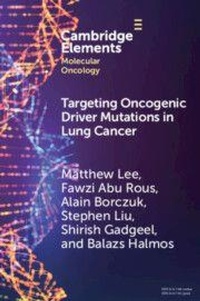
Targeting Oncogenic Driver Mutations in Lung Cancer
Published on 2. February 2023
Book
Paperback/Softback
96 pages
978-1-009-33613-0 (ISBN)
Description
The recent advances in the field of molecular diagnostic techniques have led to the identification of targetable alterations prompting a paradigm shift in the management of non-small cell lung cancer (NSCLC) and an era of precision oncology. This Element highlights the most clinically relevant oncogenic drivers other than EGFR, their management and current advancements in treatment. It also examines the different challenges in resistance to targeted therapies and diagnostic dilemmas for each oncogenic driver and the future direction of NSCLC management.
More details
Series
Language
English
Place of publication
Cambridge
United Kingdom
Product notice
Paperback (trade)
Illustrations
Worked examples or Exercises
Dimensions
Height: 229 mm
Width: 152 mm
Thickness: 5 mm
Weight
141 gr
ISBN-13
978-1-009-33613-0 (9781009336130)
Copyright in bibliographic data and cover images is held by Nielsen Book Services Limited or by the publishers or by their respective licensors: all rights reserved.
Schweitzer Classification
Other editions
Additional editions
Matthew Lee | Fawzi Abu Rous | Alain Borczuk
Targeting Oncogenic Driver Mutations in Lung Cancer
E-Book
02/2023
Cambridge University Press
€22.49
Available for download
Matthew Lee | Fawzi Abu Rous | Alain Borczuk
Targeting Oncogenic Driver Mutations in Lung Cancer
E-Book
01/2023
Cambridge University Press
€22.49
Available for download
Persons
Content
1. Introduction; 2. ALK gene rearrangements; 3. ROSI gene rearrangements; 4. RET gene rearrangements; 5. MET alterations; 6. KRAS point mutations; 7. B-RAF point mutations; 8. NTRK1/2/3 gene fusions; 9. ERBB2 (HER2) mutations; 10. Diagnostic strategies; References.