

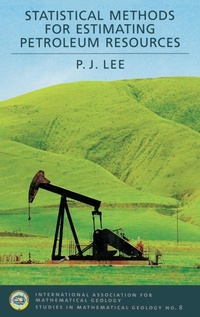
Statistical Methods for Estimating Petroleum Resources
Edited by Jo Anne DeGraffenreid
Published on 1. May 2008
Book
Hardback
258 pages
978-0-19-533190-5 (ISBN)
Description
This book describes procedures for determining the total hydrocarbon (petroleum) resource or resource potential in a region. Statistical concepts and methods employed in petroleum resource assessment are the subject of the manuscript, extensively illustrated by numerous real case studies. Prof. Lee's computer-aided Petroleum Information Management and Resource Evaluation System (PETRIMES) methodology has been adopted by governments around the world and by major multinational oil companies to perform resource assessment and to predict future oil and gas production. Though this methodology is so widely used, there is no "user's guide" to it, and this book will be the definitive resource for PETRIMES users.
More details
Series
Language
English
Place of publication
New York
United States
Target group
College/higher education
Professional and scholarly
Illustrations
73 line illustrations
Dimensions
Height: 240 mm
Width: 161 mm
Thickness: 20 mm
Weight
602 gr
ISBN-13
978-0-19-533190-5 (9780195331905)
Copyright in bibliographic data and cover images is held by Nielsen Book Services Limited or by the publishers or by their respective licensors: all rights reserved.
Schweitzer Classification
Other editions
Additional editions
P. J. Lee | Jo Anne Degraffenreid
Statistical Methods for Estimating Petroleum Resources
E-Book
05/2008
1st Edition
OUP eBook
€101.99
Available for download
Persons
P.J. Lee received his doctoral degree from McMaster University in Canada, after which he worked for Home Oil Company and then joined the Geological Survey of Canada in Calgary in 1979. In 1996, he became Professor and Chairman of the Department of Earth Sciences, National Cheng Kung University of Taiwan. After returning to Canada as President of Perspective Information Inc., he was involved in a new project for a computer system with the National Cheng Kung
University.
P.J. Lee had over forty years of experience in petroleum geology, basin analysis, and petroleum resource evaluation, and developed a computer-aided Petroleum Information Management and Resource Evaluation System (PETRIMES/W) for estimating undiscovered petroleum resources. He had more than 80 scientific articles published in various international journals.
Among the many honors P.J. Lee received were the Gold Medal in 1993 presented by the First Annual Celebration of Excellence in Information Management in the Federal Government of Canada; he was the recipient of the Commemorative Medal for the 125th Anniversary of the Confederation of Canada presented by the Governor General of Canada; and the outstanding research awards for 1996,1997, and 1998 presented by the National Science Council of Taiwan.
University.
P.J. Lee had over forty years of experience in petroleum geology, basin analysis, and petroleum resource evaluation, and developed a computer-aided Petroleum Information Management and Resource Evaluation System (PETRIMES/W) for estimating undiscovered petroleum resources. He had more than 80 scientific articles published in various international journals.
Among the many honors P.J. Lee received were the Gold Medal in 1993 presented by the First Annual Celebration of Excellence in Information Management in the Federal Government of Canada; he was the recipient of the Commemorative Medal for the 125th Anniversary of the Confederation of Canada presented by the Governor General of Canada; and the outstanding research awards for 1996,1997, and 1998 presented by the National Science Council of Taiwan.
Content
1. Introduction ; 2. Evaluation Models ; 3. Estimating Mature Plays ; 4. More About Discovery Process Models ; 5. Evaluating Conceptual Plays ; 6. Estimation Update and Feedback Procedures ; 7. Other Assessment Methods - An Overview ; 8. Concluding Remarks ; Appendix A ; Appendix B ; Appendix C ; Appendix D ; References