

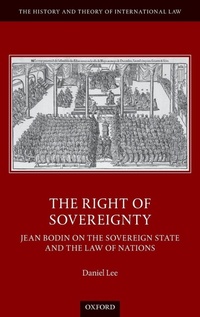
The Right of Sovereignty
Jean Bodin on the Sovereign State and the Law of Nations
Published on 31. August 2021
Book
Hardback
320 pages
978-0-19-875553-1 (ISBN)
Description
Sovereignty is the vital organizing principle of modern international law. This book examines the origins of that principle in the legal and political thought of its most influential theorist, Jean Bodin (1529/30-1596). As the author argues in this study, Bodin's most lasting theoretical contribution was his thesis that sovereignty must be conceptualized as an indivisible bundle of legal rights constitutive of statehood. While these uniform 'rights of sovereignty' licensed all states to exercise numerous exclusive powers, including the absolute power to 'absolve' and release its citizens from legal duties, they were ultimately derived from, and therefore limited by, the law of nations. The book explores Bodin's creative synthesis of classical sources in philosophy, history, and the medieval legal science of Roman and canon law in crafting the rules governing state-centric politics.
The Right of Sovereignty is the first book in English on Bodin's legal and political theory to be published in nearly a half-century and surveys themes overlooked in modern Bodin scholarship: empire, war, conquest, slavery, citizenship, commerce, territory, refugees, and treaty obligations. It will interest specialists in political theory and the history of modern political thought, as well as legal history, the philosophy of law, and international law.
The Right of Sovereignty is the first book in English on Bodin's legal and political theory to be published in nearly a half-century and surveys themes overlooked in modern Bodin scholarship: empire, war, conquest, slavery, citizenship, commerce, territory, refugees, and treaty obligations. It will interest specialists in political theory and the history of modern political thought, as well as legal history, the philosophy of law, and international law.
Reviews / Votes
Daniel Lee's The Right of Sovereignty compels us to understand Bodin as a profoundly juridical thinker. The concept of legal sovereignty Lee disinters is more than an important contribution to our understanding of early modern legal and political theory. It also has great salience to our debates about sovereignty today. * David Dyzenhaus, University of Toronto * Daniel Lee has produced a real chef d'oeuvre. He presents to us Jean Bodin the lawyer whose idea of sovereignty was embedded in legal authority, not brute force. Pirates and robbers may constrain, but do not make a state. Situating Bodin's views of sovereign authority and of statehood in the context of Roman and continental jurisprudence, Daniel Lee has produced a vital but also eminently readable corrective to standard readings of one classic of legal and political thought. The demonstration that rulers have duties, even if they cannot be enforced by courts, and that tyrants are not sovereigns, resonates strongly also in the contemporary world. This is a hugely admirable work. * Martti Koskenniemi, University of Helsinki * Bodin's great contribution to Western political thought was to create a synthetic theory of sovereignty from the disparate pieces contributed by his medieval forebears. Lee lays bare the complicated medieval substructure of Bodin's concept of sovereignty that was based on legal, theological, and philosophical concepts established in an age when sovereignty was not absolute but fragmented. Lee's splendid volume will not be the last book written about Bodin and sovereignty, but it will be a book that every future historian of both will have to deal. * Kenneth Pennington, Catholic University of America * Daniel Lee's new interpretation of the thought of Jean Bodin challenges the dominant interpretation of the French theorist as the prophet of 'classical' or 'Westphalian' sovereignty, in which the sovereign is above the law at home and free from standing obligations abroad. No, Lee argues, Bodin envisioned sovereign authority as subject to the rule of law, enmeshed in reciprocal rights and duties with its subjects, and bound by duties towards foreigners. Compelling, meticulous, and judiciously argued, Lee's interpretation will be absorbed widely and sympathetically well into the future, while, as a result, Bodin will be read far more widely and, yes, sympathetically. * Daniel Philpott, University of Notre Dame * The Right of Sovereignty, because of the methodical approach and the highly didactic style of the author, is accessible even to readers unfamiliar with Bodin's sources in Roman and canon law...Lee's work provides an invaluable companion for any scholar taking a dive into Bodin's reflection on the pre-Westphalian notion of sovereignty. * Philippe Baillargeon, Renaissance Quarterly *More details
Series
Language
English
Place of publication
Oxford
United Kingdom
Target group
Professional and scholarly
Dimensions
Height: 240 mm
Width: 161 mm
Thickness: 21 mm
Weight
634 gr
ISBN-13
978-0-19-875553-1 (9780198755531)
Copyright in bibliographic data and cover images is held by Nielsen Book Services Limited or by the publishers or by their respective licensors: all rights reserved.
Schweitzer Classification
Other editions
Additional editions
E-Book
08/2021
1st Edition
OUP eBook
€67.49
Available for download
E-Book
08/2021
1st Edition
OUP eBook
€67.49
Available for download
Person
Daniel Lee is Associate Professor of Political Science and Director of Graduate Studies in Political Science at the University of California, Berkeley. He specializes in political theory, the history of political thought, and jurisprudence. He is the author of Popular Sovereignty in Early Modern Constitutional Thought (OUP, 2016) and A Division of the Whole Law (forthcoming with OUP).
Content
Introduction
1: The State
2: The Right of Sovereignty
3: Slaves, Subjects, Citizens
4: Absolute Power: Law, Sovereignty, Absolution
5: The Common Law of Mankind, The Common Enemies of Mankind
Conclusion: The Duties of Sovereignty
1: The State
2: The Right of Sovereignty
3: Slaves, Subjects, Citizens
4: Absolute Power: Law, Sovereignty, Absolution
5: The Common Law of Mankind, The Common Enemies of Mankind
Conclusion: The Duties of Sovereignty