

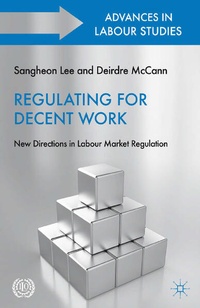
Regulating for Decent Work
New Directions in Labour Market Regulation
Published on 1. January 2011
Book
Paperback/Softback
XVI, 376 pages
978-1-349-33751-4 (ISBN)
Description
Regulating for Decent Work is a response to the dominant deregulatory approaches that have shaped labour market regulation in recent years. The inter-disciplinary and international approach invigorates current debates through the identification of new challenges, subjects and perspectives.
Reviews / Votes
'Regulating the labour market is a distortion for some, a panacea for others. This book provides the ingredients for those who wish to transcend simple positions. Drawing on empirical, inter-disciplinary and comparative perspectives, this unique collection of essays establishes the moral and economic case for regulation, identifies the circumstances that make regulation effective, and reveals the gap between 'law on the books' and 'law in action'. It is a significant resource for scholars and policy-makers who are engaged in thinking about regulation as part of a just market regime.' - Guy Mundlak, Tel-Aviv University
More details
Series
Edition
1st ed. 2011
Language
English
Place of publication
London
United Kingdom
Target group
Professional and scholarly
Illustrations
XVI, 376 p.
Dimensions
Height: 216 mm
Width: 140 mm
Thickness: 22 mm
Weight
497 gr
ISBN-13
978-1-349-33751-4 (9781349337514)
DOI
10.1057/9780230307834
Schweitzer Classification
Other editions
Additional editions
E-Book
06/2011
1st Edition
Palgrave Macmillan
€53.49
Available for download
Book
06/2011
Palgrave Macmillan
€53.49
Shipment within 15-20 days
Persons
SANGHEON LEE Research and Policy Coordinator for Conditions of Work and Employment Programme of the International Labour Office. He specializes in analyzing and monitoring changes in wages and working conditions with a view to developing improved policy responses. Dr. Lee has written extensively on working conditions issues. His recent publications include
Globalization and Changes in Employment Conditions in East Asia and the Pacific
(co-editor with F. Eyraud, Chandos and ILO, 2008) and
Working Time Around the World
(with D. McCann and J. Messenger, 2007, Routlegde and ILO). He is also one of the main authors of the ILO's
Global Wage Report 2010/11
(2010) and a Co-ordinator of the Regulating for Decent Work Network. He holds a PhD in economics from Cambridge University.
DEIRDRE MCCANNSenior Lecturer in the School of Law at the University of Manchester, UK. Her research is in the field of labour law and policy and has a particular focus on the regulation of working conditions, precarious work, and the influence of flexibility discourses on labour market regulation. Her publications have focused on the regulation of working time, non-standard work and work/family reconciliation. They include Regulating Flexible Work (Oxford University Press 2008). She was previously a Senior Researcher at the International Labour Office in Geneva and is a co-ordinator of the international research network on Regulating for Decent Work.
DEIRDRE MCCANNSenior Lecturer in the School of Law at the University of Manchester, UK. Her research is in the field of labour law and policy and has a particular focus on the regulation of working conditions, precarious work, and the influence of flexibility discourses on labour market regulation. Her publications have focused on the regulation of working time, non-standard work and work/family reconciliation. They include Regulating Flexible Work (Oxford University Press 2008). She was previously a Senior Researcher at the International Labour Office in Geneva and is a co-ordinator of the international research network on Regulating for Decent Work.
Content
PREFACE New Directions in Labour Regulation Research; S.Lee & D.McCann PART I: THEORIES AND PERSPECTIVES The Evidence-based Case for Labour Regulation; S.Deakin Precarious Employment and the Problem of SER-Centrism in Regulating for Decent Work; L.Vosko The Growth of Extended 'Entry Tournaments' and the Decline of Institutionalized Occupational Labour Markets in Britain; D.Marsden PART II: RECENT COUNTRY EXPERIENCES Laws or Luck?: Understanding Rising Formality in Brazil in the 2000s; J.Berg Labour Market Regulations and the Welfare of Indonesian Workers; Y.Islam The Enactment of Three New Labour Laws in China: Unintended Consequences and Emergence of 'New' Actors in Employment Relationships; F.L.Cooke PART III: OLD CHALLENGES, NEW TECHNIQUES Short Time Compensation as an Employment Stabilization Policy; R.LaJeunesse Gender and the Minimum Wage; D.Grimshaw & J.Rubery Decent Work for Domestic Work: an Achievable Goal or Wishful Thinking?; M.Tomei PART IV: ELEMENTS OF EFFECTIVE REGULATION The Impact of Labour Regulations: Measuring the Effectiveness of Legal Norms; S.Lee & D.McCann Governing Regulatory Discretion: Innovation and Accountability in Two Models of Labour Inspection Work; R.Pires A Diagnostic Methodology for Regulating Decent Work; D.Frey