

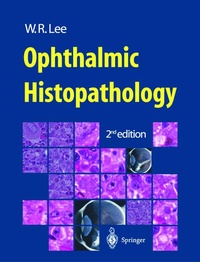
Ophthalmic Histopathology
2nd Edition
Published on 8. July 2002
Book
Hardback
XI, 475 pages
978-1-85233-049-1 (ISBN)
Description
The first edition of this book was written prior to 1991 and it seemed appropriate to revise and update the text in view of the rapid expansion in information which has occurred in the last decade. Furthermore, in the first edition, the reproduction of some of the illustrations was not of sufficient standard to be of value to the reader. Accordingly some of the inadequate figures have been replaced by colour figures which have been inserted into the text. Colour has also been included because many histopathological illustrations, e. g. special stains such as Gram, PAS, trichrome stains etc. , and immunohistochemical reactions, are much better appreciated. With regard to references, I have taken advantage of the currently available access to all the medical literat ure, which is what I anticipate will be the course of action of the reader. Glasgow, 2001 Acknowledgements It is a pleasure to re cord the support I have received in the last decade from Professors Wallace Foulds, Colin Kirkness and Gordon Dutton and from Mr Bertil Damato in their continuing efforts to educate me in the subtleties of clinical ophthalmology. I am particularly indebted to Dr Sarah Coupland who provided the information on lymphoid neoplasia which is included in this book and I must thank Dr Weng Sehu who established the computer equipment which has been so valuable in the preparation of the new illustrations.
More details
Edition
2nd ed. 2002
Language
English
Place of publication
London
United Kingdom
Target group
Professional and scholarly
Professional/practitioner
Edition type
Revised edition
Illustrations
XI, 475 p. 3757 illus., 3118 illus. in color., 639 s/w Abbildungen, 3118 farbige Abbildungen
519 colour and 615 b&w illustrations
Dimensions
Height: 0.1 cm
Width: 0.1 cm
Weight
1760 gr
ISBN-13
978-1-85233-049-1 (9781852330491)
DOI
10.1007/978-1-4471-3910-2
Schweitzer Classification
Other editions
New editions
Fiona Roberts | Chee Koon Thum
Lee's Ophthalmic Histopathology
Book
08/2021
4th Edition
Springer
€171.19
Shipment within 7-9 days
Fiona Roberts | Chee Koon Thum
Lee's Ophthalmic Histopathology
Book
11/2013
3rd Edition
Springer
€213.99
Article exhausted; check for reprint
Additional editions
Previous edition

Content
CHAPTER 1 EXAMINATION OF THE GLOBE. TECHNICAL ASPECTS: 1.1.1 Introduction
1.1.2 Clinical correlation
1.1.2.1 Background information
1.1.2.2 Clinical techniques for illustration and documentation
1.2 Equipment for macroscopic examination
1.3 Basic gross anatomy: External features
1.3.1 Measurement of ocular dimensions
1.3.2 The anterior segment
1.3.2.1 The cornea
1.3.2.2 The anterior chamber
1.3.2.3 The anterior sclera
1.3.3 The posterior aspect
1.3.3.1 The optic nerve
1.3.3.2 The vortex veins
1.3.4 Orientation of the primary cuts into the globe
1.3.4.1 Transillumination
1.3.4.2 Vertical calottes
1.3.4.3 Horizontal calottes
1.3.4.4 Oblique calottes
1.3.4.5 The unfixed globe
1.4 Basic gross anatomy: Internal features
1.4.1 Examination of specific features
1.4.2 Retrieval of tissue from the calottes
1.5 Radiological examination of the globe
1.6 Common artefacts
1.6.1 Myelin artefact
1.6.2 Shrinkage artefact
1.6.3. Autopsy material
1.7 Fixation techniques
1.7.1 Formalin based fixatives p11
1.7.1.1 Formaldehyde
1.7.1.2 Formal acetic methanol
1.7.2 Paraformaldehyde
1.7.3 Glutaraldehyde
1.8 Embedding techniques
1.8.1 General considerations
1.8.2 Paraffin wax
1.8.3 Celloidin
1.8.4 Plastic embedding
1.8.5 The importance of serial sections
1.9 Histological examination of a section of the globe
1.10 Specialised techniques
1.10.1 Introduction
1.10.2 Retinal digest preparations
1.10.3 Injection techniques (carbon, plastic)
1.11 Stains for microscopy
1.11.1 Conventional stains
1.11.2. Frozen sections for fat
1.11.3. Immunohistochemistry
1.11.3.1 Identification of tissue proteins by immune
labelling
1.11.4 Silver stains for nucleolar organising regions (AgNOR's)
1.11.5 In situ hybridisation
1.11.6. Polymerase chain reaction
1.11.7. Techniques for identification of proliferation and apoptosis
in cells.
1.12 Techniques for illustration and documentation
1.12.1 Photomacrography
l.11.2 Photomicrography
1.12 Fluorescence microscopy
1.13 Polarised light/interference contrast microscopy
1.15 Electron microscopy
1.16 Diagnostic cytopathology
1.17 Normal ocular histology
CHAPTER 2 THE TRAUMATISED EYE:
2.1 Introduction
2.2 The irreparable eye
2.2.1 Large penetrating or perforating wounds of the corneoscleral
envelope.
2.2.2 Macroscopic examination
2.2.3 Microscopic examination
2.3 The globe removed after unsuccessful attempts at repair
2.3.0 Introduction
2.3.1 Reparative changes in ocular tissues
2.3.1.1 Fibrous ingrowth
2.3.1.2 Organisation of blood
2.3.1.3 Hypotonia
2.3.1.4 Retina and optic nerve
2.3.1.5 Photoreceptor fragmentation
2.3.1.6 Lens
2.3.1.7 Haemosiderosis bulbi
2.4 Globe containing a metallic foreign body
2.4.1 Macroscopic examination
2.4.2 Types of and effects of metallic foreign bodies
2.4.3 Siderosis
2.4.4 Chalcosis
2.5 Long-term effects of ocular trauma
2.5.0 Introduction
2.5.1 Macroscopic
2.5.2 Post-traumatic glaucoma
2.5.2.1 Secondary angle closure
2.5.2.2 Secondary open angle glaucoma
2.5.2.2.1 Angle recession
2.5.2.2.2 Epithelial downgrowth
2.5.3 Lens abnormalities
2.5.3.1 Lens dislocation
2.5.3.2 Lens induced uveitis
2.5.4 Post traumatic retinal pathology
2.5.4.1 General
2.5.4.1 Post-traumatic pseudoretinitis pigmentosa
2.5.5 Sympathetic ophthalmitis
2.5.5.1 Introduction
2.5.5.2 Macroscopic examination
2.5.5.3 Microscopic examination
2.5.5.4 Research
2.6 Phthisis bulbi, ocular atrophy and ossification
2.6.1 General
2.6.2 Cyclitic membrane
2.6.3 Lens pathology in a phthisical eye
2.6.4 Retinal gliosis
2.6.5 Retinal pigment epithelium in phthisis bulbi
2.6.6 The choroid in phthisis bulbi
2.6.7 The optic nerve
2.7 Hot metals, acid burns and alkali burns
2.8 Ionising radiation