

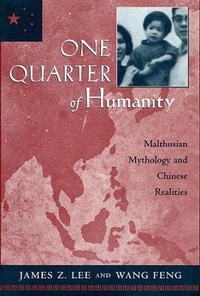
One Quarter of Humanity
Malthusian Mythology and Chinese Realities, 1700-2000
Published on 21. December 2001
Book
Paperback/Softback
268 pages
978-0-674-00709-3 (ISBN)
Description
This book presents evidence about historical and contemporary Chinese population behavior that overturns much of the received wisdom about the differences between China and the West first voiced by Malthus. Malthus described a China in which early and universal marriage ensured high fertility and therefore high mortality. He contrasted this with Western Europe, where marriage occurred late and was far from universal, resulting in lower fertility and higher demographic responsiveness to economic circumstances. The result in China was thought to be mass misery as part of the population teetered on the brink of a Malthusian precipice, whereas in the West conditions were less severe.
In reality, James Lee and Wang Feng argue, there has been effective regulation of population growth in China through a variety of practices that depressed marital fertility to levels far below European standards, and through the widespread practices of infanticide and abortion. Moreover, in China, population behavior has long been primarily a consequence of collective intervention. This collective culture underlies four distinctive features of the Chinese demographic pattern-high rates of female infanticide, low rates of male marriage, low rates of marital fertility, and high rates of adoption-that Lee and Wang trace from 1700 to today. These and other distinctive features of the Chinese demographic and social system, they argue, led to a different demographic transition in China from the one that took place in the West.
In reality, James Lee and Wang Feng argue, there has been effective regulation of population growth in China through a variety of practices that depressed marital fertility to levels far below European standards, and through the widespread practices of infanticide and abortion. Moreover, in China, population behavior has long been primarily a consequence of collective intervention. This collective culture underlies four distinctive features of the Chinese demographic pattern-high rates of female infanticide, low rates of male marriage, low rates of marital fertility, and high rates of adoption-that Lee and Wang trace from 1700 to today. These and other distinctive features of the Chinese demographic and social system, they argue, led to a different demographic transition in China from the one that took place in the West.
Reviews / Votes
I congratulate the authors for daring to use their careful quantative work to expres bold, provocative theses about Chinese society, past and present. This is one of the best contributions to Chinese social and economic history we have seen in a long time. -- Peter C. Perdue * Journal of Asian Studies * This important book takes stock of over a decade of research by the authors, Cameron Campbell and other collaborators and attempts to reconstruct and interpret centuries of Chinese demography?Overall, the authors must be commended for formulating many engaging suggestions?After many years of research, most issues in European fertility transition are still fiercely debated, and thanks largely to the authors and their collaborators, Chinese historical demography has much more recently begun to raise equally stimulating questions. -- Patrick Heuveline * American Journal of Sociology *More details
Language
English
Place of publication
Cambridge, Mass
United States
Target group
Professional and scholarly
US School Grade: College Graduate Student
Illustrations
29 line illustrations, 1 map, 16 tables
Dimensions
Height: 235 mm
Width: 156 mm
Weight
395 gr
ISBN-13
978-0-674-00709-3 (9780674007093)
Copyright in bibliographic data and cover images is held by Nielsen Book Services Limited or by the publishers or by their respective licensors: all rights reserved.
Schweitzer Classification
Other editions
Additional editions
James Z. Lee | Wang Feng
One Quarter of Humanity
Malthusian Mythology and Chinese Realities, 1700-2000
E-Book
07/2009
Harvard University Press
€55.49
Available for download
Persons
James Z. Lee is Associate Professor of Chinese History at the California Institute of Technology. Wang Feng is Assistant Professor of Sociology at the University of California, Irvine.
Content
PART I: Mythologies 1. Introduction 2. Malthusian Myths PART II: Realities 3. Subsistence 4. Mortality 5. Marriage 6. Fertility PART III: Implications 7. System 8. Society 9. Demography, Ideology, and Politics Appendix: Chinese Population Sources, 1700-2000 Notes References Index