

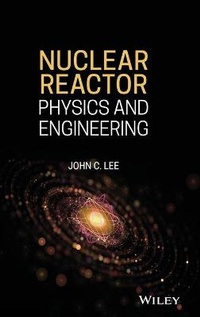
Nuclear Reactor
Physics and Engineering
Published on 9. April 2020
Book
Hardback
656 pages
978-1-119-58232-8 (ISBN)
Description
An introductory text for broad areas of nuclear reactor physics
Nuclear Reactor Physics and Engineering offers information on analysis, design, control, and operation of nuclear reactors. The author-a noted expert on the topic-explores the fundamentals and presents the mathematical formulations that are grounded in differential equations and linear algebra.
The book puts the focus on the use of neutron diffusion theory for the development of techniques for lattice physics and global reactor system analysis. The author also includes recent developments in numerical algorithms, including the Krylov subspace method, and the MATLAB software, including the Simulink toolbox, for efficient studies of steady-state and transient reactor configurations. In addition, nuclear fuel cycle and associated economics analysis are presented, together with the application of modern control theory to reactor operation. This important book:
Provides a comprehensive introduction to the fundamental concepts of nuclear reactor physics and engineering
Contains information on nuclear reactor kinetics and reactor design analysis
Presents illustrative examples to enhance understanding
Offers self-contained derivation of ?uid conservation equations
Written for undergraduate and graduate students in nuclear engineering and practicing engineers, Nuclear Reactor Physics and Engineering covers the fundamental concepts and tools of nuclear reactor physics and analysis.
Nuclear Reactor Physics and Engineering offers information on analysis, design, control, and operation of nuclear reactors. The author-a noted expert on the topic-explores the fundamentals and presents the mathematical formulations that are grounded in differential equations and linear algebra.
The book puts the focus on the use of neutron diffusion theory for the development of techniques for lattice physics and global reactor system analysis. The author also includes recent developments in numerical algorithms, including the Krylov subspace method, and the MATLAB software, including the Simulink toolbox, for efficient studies of steady-state and transient reactor configurations. In addition, nuclear fuel cycle and associated economics analysis are presented, together with the application of modern control theory to reactor operation. This important book:
Provides a comprehensive introduction to the fundamental concepts of nuclear reactor physics and engineering
Contains information on nuclear reactor kinetics and reactor design analysis
Presents illustrative examples to enhance understanding
Offers self-contained derivation of ?uid conservation equations
Written for undergraduate and graduate students in nuclear engineering and practicing engineers, Nuclear Reactor Physics and Engineering covers the fundamental concepts and tools of nuclear reactor physics and analysis.
More details
Language
English
Place of publication
New York
United States
Target group
Professional and scholarly
Dimensions
Height: 234 mm
Width: 158 mm
Thickness: 33 mm
Weight
885 gr
ISBN-13
978-1-119-58232-8 (9781119582328)
Copyright in bibliographic data and cover images is held by Nielsen Book Services Limited or by the publishers or by their respective licensors: all rights reserved.
Schweitzer Classification
Other editions
New editions
John C. Lee
Nuclear Reactor Physics and Engineering
Book
12/2024
2nd Edition
Wiley
€130.50
Shipment within 15-20 days
Person
JOHN C. LEE, PHD, is professor in the Department of Nuclear Engineering and Radiological Sciences, University of Michigan, Ann Arbor.
Content
Preface xiv
Permissions and Copyrights xvi
List of Tables xviii
List of Figures xix
1 Nuclear Power Plants 1
2 Neutronnucleus Reaction and Neutron Cross Section 27
3 Neutron Flux, Reaction Rate, and Effective Cross Section 59
4 Derivation of the Neutron Diffusion Equation 77
5 Applications of the One-Group Neutron Diffusion Equation 99
6 Numerical Solution of the Neutron Diffusion Equation 131
7 Applications of the Two-Group Neutron Diffusion Equation 165
8 Nuclear Reactor Kinetics 181
9 Fast Neutron Spectrum Calculation 219
10 Perturbation Theory and Adjoint Flux 255
11 Lattice Physics Analysis of Heterogeneous Cores 273
12 Nuclear Fuel Cycle Analysis and Management 323
13 Thermal-Hydraulic Analysis of Reactor Systems 373
14 Power Coefficients of Reactivity 455
15 Nuclear Energy Economics 471
16 Space-Time Kinetics and Reactor Control 489
17 Elements of Neutron Transport Theory 543
Appendix A: Key Physical Constants 575
Appendix B: Comparison of Major Reactor Types 577
Appendix C: Special Mathematical Functions 581
Appendix D: Integral Transforms 591
Appendix E: Calculus of Variation for Optimal Control Formulation 595
Appendix F: Kalman Filter Algorithm 603
Answers to Selected Problems 609
Index 621
Permissions and Copyrights xvi
List of Tables xviii
List of Figures xix
1 Nuclear Power Plants 1
2 Neutronnucleus Reaction and Neutron Cross Section 27
3 Neutron Flux, Reaction Rate, and Effective Cross Section 59
4 Derivation of the Neutron Diffusion Equation 77
5 Applications of the One-Group Neutron Diffusion Equation 99
6 Numerical Solution of the Neutron Diffusion Equation 131
7 Applications of the Two-Group Neutron Diffusion Equation 165
8 Nuclear Reactor Kinetics 181
9 Fast Neutron Spectrum Calculation 219
10 Perturbation Theory and Adjoint Flux 255
11 Lattice Physics Analysis of Heterogeneous Cores 273
12 Nuclear Fuel Cycle Analysis and Management 323
13 Thermal-Hydraulic Analysis of Reactor Systems 373
14 Power Coefficients of Reactivity 455
15 Nuclear Energy Economics 471
16 Space-Time Kinetics and Reactor Control 489
17 Elements of Neutron Transport Theory 543
Appendix A: Key Physical Constants 575
Appendix B: Comparison of Major Reactor Types 577
Appendix C: Special Mathematical Functions 581
Appendix D: Integral Transforms 591
Appendix E: Calculus of Variation for Optimal Control Formulation 595
Appendix F: Kalman Filter Algorithm 603
Answers to Selected Problems 609
Index 621