

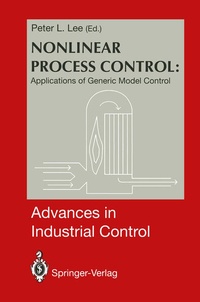
Nonlinear Process Control:
Applications of Generic Model Control
Published on 22. November 2011
Book
Paperback/Softback
XIII, 250 pages
978-1-4471-2081-0 (ISBN)
Description
It is a valuable contribution to the task of filling the theory and practice gap that exists in Process Control. The volume editor has drawn together a number of industrial case studies where Generic Model Control has been successfully applied. Each case study is documented and described in detail.
Nonlinear Process
Control
will be of particular interest to industrial practitioners. It provides a tutorial introduction to Generic Model Control and assists them in applying modern control methods to their processes.
More details
Series
Edition
Softcover reprint of the original 1st ed. 1993
Language
English
Place of publication
London
United Kingdom
Target group
Professional and scholarly
Research
Illustrations
XIII, 250 p.
Dimensions
Height: 235 mm
Width: 155 mm
Thickness: 15 mm
Weight
411 gr
ISBN-13
978-1-4471-2081-0 (9781447120810)
DOI
10.1007/978-1-4471-2079-7
Schweitzer Classification
Other editions
Additional editions
Book
11/1993
Springer
€85.55
Article exhausted; check different version
Content
1 Introduction.- 1.1 References.- 2 Generic Model Control - The Basics.- 2.1 Introduction.- 2.2 The Basics.- 2.3 Reference Systems.- 2.4 Using Steady State Models.- 2.5 Constraint Handling Strategy.- 2.6 Robust Stability and Performance Analysis.- 2.7 Applications.- 2.8 References.- 3 Industrial Applications of Reference System Synthesis/Generic Model Control: Wastewater pH Control.- 3.1 Abstract.- 3.2 Introduction.- 3.3 Process Description.- 3.4 Model Development.- 3.5 Model Validation.- 3.6 Controller Design and Tuning.- 3.7 Implementation.- 3.8 Results.- 3.9 Conclusions.- 3.10 Acknowledgement.- 3.11 Nomenclature.- 3.12 References.- 4 Using Tray-To-Tray Models for Distillation Control.- 4.1 Introduction.- 4.2 Description of Columns Considered.- 4.3 Controller Models.- 4.4 Implementation Issues.- 4.5 Results.- 4.6 Economic Benefits.- 4.7 Conclusions.- 4.8 References.- 5 Automatic Moisture Control in Particulate Dryers.- 5.1 Abstract.- 5.2 Introduction.- 5.3 Rationale.- 5.4 Research and Development of the Control System.- 5.5 Development of the Controller.- 5.6 Results.- 5.7 Cost Benefit Analysis.- 5.8 Discussion.- 5.9 Conclusions.- 5.10 Acknowledgements.- 5.11 References.- 6 Eccentricity Control of a Cable Jacketing Line.- 6.1 Introduction.- 6.2 The Application.- 6.3 The Controllers.- 6.4 Results.- 6.5 Conclusions.- 6.6 Acknowledgements.- 6.7 References.- 7 The Development of a Nonlinear Adaptive Generic Model Controller for Chemical Reaction Quality Control.- 7.1 Abstract.- 7.2 Inntroduction.- 7.3 Chronological Development of the Control Strategy.- 7.4 Summary.- 7.5 Issues in Nonlinear Adaptive Control.- 7.6 References.- 8 Blast Furnace Stove Control.- 8.1 Introduction.- 8.2 Blast Furnace Stoves.- 8.3 Model and Control Law Development.- 8.4 Implementation.- 8.5Results.- 8.6 Economic Benefits.- 8.7 References.- 9 Conclusions.