

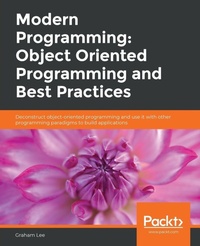
Modern Programming: Object Oriented Programming and Best Practices
Deconstruct object-oriented programming and use it with other programming paradigms to build applications
Published on 27. June 2019
Book
Paperback/Softback
266 pages
978-1-83898-618-6 (ISBN)
Description
Discover the untapped features of object-oriented programming and use it with other software tools to code fast, efficient applications.
Key Features
Explore the complexities of object-oriented programming (OOP)
Discover what OOP can do for you
Learn to use the key tools and software engineering practices to support your own programming needs
Book DescriptionYour experience and knowledge always influence the approach you take and the tools you use to write your programs. With a sound understanding of how to approach your goal and what software paradigms to use, you can create high-performing applications quickly and efficiently.
In this two-part book, you'll discover the untapped features of object-oriented programming and use it with other software tools to code fast and efficient applications. The first part of the book begins with a discussion on how OOP is used today and moves on to analyze the ideas and problems that OOP doesn't address. It continues by deconstructing the complexity of OOP, showing you its fundamentally simple core. You'll see that, by using the distinctive elements of OOP, you can learn to build your applications more easily.
The next part of this book talks about acquiring the skills to become a better programmer. You'll get an overview of how various tools, such as version control and build management, help make your life easier. This book also discusses the pros and cons of other programming paradigms, such as aspect-oriented programming and functional programming, and helps to select the correct approach for your projects. It ends by talking about the philosophy behind designing software and what it means to be a "good" developer.
By the end of this two-part book, you will have learned that OOP is not always complex, and you will know how you can evolve into a better programmer by learning about ethics, teamwork, and documentation.
What you will learn
Untangle the complexity of object-oriented programming by breaking it down to its essential building blocks
Realize the full potential of OOP to design efficient, maintainable programs
Utilize coding best practices, including TDD, pair programming and code reviews, to improve your work
Use tools, such as source control and IDEs, to work more efficiently
Learn how to most productively work with other developers
Build your own software development philosophy
Who this book is forThis book is ideal for programmers who want to understand the philosophy behind creating software and what it means to be "good" at designing software. Programmers who want to deconstruct the OOP paradigm and see how it can be reconstructed in a clear, straightforward way will also find this book useful. To understand the ideas expressed in this book, you must be an experienced programmer who wants to evolve their practice.
Key Features
Explore the complexities of object-oriented programming (OOP)
Discover what OOP can do for you
Learn to use the key tools and software engineering practices to support your own programming needs
Book DescriptionYour experience and knowledge always influence the approach you take and the tools you use to write your programs. With a sound understanding of how to approach your goal and what software paradigms to use, you can create high-performing applications quickly and efficiently.
In this two-part book, you'll discover the untapped features of object-oriented programming and use it with other software tools to code fast and efficient applications. The first part of the book begins with a discussion on how OOP is used today and moves on to analyze the ideas and problems that OOP doesn't address. It continues by deconstructing the complexity of OOP, showing you its fundamentally simple core. You'll see that, by using the distinctive elements of OOP, you can learn to build your applications more easily.
The next part of this book talks about acquiring the skills to become a better programmer. You'll get an overview of how various tools, such as version control and build management, help make your life easier. This book also discusses the pros and cons of other programming paradigms, such as aspect-oriented programming and functional programming, and helps to select the correct approach for your projects. It ends by talking about the philosophy behind designing software and what it means to be a "good" developer.
By the end of this two-part book, you will have learned that OOP is not always complex, and you will know how you can evolve into a better programmer by learning about ethics, teamwork, and documentation.
What you will learn
Untangle the complexity of object-oriented programming by breaking it down to its essential building blocks
Realize the full potential of OOP to design efficient, maintainable programs
Utilize coding best practices, including TDD, pair programming and code reviews, to improve your work
Use tools, such as source control and IDEs, to work more efficiently
Learn how to most productively work with other developers
Build your own software development philosophy
Who this book is forThis book is ideal for programmers who want to understand the philosophy behind creating software and what it means to be "good" at designing software. Programmers who want to deconstruct the OOP paradigm and see how it can be reconstructed in a clear, straightforward way will also find this book useful. To understand the ideas expressed in this book, you must be an experienced programmer who wants to evolve their practice.
More details
Language
English
Place of publication
Birmingham
United Kingdom
Target group
Professional and scholarly
US School Grade: College Graduate Student
Dimensions
Height: 235 mm
Width: 191 mm
Thickness: 15 mm
Weight
503 gr
ISBN-13
978-1-83898-618-6 (9781838986186)
Copyright in bibliographic data and cover images is held by Nielsen Book Services Limited or by the publishers or by their respective licensors: all rights reserved.
Schweitzer Classification
Other editions
Additional editions
Graham Lee
Modern Programming: Object Oriented Programming and Best Practices
Deconstruct object-oriented programming and use it with other programming paradigms to build applications
E-Book
09/2024
Packt Publishing
€31.49
Available for download
Person
Graham Lee is an experienced programmer and writer. He has written books including Professional Cocoa Application Security, Test-Driven iOS Development, APPropriate Behaviour, and APPosite Concerns. He is a developer who's been doing this stuff for long enough to want to start telling other people about the mistakes he's made, in the hope that they'll avoid repeating them. In his case, this means having worked for about 12 years as a professional. His first programming experience can hardly be called professional at all: that was done in BASIC on a Dragon 32 microcomputer. He's been paid for software written in Perl, Python, Bash, LISP, Pascal, C, Objective-C, Java, Applescript, Ruby, C++, JavaScript, and probably some other things.
Content
Table of Contents
Antithesis
Thesis
Synthesis
Tools that Support Software Development
Coding Practices
Testing
Architecture
Documentation
Requirements Engineering
Learning
Critical Analysis
Business
Teamwork
Ethics
Philosophy
Antithesis
Thesis
Synthesis
Tools that Support Software Development
Coding Practices
Testing
Architecture
Documentation
Requirements Engineering
Learning
Critical Analysis
Business
Teamwork
Ethics
Philosophy