

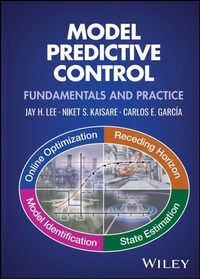
Model Predictive Control
Fundamentals and Practice
1st Edition
Will be published approx. on 1. September 2026
Book
Hardback
560 pages
978-1-394-33329-5 (ISBN)
Description
Master advanced control methods bridging academic theory and industrial practice
Model Predictive Control: Fundamentals and Practice walks engineers through the transition from academic study to industrial application of advanced process control. This comprehensive text connects current model predictive control (MPC) theory to its industrial origins and classical linear control methods, providing the foundations necessary for effective real-world application.
This book's three-part structure guides readers from basic industrial algorithms through linear systems fundamentals to advanced MPC topics. It clarifies equivalences between MPC and Linear-Quadratic optimal control, and between Moving Horizon Estimation and Kalman filtering. It also includes practical coverage of system identification. The book balances up-to-date theory with hands-on applications and maintains accessibility without sacrificing mathematical rigor.
Readers will learn to:
Effectively transition theoretical knowledge into practical control applications for complex processes
Understand connections between MPC and classical optimal control methods through clear detailed explanations
Master system identification techniques essential for developing accurate process models
Explore nonlinear MPC and the innovative Repetitive MPC for advanced real-world control challenges
Apply concepts through curated sample problems designed to enhance practical understanding and implementation skills
This is an ideal graduate-level textbook and essential reference for practicing engineers seeking to master advanced control strategies. It balances authoritative theoretical explanation with practical application, preparing readers to solve real-world control problems.
Model Predictive Control: Fundamentals and Practice walks engineers through the transition from academic study to industrial application of advanced process control. This comprehensive text connects current model predictive control (MPC) theory to its industrial origins and classical linear control methods, providing the foundations necessary for effective real-world application.
This book's three-part structure guides readers from basic industrial algorithms through linear systems fundamentals to advanced MPC topics. It clarifies equivalences between MPC and Linear-Quadratic optimal control, and between Moving Horizon Estimation and Kalman filtering. It also includes practical coverage of system identification. The book balances up-to-date theory with hands-on applications and maintains accessibility without sacrificing mathematical rigor.
Readers will learn to:
Effectively transition theoretical knowledge into practical control applications for complex processes
Understand connections between MPC and classical optimal control methods through clear detailed explanations
Master system identification techniques essential for developing accurate process models
Explore nonlinear MPC and the innovative Repetitive MPC for advanced real-world control challenges
Apply concepts through curated sample problems designed to enhance practical understanding and implementation skills
This is an ideal graduate-level textbook and essential reference for practicing engineers seeking to master advanced control strategies. It balances authoritative theoretical explanation with practical application, preparing readers to solve real-world control problems.
More details
Language
English
Place of publication
New York
United States
Target group
Professional and scholarly
ISBN-13
978-1-394-33329-5 (9781394333295)
Copyright in bibliographic data and cover images is held by Nielsen Book Services Limited or by the publishers or by their respective licensors: all rights reserved.
Schweitzer Classification
Persons
JAY H. LEE, PhD, is the Choon Hoon Cho Chair and Professor of Chemical and Materials Science, Aerospace and Mechanical Engineering, Electrical and Computer Engineering, and Industrial and Systems Engineering at the University of Southern California. He has been an authoritative researcher on model predictive control, optimization, and AI applications.
NIKET S. KAISARE, PhD, is a Professor in the Department of Chemical Engineering at the Indian Institute of Technology - Madras. He specializes in advanced process control, catalytic micro-reactors, and energy systems, and is an expert in model-based advanced process control.
CARLOS E. GARCIA, PhD, has retired as the Global Discipline Head for Process Control at Shell Oil Company following a 36-year career. He is widely recognized as one of the pioneers of model predictive control and is a member of the Control Process Automation Hall of Fame.
NIKET S. KAISARE, PhD, is a Professor in the Department of Chemical Engineering at the Indian Institute of Technology - Madras. He specializes in advanced process control, catalytic micro-reactors, and energy systems, and is an expert in model-based advanced process control.
CARLOS E. GARCIA, PhD, has retired as the Global Discipline Head for Process Control at Shell Oil Company following a 36-year career. He is widely recognized as one of the pioneers of model predictive control and is a member of the Control Process Automation Hall of Fame.
Content
Foreword xv
Preface xxv
Acknowledgments xxvii
1 Introduction 1
1.1 What Is MPC? 1
1.2 Why MPC? 5
1.3 Historical Overview 10
1.4 Impact of MPC on Control Research 13
1.5 A Typical Industrial Control Problem 17
1.6 Organization of This Book 20
Part I Early Industrial MPC Algorithms 23
2 Step Response Modeling and Identification 25
2.1 Linear Time-invariant Systems 26
2.2 Impulse/Step Response Models 28
2.3 Multi-step Prediction 34
2.4 Examples 39
2.5 Identification 41
3 Dynamic Matrix Control: The Basic Algorithm 51
3.1 The Concept of Moving Horizon Control 51
3.2 Multi-step Prediction 52
3.3 Objective Function 56
3.4 Constraints 57
3.5 Quadratic Programming Solution of the Control Problem 60
3.6 Implementation 62
3.7 Examples: Analysis and Guidelines 71
3.8 Case Study: Control of the "Shell Heavy Oil Fractionator" Using DMC 83
4 Dynamic Matrix Control-Extensions and Variations 99
4.1 Features Found in Other Industrial Algorithms 99
4.2 Connection with Internal Model Control 104
4.3 Some Possible Enhancements to DMC 106
Part II Basics of Linear Systems, Optimal Control, and System Identification 117
5 Linear Time Invariant System Models 119
5.1 Sampling and Reconstruction 120
5.2 Introduction to z-transform 124
5.3 Transfer Function Models 125
5.4 State-space Model 130
5.5 Conversion Between Discrete-time Models 134
6 Discrete-time State Space Models 145
6.1 State-coordinate Transformation 145
6.2 Stability 146
6.3 Controllability, Reachability, and Stabilizability 148
6.4 Observability, Reconstructability, and Detectability 156
6.5 Kalman Decomposition and Minimal Realization 160
6.6 Disturbance Modeling 163
7 State Estimation 171
7.1 Linear Estimator Structure 172
7.2 Observer Pole Placement 173
7.3 Kalman Filter 176
7.4 Extensions 185
7.5 Least Squares Formulation of State Estimation 192
8 Unconstrained Quadratic Optimal Control 201
8.1 Linear State Feedback Controller Design 202
8.2 Finite-horizon Quadratic Optimal Control 203
8.3 Infinite-horizon Quadratic Optimal Control 208
8.4 Analysis 214
8.5 Stochastic LQ Control 216
9 Constrained Quadratic Optimal Control 223
9.1 Finite-horizon Problem 223
9.2 Infinite-horizon Problem 224
9.3 Constraint Softening 231
9.4 Derivation of an Explicit Form of the Optimal Control Law via Multi-parametric Programming 232
9.5 Analysis 235
9.6 Stochastic Case (*) 243
10 System Identification 249
10.1 Problem Overview 249
10.2 Model Structures 250
10.3 Parametric Identification Methods 255
10.4 Nonparametric Identification 270
10.5 Subspace Identification 275
10.6 Practice of System Identification: A User's Perspective 284
Part III Advanced MPC 297
11 Linear MPC: State-space Formulation 299
11.1 Model Construction 300
11.2 The Background: Deterministic State-space MPC 310
11.3 The Workhorse: MPC with State Estimation 316xii Contents
11.4 Inferential Control 335
11.5 Sequential Linearization-based MPC (for Nonlinear Systems) 341
12 Nonlinear Model Predictive Control 359
12.1 NMPC Formulation 360
12.2 Solution via NLP 362
12.3 Stability and Other Properties 368
12.4 Nonlinear State Estimation 372
12.5 Case Study 379
12.6 Conclusions and Future Directions 382
13 Repetitive MPC for Batch and Periodic Systems 387
13.1 Historical Background 387
13.2 General Framework 388
13.3 Iterative Learning Model Predictive Control for Batch Systems 391
13.4 Repetitive Model Predictive Control for Continuous Systems with Periodic Operations 397
13.5 Future Outlook 405
Exercises 406
Appendix A Review of Linear Transformation 409
Appendix B Random Variables and Stochastic Processes 433
Appendix C Model Reduction 455
Appendix D Optimality of Kalman Filter and LQG Controller for Linear Gaussian Systems 463
Appendix E Internal Model Control Basics 479
Appendix F MPC Toolbox Tutorial: Shell Oil Fractionator 495
Appendix G A Brief Tutorial on Simulink 513
Bibliography 517
Index 523
Preface xxv
Acknowledgments xxvii
1 Introduction 1
1.1 What Is MPC? 1
1.2 Why MPC? 5
1.3 Historical Overview 10
1.4 Impact of MPC on Control Research 13
1.5 A Typical Industrial Control Problem 17
1.6 Organization of This Book 20
Part I Early Industrial MPC Algorithms 23
2 Step Response Modeling and Identification 25
2.1 Linear Time-invariant Systems 26
2.2 Impulse/Step Response Models 28
2.3 Multi-step Prediction 34
2.4 Examples 39
2.5 Identification 41
3 Dynamic Matrix Control: The Basic Algorithm 51
3.1 The Concept of Moving Horizon Control 51
3.2 Multi-step Prediction 52
3.3 Objective Function 56
3.4 Constraints 57
3.5 Quadratic Programming Solution of the Control Problem 60
3.6 Implementation 62
3.7 Examples: Analysis and Guidelines 71
3.8 Case Study: Control of the "Shell Heavy Oil Fractionator" Using DMC 83
4 Dynamic Matrix Control-Extensions and Variations 99
4.1 Features Found in Other Industrial Algorithms 99
4.2 Connection with Internal Model Control 104
4.3 Some Possible Enhancements to DMC 106
Part II Basics of Linear Systems, Optimal Control, and System Identification 117
5 Linear Time Invariant System Models 119
5.1 Sampling and Reconstruction 120
5.2 Introduction to z-transform 124
5.3 Transfer Function Models 125
5.4 State-space Model 130
5.5 Conversion Between Discrete-time Models 134
6 Discrete-time State Space Models 145
6.1 State-coordinate Transformation 145
6.2 Stability 146
6.3 Controllability, Reachability, and Stabilizability 148
6.4 Observability, Reconstructability, and Detectability 156
6.5 Kalman Decomposition and Minimal Realization 160
6.6 Disturbance Modeling 163
7 State Estimation 171
7.1 Linear Estimator Structure 172
7.2 Observer Pole Placement 173
7.3 Kalman Filter 176
7.4 Extensions 185
7.5 Least Squares Formulation of State Estimation 192
8 Unconstrained Quadratic Optimal Control 201
8.1 Linear State Feedback Controller Design 202
8.2 Finite-horizon Quadratic Optimal Control 203
8.3 Infinite-horizon Quadratic Optimal Control 208
8.4 Analysis 214
8.5 Stochastic LQ Control 216
9 Constrained Quadratic Optimal Control 223
9.1 Finite-horizon Problem 223
9.2 Infinite-horizon Problem 224
9.3 Constraint Softening 231
9.4 Derivation of an Explicit Form of the Optimal Control Law via Multi-parametric Programming 232
9.5 Analysis 235
9.6 Stochastic Case (*) 243
10 System Identification 249
10.1 Problem Overview 249
10.2 Model Structures 250
10.3 Parametric Identification Methods 255
10.4 Nonparametric Identification 270
10.5 Subspace Identification 275
10.6 Practice of System Identification: A User's Perspective 284
Part III Advanced MPC 297
11 Linear MPC: State-space Formulation 299
11.1 Model Construction 300
11.2 The Background: Deterministic State-space MPC 310
11.3 The Workhorse: MPC with State Estimation 316xii Contents
11.4 Inferential Control 335
11.5 Sequential Linearization-based MPC (for Nonlinear Systems) 341
12 Nonlinear Model Predictive Control 359
12.1 NMPC Formulation 360
12.2 Solution via NLP 362
12.3 Stability and Other Properties 368
12.4 Nonlinear State Estimation 372
12.5 Case Study 379
12.6 Conclusions and Future Directions 382
13 Repetitive MPC for Batch and Periodic Systems 387
13.1 Historical Background 387
13.2 General Framework 388
13.3 Iterative Learning Model Predictive Control for Batch Systems 391
13.4 Repetitive Model Predictive Control for Continuous Systems with Periodic Operations 397
13.5 Future Outlook 405
Exercises 406
Appendix A Review of Linear Transformation 409
Appendix B Random Variables and Stochastic Processes 433
Appendix C Model Reduction 455
Appendix D Optimality of Kalman Filter and LQG Controller for Linear Gaussian Systems 463
Appendix E Internal Model Control Basics 479
Appendix F MPC Toolbox Tutorial: Shell Oil Fractionator 495
Appendix G A Brief Tutorial on Simulink 513
Bibliography 517
Index 523