

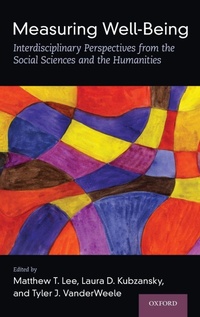
Measuring Well-Being
Interdisciplinary Perspectives from the Social Sciences and the Humanities
Published on 5. October 2021
Book
Hardback
622 pages
978-0-19-751253-1 (ISBN)
Description
This edited volume focuses on both conceptual and practical challenges in measuring well-being. Leveraging insights across diverse disciplines, including psychology, economics, sociology, statistics, public health, theology, and philosophy, contributors consider the philosophical and theological traditions on happiness, well-being and the good life, as well as recent empirical research on well-being and its measurement. The chapters review what is known empirically about how different measures of well-being relate to each other and considers various arguments for and against use of specific measures of well-being in different contexts. Further, the volume includes discussion of how a synthesis of existing research helps us make sense of the proliferation of different measures and concepts within the field, while also foregrounding the insights gained by investigations and conceptual thinking occurring across diverse disciplines.
Reviews / Votes
Measuring Well-Being represents a tremendous advance in discussions of wellbeing. Bringing together diverse disciplines and perspectives into dialog, this book provides critical historical and conceptual background for understanding the complexities and challenges in measuring well-being. Importantly, this book also provides practical guidance for selecting tools and implementing assessment across a range of contexts. * Crystal Park, Professor of Psychological Sciences, University of Connecticut, co-author of Trauma, Meaning, and Spirituality and co-editor of The Handbook of Psychology of Religion and Spirituality * This interesting volume has something for everyone. It brings together the down-to-earth empiricism of the World Happiness Report with a wide range of philosophical and theological perspectives. And miraculously they produce agreed recommendations. A very thought-provoking read. * Richard Layard, Programme Director of the Centre for Economic Performance at the London School of Economics, Co-editor of the World Happiness Report, and author of Can We Be Happier? Evidence and Ethics * Measuring Well-Being: Interdisciplinary Perspectives from the Social Sciences and the Humanities, edited by Matthew Lee, Laura Kubzansky, and Tyler VanderWeele, is easily one of the most creative syntheses of past, present, and future research on well-being that exists. It is not often that a panel of such original and cooperative scholars-from disciplines such as psychology, psychiatry, philosophy, theology, economics, public health, political science, and policy-can be assembled. If you have an inquisitive mind and a creative motivation, this is a great read. * Everett L. Worthington Jr., Commonwealth Professor of Psychology at Virginia Commonwealth University, co-editor of Handbook of Humility: Theory, Research and Applications, and author of Forgiveness and Reconciliation: Theory and Application *More details
Language
English
Place of publication
New York
United States
Target group
Professional and scholarly
Dimensions
Height: 240 mm
Width: 161 mm
Thickness: 38 mm
Weight
1089 gr
ISBN-13
978-0-19-751253-1 (9780197512531)
Copyright in bibliographic data and cover images is held by Nielsen Book Services Limited or by the publishers or by their respective licensors: all rights reserved.
Schweitzer Classification
Other editions
Additional editions
Matthew T. Lee | Laura D. Kubzansky | Tyler J. VanderWeele
Measuring Well-Being
Interdisciplinary Perspectives from the Social Sciences and the Humanities
E-Book
03/2021
1st Edition
OUP eBook
€22.49
Available for download
Matthew T. Lee | Laura D. Kubzansky | Tyler J. VanderWeele
Measuring Well-Being
Interdisciplinary Perspectives from the Social Sciences and the Humanities
E-Book
03/2021
1st Edition
OUP eBook
€0.00
Available for download
Persons
Matthew T. Lee is Director of Empirical Research at the Human Flourishing Program in the Institute for Quantitative Social Science at Harvard University and coauthor of The Heart of Religion (Oxford University Press). His research explores pathways to human flourishing, benevolent service to others, and the integration of social science and the humanities.
Laura D. Kubzansky is Lee Kum Kee Professor of Social and Behavioral Sciences and co-Director of the Lee Kum Sheung Center for Health and Happiness at the Harvard T.H. Chan School of Public Health. She has published extensively on the role of psychological and social factors in health. She has served on the leadership team for multiple training programs for junior scholars and is PI or co-investigator on numerous grants.
Tyler J. VanderWeele is the John L. Loeb and Frances Lehman Loeb Professor of Epidemiology in the Departments of Epidemiology and Biostatistics at the Harvard T. H. Chan School of Public Health, Director of the Human Flourishing Program, and Co-Director of the Initiative on Health, Religion, and Spirituality at Harvard University. His research concerns methodology for distinguishing between association and causation in observational studies, and his empirical research spans psychiatric, perinatal, and social epidemiology; the science of happiness and flourishing; and the study of religion and health.
Laura D. Kubzansky is Lee Kum Kee Professor of Social and Behavioral Sciences and co-Director of the Lee Kum Sheung Center for Health and Happiness at the Harvard T.H. Chan School of Public Health. She has published extensively on the role of psychological and social factors in health. She has served on the leadership team for multiple training programs for junior scholars and is PI or co-investigator on numerous grants.
Tyler J. VanderWeele is the John L. Loeb and Frances Lehman Loeb Professor of Epidemiology in the Departments of Epidemiology and Biostatistics at the Harvard T. H. Chan School of Public Health, Director of the Human Flourishing Program, and Co-Director of the Initiative on Health, Religion, and Spirituality at Harvard University. His research concerns methodology for distinguishing between association and causation in observational studies, and his empirical research spans psychiatric, perinatal, and social epidemiology; the science of happiness and flourishing; and the study of religion and health.
Editor
Director of Empirical Research, Human Flourishing ProgramDirector of Empirical Research, Human Flourishing Program, Institute for Quantitative Social Science, Harvard University
Professor of Social and Behavioral Sciences, Co-Director of the Center for Health and HappinessProfessor of Social and Behavioral Sciences, Co-Director of the Center for Health and Happiness, Harvard University
John L. Loeb and Frances Lehman Loeb Professor of EpidemiologyJohn L. Loeb and Frances Lehman Loeb Professor of Epidemiology, Harvard University
Content
Introduction
Part 1: Empirical Research and Reflections on Well-Being Measurement
Chapter 1: Measuring and Using Happiness to Support Public Policies, John F. Helliwell
Chapter 2: Reflections on the Introduction of Official Measures of Subjective Well-Being in the UK: Moving from Measurement to Use, Paul Allin
Chapter 3: Assessments of Societal Subjective Well-Being: Ten Methodological Issues for Consideration, Louis Tay, Andrew T. Jebb, and Victoria S. Scotney
Chapter 4: Eudaimonic and Hedonic Well-Being: An Integrative Perspective with Linkages to Sociodemographic Factors and Health, Carol D. Ryff, Jennifer Morozink Boylan, and Julie A. Kirsch
Chapter 5: A Review of Psychological Well-Being and Mortality Risk: Are All Dimensions of Psychological Well-Being Equal? Claudia Trudel-Fitzgerald, Laura D. Kubzansky, and Tyler J. VanderWeele
Part 2: Conceptual Reflections on Well-Being Measurement
Chapter 6: "Positive Biology" and Well-Ordered Science, Colin Farrelly
Chapter 7: Philosophy of Well-Being for the Social Sciences: A Primer, Guy Fletcher
Chapter 8: Defending a Hybrid of Objective-List and Desire Theories of Well-Being, William A. Lauinger
Chapter 9: The Challenge of Measuring Well-Being as Philosophers Conceive of It, Anne Baril
Chapter 10: Human Flourishing: A Christian Theological Perspective, Neil G. Messer
Chapter 11: Comparing Empirical and Theological Perspectives on the Relationship Between Hope and Aesthetic Experience: An Approach to the Nature of Spiritual Well-Being, Mark Wynn
Part 3: Advancing the Conversation about Measurement
Chapter 12: The Comprehensive Measure of Meaning: Psychological and Philosophical Foundations, Jeffrey Hanson and Tyler J. VanderWeele
Chapter 13: Empirical Relationships among Five Types of Well-Being, Seth Margolis, Eric Schwitzgebel, Daniel J. Ozer, and Sonja Lyubomirsky
Chapter 14: Measures of Community Well-Being: A Template, Tyler J. VanderWeele
Chapter 15: Inner Peace as a Contribution to Human Flourishing: A New Scale Developed from Ancient Wisdom, Juan Xi and Matthew T. Lee
Chapter 16: Tradition-Specific Measures of Spiritual Well-Being, Tyler J. VanderWeele, Katelyn N. Long, and Michael J. Balboni
Part 4: Scholarly Dialogue on the Science of Well-Being
Chapter 17: Current Recommendations on the Selection of Measures for Well-Being, Tyler J. VanderWeele, Claudia Trudel-Fitzgerald, Paul Allin, Colin Farrelly, Guy Fletcher, Donald E. Frederick, Jon Hall, John F. Helliwell, Eric S. Kim, William A. Lauinger, Matthew T. Lee, Sonja Lyubomirsky, Seth Margolis, Eileen McNeely, Neil G. Messer, Louis Tay, Vish Viswanath, Dorota Woziak-Biaowolska, Laura D. Kubzansky
Chapter 18: Advancing the Science of Well-Being: A Dissenting View on Measurement Recommendations, Carol D. Ryff, Jennifer Morozink Boylan, and Julie A. Kirsch
Chapter 19: Response to "Advancing the Science of Well-Being: A Dissenting View on Measurement Recommendations," Tyler J. VanderWeele, Claudia Trudel-Fitzgerald, and Laura D. Kubzansky
Chapter 20: Response to Response: Growing the Field of Well-Being, Carol D. Ryff, Jennifer Morozink Boylan, and Julie A. Kirsch
Conclusion, Matthew T. Lee, Laura D. Kubzansky, and Tyler J. VanderWeele
Part 1: Empirical Research and Reflections on Well-Being Measurement
Chapter 1: Measuring and Using Happiness to Support Public Policies, John F. Helliwell
Chapter 2: Reflections on the Introduction of Official Measures of Subjective Well-Being in the UK: Moving from Measurement to Use, Paul Allin
Chapter 3: Assessments of Societal Subjective Well-Being: Ten Methodological Issues for Consideration, Louis Tay, Andrew T. Jebb, and Victoria S. Scotney
Chapter 4: Eudaimonic and Hedonic Well-Being: An Integrative Perspective with Linkages to Sociodemographic Factors and Health, Carol D. Ryff, Jennifer Morozink Boylan, and Julie A. Kirsch
Chapter 5: A Review of Psychological Well-Being and Mortality Risk: Are All Dimensions of Psychological Well-Being Equal? Claudia Trudel-Fitzgerald, Laura D. Kubzansky, and Tyler J. VanderWeele
Part 2: Conceptual Reflections on Well-Being Measurement
Chapter 6: "Positive Biology" and Well-Ordered Science, Colin Farrelly
Chapter 7: Philosophy of Well-Being for the Social Sciences: A Primer, Guy Fletcher
Chapter 8: Defending a Hybrid of Objective-List and Desire Theories of Well-Being, William A. Lauinger
Chapter 9: The Challenge of Measuring Well-Being as Philosophers Conceive of It, Anne Baril
Chapter 10: Human Flourishing: A Christian Theological Perspective, Neil G. Messer
Chapter 11: Comparing Empirical and Theological Perspectives on the Relationship Between Hope and Aesthetic Experience: An Approach to the Nature of Spiritual Well-Being, Mark Wynn
Part 3: Advancing the Conversation about Measurement
Chapter 12: The Comprehensive Measure of Meaning: Psychological and Philosophical Foundations, Jeffrey Hanson and Tyler J. VanderWeele
Chapter 13: Empirical Relationships among Five Types of Well-Being, Seth Margolis, Eric Schwitzgebel, Daniel J. Ozer, and Sonja Lyubomirsky
Chapter 14: Measures of Community Well-Being: A Template, Tyler J. VanderWeele
Chapter 15: Inner Peace as a Contribution to Human Flourishing: A New Scale Developed from Ancient Wisdom, Juan Xi and Matthew T. Lee
Chapter 16: Tradition-Specific Measures of Spiritual Well-Being, Tyler J. VanderWeele, Katelyn N. Long, and Michael J. Balboni
Part 4: Scholarly Dialogue on the Science of Well-Being
Chapter 17: Current Recommendations on the Selection of Measures for Well-Being, Tyler J. VanderWeele, Claudia Trudel-Fitzgerald, Paul Allin, Colin Farrelly, Guy Fletcher, Donald E. Frederick, Jon Hall, John F. Helliwell, Eric S. Kim, William A. Lauinger, Matthew T. Lee, Sonja Lyubomirsky, Seth Margolis, Eileen McNeely, Neil G. Messer, Louis Tay, Vish Viswanath, Dorota Woziak-Biaowolska, Laura D. Kubzansky
Chapter 18: Advancing the Science of Well-Being: A Dissenting View on Measurement Recommendations, Carol D. Ryff, Jennifer Morozink Boylan, and Julie A. Kirsch
Chapter 19: Response to "Advancing the Science of Well-Being: A Dissenting View on Measurement Recommendations," Tyler J. VanderWeele, Claudia Trudel-Fitzgerald, and Laura D. Kubzansky
Chapter 20: Response to Response: Growing the Field of Well-Being, Carol D. Ryff, Jennifer Morozink Boylan, and Julie A. Kirsch
Conclusion, Matthew T. Lee, Laura D. Kubzansky, and Tyler J. VanderWeele