

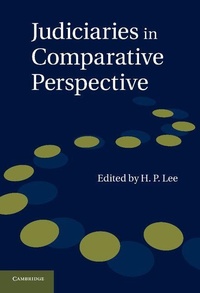
Judiciaries in Comparative Perspective
Published on 11. August 2011
Book
Hardback
624 pages
978-0-521-19060-2 (ISBN)
Description
An independent and impartial judiciary is fundamental to the existence and operation of a liberal democracy. Focussing on Australia, Canada, New Zealand, South Africa, the United Kingdom and the United States, this comparative 2011 study explores four major issues affecting the judicial institution. These issues relate to the appointment and discipline of judges; judges and freedom of speech; the performance of non-judicial functions by judges; and judicial bias and recusal, and each is set within the context of the importance of maintaining public confidence in the judiciary. The essays highlight important episodes or controversies affecting members of the judiciary to illustrate relevant principles.
More details
Language
English
Place of publication
Cambridge
United Kingdom
Target group
Professional and scholarly
Illustrations
2 Halftones, unspecified
Dimensions
Height: 235 mm
Width: 157 mm
Thickness: 38 mm
Weight
1041 gr
ISBN-13
978-0-521-19060-2 (9780521190602)
Copyright in bibliographic data and cover images is held by Nielsen Book Services Limited or by the publishers or by their respective licensors: all rights reserved.
Schweitzer Classification
Other editions
Additional editions
H. P. Lee
Judiciaries in Comparative Perspective
E-Book
12/2011
1st Edition
Cambridge University Press
€133.99
Available for download
H. P. Lee
Judiciaries in Comparative Perspective
E-Book
08/2011
Cambridge University Press
€112.99
Available for download
Person
Hoong Phun ('H. P.') Lee holds the Sir John Latham Chair of Law at Monash University and was the Vice-Chairman of the Australian Press Council from 1994 to 2010. He was appointed an Adjunct Professor of Law, City University of Hong Kong in 2009. His areas of teaching and research interests include the judiciary, comparative constitutional law, administrative law and the Malaysian and Singaporean constitutional systems.
Content
Part I: 1. Judicial independence and accountability: core values in liberal democracies Shimon Shetreet; Part II: 2. Appointment, discipline and removal of judges in Australia H. P. Lee; 3. Appointment, discipline and removal of judges in Canada Martin Friedland; 4. Appointment, discipline and removal of judges in New Zealand Philip Joseph; 5. Appointment, discipline and removal of judges in South Africa Hugh Corder; 6. Appointment, discipline and removal of judges - fundamental reforms in the United Kingdom Kate Malleson; 7. Judicial selection, removal and discipline in the United States Mark Tushnet; Part III: 8. Judges' freedom of speech: Australia John Williams; 9. Judges and free speech in Canada Kent Roach; 10. Judges and free speech in New Zealand The Hon. Grant Hammond; 11. The judiciary and freedom of speech in South Africa Iain Currie; 12. Judges and free speech in the United Kingdom Keith Ewing; 13. The criticism and speech of judges in the United States Charles Gardner Geyh; Part IV: 14. Judges, bias and recusal in Australia Colin Campbell; 15. Judges, bias and recusal in Canada Lorne Soissin; 16. Judicial recusal in New Zealand Gerard McCoy; 17. Judges, bias and recusal in South Africa The Hon. Kate O'Regan and The Hon. Edwin Cameron; 18. Judges, bias and recusal in the United Kingdom Christopher Forsyth; 19. Bias, the appearance of bias, and judicial disqualification in the United States W. W. Hodes; Part V: 20. Judges and non-judicial functions in Australia Patrick Emerton and H. P. Lee; 21. The impact of extra-judicial service on the Canadian judiciary: the need for reform Patrick Monahan and Byron Shaw; 22. Judges and the non-judicial function in New Zealand Sir Geoffrey Palmer; 23. Judges and non-judicial functions in South Africa Cora Hoexter; 24. Judges and non-judicial functions in the United Kingdom Abimbola Olowofoyeku; 25. Judges and non-judicial functions in the United States Jeffrey M. Shaman; Part VI: 26. The judiciary - a comparative conspectus H. P. Lee.