

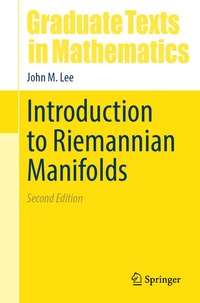
Introduction to Riemannian Manifolds
2nd Edition
Published on 14. January 2019
Book
Hardback
XIII, 437 pages
978-3-319-91754-2 (ISBN)
Description
This textbook is designed for a one or two semester graduate course on Riemannian geometry for students who are familiar with topological and differentiable manifolds. The second edition has been adapted, expanded, and aptly retitled from Lee's earlier book,
Riemannian Manifolds: An Introduction to Curvature
. Numerous exercises and problem sets provide the student with opportunities to practice and develop skills; appendices contain a brief review of essential background material.
While demonstrating the uses of most of the main technical tools needed for a careful study of Riemannian manifolds, this text focuses on ensuring that the student develops an intimate acquaintance with the geometric meaning of curvature. The reasonably broad coverage begins with a treatment of indispensable tools for working with Riemannian metrics such as connections and geodesics. Several topics have been added, including an expanded treatment of pseudo-Riemannianmetrics, a more detailed treatment of homogeneous spaces and invariant metrics, a completely revamped treatment of comparison theory based on Riccati equations, and a handful of new local-to-global theorems, to name just a few highlights.
Reviews of the first edition:
Arguments and proofs are written down precisely and clearly. The expertise of the author is reflected in many valuable comments and remarks on the recent developments of the subjects. Serious readers would have the challenges of solving the exercises and problems. The book is probably one of the most easily accessible introductions to Riemannian geometry. (M.C. Leung, MathReview )
The book's aim is to develop tools and intuition for studying the central unifying theme in Riemannian geometry, which is the notion of curvature and its relation with topology. The main ideas of the subject, motivated as in the original papers, are introduced here in an intuitive and accessible way.The book is an excellent introduction designed for a one-semester graduate course, containing exercises and problems which encourage students to practice working with the new notions and develop skills for later use. By citing suitable references for detailed study, the reader is stimulated to inquire into further research. (C.-L. Bejan, zBMATH )
While demonstrating the uses of most of the main technical tools needed for a careful study of Riemannian manifolds, this text focuses on ensuring that the student develops an intimate acquaintance with the geometric meaning of curvature. The reasonably broad coverage begins with a treatment of indispensable tools for working with Riemannian metrics such as connections and geodesics. Several topics have been added, including an expanded treatment of pseudo-Riemannianmetrics, a more detailed treatment of homogeneous spaces and invariant metrics, a completely revamped treatment of comparison theory based on Riccati equations, and a handful of new local-to-global theorems, to name just a few highlights.
Reviews of the first edition:
Arguments and proofs are written down precisely and clearly. The expertise of the author is reflected in many valuable comments and remarks on the recent developments of the subjects. Serious readers would have the challenges of solving the exercises and problems. The book is probably one of the most easily accessible introductions to Riemannian geometry. (M.C. Leung, MathReview )
The book's aim is to develop tools and intuition for studying the central unifying theme in Riemannian geometry, which is the notion of curvature and its relation with topology. The main ideas of the subject, motivated as in the original papers, are introduced here in an intuitive and accessible way.The book is an excellent introduction designed for a one-semester graduate course, containing exercises and problems which encourage students to practice working with the new notions and develop skills for later use. By citing suitable references for detailed study, the reader is stimulated to inquire into further research. (C.-L. Bejan, zBMATH )
Reviews / Votes
"One interesting aspect of the book is the decision of which audience to target it towards. . Overall, this would make a very appropriate text for a graduate course, or a programme of individual study in Riemannian geometry, whether to give a thorough treatment of the fundamentals, or to introduce the more advanced topics in global geometry." (Robert J. Low, Mathematical Reviews, November, 2019)"This material is carefully developed and several useful examples and exercises are included in each chapter. The reviewer's belief is that this excellent edition will become soon a standard text for several graduate courses as well as an frequent citation in articles." (Mircea Crâsmareanu, zbMATH 1409.53001, 2019)
More details
Series
Edition
2nd ed. 2018
Language
English
Place of publication
Cham
Switzerland
Publishing group
Springer International Publishing
Target group
Primary & secondary/elementary & high school
Illustrations
210 s/w Abbildungen
XIII, 437 p. 210 illus.
Dimensions
Height: 241 mm
Width: 160 mm
Thickness: 30 mm
Weight
840 gr
ISBN-13
978-3-319-91754-2 (9783319917542)
DOI
10.1007/978-3-319-91755-9
Schweitzer Classification
Other editions
Additional editions
John M. Lee
Introduction to Riemannian Manifolds
Book
08/2021
2nd Edition
Springer
€53.49
Shipment within 7-9 days
John M. Lee
Introduction to Riemannian Manifolds
E-Book
01/2019
2nd Edition
Springer
€53.49
Available for download
Previous edition
Book
09/1997
1st Edition
Springer
€67.36
Shipment within 5-7 days
Person
John "Jack" M. Lee
is a professor of mathematics at the University of Washington. Professor Lee is the author of three highly acclaimed Springer graduate textbooks :
Introduction to Smooth Manifolds
, (GTM 218)
Introduction to Topological Manifolds
(GTM 202), and
Riemannian Manifolds
(GTM 176). Lee's research interests include differential geometry, the Yamabe problem, existence of Einstein metrics, the constraint equations in general relativity, geometry and analysis on CR manifolds.
Content
Preface.- 1. What Is Curvature?.- 2. Riemannian Metrics.- 3. Model Riemannian Manifolds.- 4. Connections.- 5. The Levi-Cevita Connection.- 6. Geodesics and Distance.- 7. Curvature.- 8. Riemannian Submanifolds.- 9. The Gauss-Bonnet Theorem.- 10. Jacobi Fields.- 11. Comparison Theory.- 12. Curvature and Topology.- Appendix A: Review of Smooth Manifolds.- Appendix B: Review of Tensors.- Appendix C: Review of Lie Groups.- References.- Notation Index.- Subject Index.