

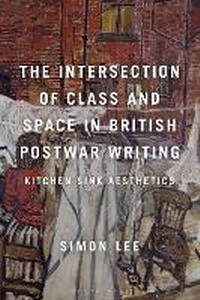
The Intersection of Class and Space in British Postwar Writing
Kitchen Sink Aesthetics
Published on 25. July 2024
Book
Paperback/Softback
240 pages
978-1-350-19315-4 (ISBN)
Description
Centering on the British kitchen sink realism movement of the late 1950s and early 1960s, specifically its documentation of the built environment's influence on class consciousness, this book highlights the settings of a variety of novels, plays, and films, turning to archival research to offer new ways of thinking about how spatial representation in cultural production sustains or intervenes in the process of social stratification.
As a movement that used gritty, documentary-style depictions of space to highlight the complexities of working-class life, the period's texts chronicled shifts in the social and topographic landscape while advancing new articulations of citizenship in response to the failures of post-war reconstruction. By exploring the impact of space on class, this book addresses the contention that critical discourse has overlooked the way the built environment informs class identity.
As a movement that used gritty, documentary-style depictions of space to highlight the complexities of working-class life, the period's texts chronicled shifts in the social and topographic landscape while advancing new articulations of citizenship in response to the failures of post-war reconstruction. By exploring the impact of space on class, this book addresses the contention that critical discourse has overlooked the way the built environment informs class identity.
Reviews / Votes
An innovative and intelligent contribution to the rapidly developing field of working-class literary studies and its project of recovering different voices, perspectives, and ways of understanding, of rethinking what literature is and what it does. * English Studies * Simon Lee sets out an important and compelling case for how the kitchen sink realism of the 1950s and 1960s moved beyond 1930s proletarian representations to establish new forms of classed identity, which remain the benchmark for working-class writing today. * Nick Hubble, Professor of Modern and Contemporary English, Brunel University, UK *More details
Language
English
Place of publication
London
United Kingdom
Publishing group
Bloomsbury Publishing PLC
Target group
College/higher education
Dimensions
Height: 234 mm
Width: 154 mm
Thickness: 16 mm
Weight
362 gr
ISBN-13
978-1-350-19315-4 (9781350193154)
Copyright in bibliographic data and cover images is held by Nielsen Book Services Limited or by the publishers or by their respective licensors: all rights reserved.
Schweitzer Classification
Other editions
Additional editions
E-Book
12/2022
1st Edition
Bloomsbury Academic
€32.99
Available for download
E-Book
12/2022
1st Edition
Bloomsbury Academic
€32.99
Available for download
Person
Simon Lee is Assistant Professor of English at Texas State University, USA where he researches and teaches Post-WWII British literature, social class and labour history. He has published on writers such as Colin MacInnes, Shelagh Delaney, John Osborne and Pat Barker, and on topics such as immigration, nationalism and cultural identity.
Content
Acknowledgments
Introduction
1 "Look at the State of this Place!"-The Impact of Domestic Space on Post-WWII Class Consciousness
Post-WWII Housing and Classed Space
Theorizing Domestic Space and Class Identity
Domestic Anxiety in Look Back in Anger
Renegotiations of Identity in Saturday Night and Sunday Morning
Queering the Domestic in A Taste of Honey
2 "Off Down the Local"-Institutional Borders in Working-Class Communities
Shared Space and Working-Class Institutions
Collective Consciousness and Shared Experience
Shared Space and Identity Formation in Saturday Night and Sunday Morning
Class Migration and Social Stasis in This Sporting Life
Contours of Class and Mobility in Up the Junction
3 Spatial Transgression and The Working-Class Imaginary
Theorizing Spatial Transgression: From the Production of Space to the Non-Space
Transgressive Space and Post-WWII Potentiality
Spatial Transgression and the Working-Class Imaginary in Up the Junction
Subterranean Space and Diasporic Demimondes in City of Spades
Differential Space and Inversion in The Loneliness of the Long Distance Runner
4 Against Class Fetishism: The Legacy of Kitchen Sink Realism
A Genealogy of the Realist Mode: Form Versus Function
Critical Approaches to Kitchen Sink Aesthetics
Multimedia Motifs and Kitchen Sink Thematics
Commodified "Kitsch-en" Sinks in Coronation Street
Channel 4 and Coordinated Class Effects
Theaters of Anger and Aggression
Class and Space in Contemporary Fiction
Conclusion
Bibliography
Index
Introduction
1 "Look at the State of this Place!"-The Impact of Domestic Space on Post-WWII Class Consciousness
Post-WWII Housing and Classed Space
Theorizing Domestic Space and Class Identity
Domestic Anxiety in Look Back in Anger
Renegotiations of Identity in Saturday Night and Sunday Morning
Queering the Domestic in A Taste of Honey
2 "Off Down the Local"-Institutional Borders in Working-Class Communities
Shared Space and Working-Class Institutions
Collective Consciousness and Shared Experience
Shared Space and Identity Formation in Saturday Night and Sunday Morning
Class Migration and Social Stasis in This Sporting Life
Contours of Class and Mobility in Up the Junction
3 Spatial Transgression and The Working-Class Imaginary
Theorizing Spatial Transgression: From the Production of Space to the Non-Space
Transgressive Space and Post-WWII Potentiality
Spatial Transgression and the Working-Class Imaginary in Up the Junction
Subterranean Space and Diasporic Demimondes in City of Spades
Differential Space and Inversion in The Loneliness of the Long Distance Runner
4 Against Class Fetishism: The Legacy of Kitchen Sink Realism
A Genealogy of the Realist Mode: Form Versus Function
Critical Approaches to Kitchen Sink Aesthetics
Multimedia Motifs and Kitchen Sink Thematics
Commodified "Kitsch-en" Sinks in Coronation Street
Channel 4 and Coordinated Class Effects
Theaters of Anger and Aggression
Class and Space in Contemporary Fiction
Conclusion
Bibliography
Index