

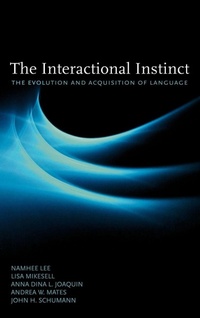
The Interactional Instinct the Evolution and Acquisition of Language
The Evolution and Acquisition of Language
Published on 5. November 2009
Book
Hardback
248 pages
978-0-19-538424-6 (ISBN)
Description
The Interactional Instinct explores the evolution of language from the theoretical view that language could have emerged without a biologically instantiated Universal Grammar. In the first part of the book, the authors speculate that a hominid group with a lexicon of about 600 words could combine these items to make larger meanings. Combinations that are successfully produced, comprehended, and learned become part of the language. Any combination that is incompatible with human mental capacities is abandoned. The authors argue for the emergence of language structure through interaction constrained by human psychology and physiology.
In the second part of the book, the authors argue that language acquisition is based on an "interactional instinct" that emotionally entrains the infant on caregivers. This relationship provides children with a motivational and attentional mechanism that ensures their acquisition of language. In adult second language acquisition, the interactional instinct is no longer operating, but in some individuals with sufficient aptitude and motivation, successful second-language acquisition can be achieved.
The Interactional Instinct presents a theory of language based on linguistic, evolutionary, and biological evidence indicating that language is a culturally inherited artifact that requires no a priori hard wiring of linguistic knowledge.
In the second part of the book, the authors argue that language acquisition is based on an "interactional instinct" that emotionally entrains the infant on caregivers. This relationship provides children with a motivational and attentional mechanism that ensures their acquisition of language. In adult second language acquisition, the interactional instinct is no longer operating, but in some individuals with sufficient aptitude and motivation, successful second-language acquisition can be achieved.
The Interactional Instinct presents a theory of language based on linguistic, evolutionary, and biological evidence indicating that language is a culturally inherited artifact that requires no a priori hard wiring of linguistic knowledge.
More details
Language
English
Place of publication
New York
United States
Target group
College/higher education
Illustrations
11 half tone, 7 line illustrations
Dimensions
Height: 235 mm
Width: 157 mm
Thickness: 19 mm
Weight
552 gr
ISBN-13
978-0-19-538424-6 (9780195384246)
Copyright in bibliographic data and cover images is held by Nielsen Book Services Limited or by the publishers or by their respective licensors: all rights reserved.
Schweitzer Classification
Other editions
Additional editions
Namhee Lee | Lisa Mikesell | Anna Dina L. Joaquin
The Interactional Instinct
The Evolution and Acquisition of Language
Book
06/2009
Oxford University Press Inc
€46.80
Shipment within 15-20 days
Namhee Lee | Lisa Mikesell | Anna Dina L. Joaquin
The Interactional Instinct
The Evolution and Acquisition of Language
E-Book
05/2009
1st Edition
OUP eBook
€16.49
Available for download
Persons
Namhee Lee : Visiting Lecturer, Assistant Professor, Defense Language Institute
Anna Dina L. Joaquin : doctoral student, Applied Linguistics, UCLA
Lisa Mikesell : doctoral student, Applied Linguistics, UCLA
Andrea W. Mates: doctoral student, Applied Linguistics, UCLA
John H. Schumann : Professor of Applied Linguistics, UCLA
Anna Dina L. Joaquin : doctoral student, Applied Linguistics, UCLA
Lisa Mikesell : doctoral student, Applied Linguistics, UCLA
Andrea W. Mates: doctoral student, Applied Linguistics, UCLA
John H. Schumann : Professor of Applied Linguistics, UCLA
Content
EVIDENCE FOR LANGUAGE EMERGENCE; THE IMPLICATIONS OF INTERACTION FOR THE NATURE OF LANGUAGE; INTERACTIONAL READINESS: INFANT-CAREGIVER INTERACTION AND THE UBIQUITY OF LANGUAGE ACQUISITION; A NEUROBIOLOGY FOR THE INTERACTIONAL INSTINCT; THE INTERACTIONAL INSTINCT IN FIRST AND SECOND LANGUAGE ACQUISITION; BROADER IMPLICATIONS OF THE INTERACTIONAL INSTINCT