

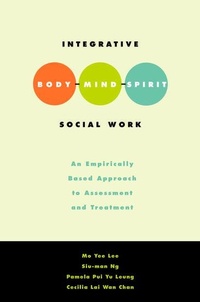
Integrative Body Mind Spirit Social Work
An Empirically Based Approach to Assessment and Treatment
Published on 2. April 2009
Book
Hardback
416 pages
978-0-19-530102-1 (ISBN)
Description
In recent years, interest in non-Western curative techniques among Americans has grown by leaps and bounds. Integrative Body-Mind-Spirit Social Work is the first book to strongly connect Western therapeutic techniques with Eastern philosophy and practices, while also providing a comprehensive and pragmatic agenda for social work, and mental health professionals. This breakthrough text, written by a cast of highly regarded researchers from both Asia and America, presents a holistic, therapeutic approach that ties Eastern philosophy and practical techniques to Western forms of therapy in order to help bring about positive, transformative changes in individuals and families.
Integrative therapy focuses on the mind-body-spirit relationship, recognizes spirituality as a fundamental domain of human existence, acknowledges and utilizes the mind's power as well as the body's, and reaches beyond self-actualization or symptom reduction to broaden a perception of self that connects individuals to a larger sense of themselves and to their communities. Here, the authors provide a pragmatic, step-by-step description of assessment and treatment techniques that employ an integrative, holistic perspective. They begin by establishing the conceptual framework of integrative body-mind-spirit social work, then expertly describe, step-by-step, assessment and treatment techniques that utilize integrative and holistic perspectives. Several case studies demonstrate the approach in action, such as one with breast cancer patients who participated in body-mind-spirit and social support groups and another in which trauma survivors used meditation to get onto a path of healing. These examples provide solid empirical evidence that integrative body-mind-spirit social work is indeed a practical therapeutic approach in bringing about tangible changes in clients. The authors also discuss ethical issues and give tips for learning integrative body-mind-spirit social work.
Professionals in social work, psychology, counseling, and nursing, as well as graduate students in courses on integral, alternative, or complementary clinical practice will find this a much-needed resource that complements the growing interest in alternatives to traditional Western psychotherapy.
Integrative therapy focuses on the mind-body-spirit relationship, recognizes spirituality as a fundamental domain of human existence, acknowledges and utilizes the mind's power as well as the body's, and reaches beyond self-actualization or symptom reduction to broaden a perception of self that connects individuals to a larger sense of themselves and to their communities. Here, the authors provide a pragmatic, step-by-step description of assessment and treatment techniques that employ an integrative, holistic perspective. They begin by establishing the conceptual framework of integrative body-mind-spirit social work, then expertly describe, step-by-step, assessment and treatment techniques that utilize integrative and holistic perspectives. Several case studies demonstrate the approach in action, such as one with breast cancer patients who participated in body-mind-spirit and social support groups and another in which trauma survivors used meditation to get onto a path of healing. These examples provide solid empirical evidence that integrative body-mind-spirit social work is indeed a practical therapeutic approach in bringing about tangible changes in clients. The authors also discuss ethical issues and give tips for learning integrative body-mind-spirit social work.
Professionals in social work, psychology, counseling, and nursing, as well as graduate students in courses on integral, alternative, or complementary clinical practice will find this a much-needed resource that complements the growing interest in alternatives to traditional Western psychotherapy.
Reviews / Votes
"The authors are to be commended for achieving a truly profound synthesis of Eastern and Western social theory that serves as a practical clinical resource for social workers and psychologists engaged in the day to day work of healing. This book will stand as an authoritative reference in the field for decades to come."--James Lake M.D., Chair, American Psychiatric Association Caucus on Complementary and Alternative Mental Health Care, and author, Textbookof Integrative Mental Health Care
"The Eastern concept of balance and harmony, yin and yang, is epitomized in this excellent book. East meets West here in a creative and productive way. Eastern practices are melded with Western supportive and psychotherapeutic principles in a manner that is clear and empirically based. What is new here is the marriage of two very old traditions in a novel and harmonious union. This book will advance the field of clinical social work, and enhance
psychosocial support for the medically ill, both Eastern and Western." -- David Spiegel, Jack, Lulu and Sam Willson Professor in the School of Medicine, Associate Chair of Psychiatry & Behavioral Sciences,
Stanford University School of Medicine
"Integrative Body-Mind-Spirit Social Work: An Empirically Based Approach to Assessment and Treatment offers a novel and important conceptual framework for social work research and practice. The text broadens the scope of social work to encompass integrative philosophy and technique, an exciting paradigm shift that has begun to transform other health care fields such as medicine and psychology. This book presents a powerful, innovative approach that
has the potential to revitalize and enliven the social work profession in the 21st century."--Matthew O. Howard, Frank A. Daniels, Jr. Distinguished Professor of Human Services Policy Information, School of
Social Work, University of North Carolina at Chapel Hill
More details
Language
English
Place of publication
New York
United States
Target group
Professional and scholarly
Illustrations
halftones, figures, tables
Dimensions
Height: 240 mm
Width: 161 mm
Thickness: 27 mm
Weight
790 gr
ISBN-13
978-0-19-530102-1 (9780195301021)
Copyright in bibliographic data and cover images is held by Nielsen Book Services Limited or by the publishers or by their respective licensors: all rights reserved.
Schweitzer Classification
Other editions
Additional editions
Mo Yee Lee | Siu-Man Ng | Pamela Pui Yu Leung
Integrative Body-Mind-Spirit Social Work
An Empirically Based Approach to Assessment and Treatment
E-Book
03/2009
1st Edition
OUP eBook
€19.99
Available for download
Mo Yee Lee | Siu-Man Ng | Pamela Pui Yu Leung
Integrative Body-Mind-Spirit Social Work
An Empirically Based Approach to Assessment and Treatment
E-Book
03/2009
1st Edition
OUP eBook
€31.49
Available for download
Persons
Mo Yee Lee is Professor at College of Social Work, Ohio State University. She has a dual focus in her clinical practice and scholarly work that includes clinical practice and research using a solution-focused/strengths perspective and cross-cultural clinical practice with individuals and families.
Siu-man Ng is Assistant Professor, Department of Social Work and Social Administration & Associate Director, Centre on Behavioral Health, The University of Hong Kong. Dr. Ng's research focus is the application of traditional Chinese medicine and philosophies in mental health practice. His key research areas are operationalizing Chinese medicine 'stagnation syndrome' concept as a psychological construct, illness coping strategies among irritable bowel syndrome
patients, and the relations between work burnout and spirituality.
Pamela Leung is Assistant Professor, Department of Social Work and Social Administration. Dr. Leung is an experienced social worker and supervisor in health and clinical social work. Her areas of interest are integrative body-mind-spirit approach, psychosocial oncology, healthcare social work and meaning-focused intervention. She is also a trainer of the Body-mind-spirit approach, locally and internationally.
Cecila L.W. Chan is Professor, Department of Social Work and Social Administration; & Director, Centre on Behavioral Health, Associate Director, HKJC Centre for Suicide Research and Prevention, The University of Hong Kong. Professor Chan publishes widely in health, practice research, empowerment, women, cancer, bereavement and palliative care. She used a strength-oriented approach in her work of empowerment of traumatized individuals. Her focus is on growth and
transformation through pain.
Siu-man Ng is Assistant Professor, Department of Social Work and Social Administration & Associate Director, Centre on Behavioral Health, The University of Hong Kong. Dr. Ng's research focus is the application of traditional Chinese medicine and philosophies in mental health practice. His key research areas are operationalizing Chinese medicine 'stagnation syndrome' concept as a psychological construct, illness coping strategies among irritable bowel syndrome
patients, and the relations between work burnout and spirituality.
Pamela Leung is Assistant Professor, Department of Social Work and Social Administration. Dr. Leung is an experienced social worker and supervisor in health and clinical social work. Her areas of interest are integrative body-mind-spirit approach, psychosocial oncology, healthcare social work and meaning-focused intervention. She is also a trainer of the Body-mind-spirit approach, locally and internationally.
Cecila L.W. Chan is Professor, Department of Social Work and Social Administration; & Director, Centre on Behavioral Health, Associate Director, HKJC Centre for Suicide Research and Prevention, The University of Hong Kong. Professor Chan publishes widely in health, practice research, empowerment, women, cancer, bereavement and palliative care. She used a strength-oriented approach in her work of empowerment of traumatized individuals. Her focus is on growth and
transformation through pain.
Author
Associate Professor of Social WorkAssociate Professor of Social Work, Ohio State University
Professor of Social Work & Social AdministrationProfessor of Social Work & Social Administration, University of Hong Kong
Lecturer and Clinical CoordinatorLecturer and Clinical Coordinator, Center on Behavioral Health
Clinical AssociateClinical Associate, Center on Behavioral Health
Content
Foreword by Edward R. Canda ; Introduction : The Coming of Integrative Body-Mind-Spirit Social Work ; Part I: A Theoretical and Practice Framework of Integrative Body-Mind-Spirit Social Work ; 1. The Philosophical Underpinnings of Integrative Body-Mind-Spirit Social Work: Holistic Wellness and the Beauty of Harmony ; 2. Assumptions of Integrative Body-Mind-Spirit Social Work Regarding Change ; Part II: Elements of Integrative Body-Mind-Spirit Social Work ; 3. Systemic Assessment: Everything is Connected ; 4. Formulating a Treatment Plan: A Multidimensional Approach ; 5. The Power of the Mind: Moving Beyond Cognition and Problem Resolution ; 6. Nurturing the Body for Balance and Tranquility ; 7. From the Body to the Mind and Spirit (by Rainbow T. H. Ho) ; 8. Spiritual Growth and Transformation: Expanding Life's Horizons ; 9. Centering the self: Personal Growth and Transformation ; Part III: Applications and Treatment Effectiveness ; 10. The Efficacy of the Integrative Body-Mind-Spirit Group and Social Support Group on Female Breast Cancer Patients (by Rainbow T. H. Ho, Cecilia L. W. Chan) ; 11. Improving the Quality of Life and Psychological Well-Being of Patients with Colorectal Cancer (by Antoinette M. Lee, Cecilia L.W. Chan, Andy H.Y. Ho, Clarissa N. Wang, Venus Y.H. Tang, Stephanie S.M. Lau, Pamela P.Y. Leung, Y. T. Fu, T. K. Yau, and Judy W.C. Ho) ; 12. Instilling Hope: The Efficacy of Integrative Body-Mind-Spirit Group Treatment for Taiwanese Female Patients with Depressive Disorders (by Fei-Hsiu Hsiao) ; 13. Integrative Body-Mind-Spirit Approach to Enhance Women's Well-Being (by Siu-Man Ng and Elaine Y. L. Tsui) ; 14. Meditation and Treatment of Trauma Survivors (by Mo Yee Lee, Amy Zaharlick, Deborah Akers) ; Part IV:Learning and Using Integrative Body-Mind-Spirit Social Work in Practice ; 15. Ethics and Integrative Body-Mind-Spirit Social Work ; 16. Learning Integrative Body-Mind-Spirit Social Work ; Appendix I: Additional Information on Yin-Yang Perspective, Buddhism, and Daoism ; Appendix II: Internet resources ; References ; Index