

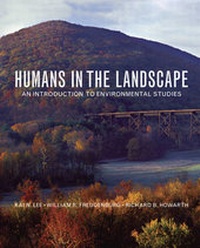
Humans in the Landscape
An Introduction to Environmental Studies
Published on 2. November 2012
Book
Paperback/Softback
431 pages
978-0-393-93072-6 (ISBN)
Description
This is the first textbook to fully synthesize all key disciplines of environmental studies. Humans in the Landscape draws on the biophysical sciences, social sciences, and humanities to explore the interactions between cultures and environments over time, and discusses classic environmental problems in the context of the overarching conflicts and frameworks that motivate them.
More details
Language
English
Place of publication
New York
United States
Target group
Professional and scholarly
Dimensions
Height: 229 mm
Width: 193 mm
Thickness: 20 mm
Weight
759 gr
ISBN-13
978-0-393-93072-6 (9780393930726)
Copyright in bibliographic data and cover images is held by Nielsen Book Services Limited or by the publishers or by their respective licensors: all rights reserved.
Schweitzer Classification
Other editions
Additional editions

Kai N. Lee | William Freudenburg | Richard Howarth
Humans in the Landscape
An Introduction to Environmental Studies
Software
03/2013
WW Norton & Co
€53.04
Article exhausted; check different version
Persons
Kai N. Lee is Rosenburg Professor of Environmental Studies, emeritus, at Williams College, and program officer for science at the David and Lucile Packard Foundation. Kai was trained as an experimental physicist at Columbia and Princeton Universities. He taught environmental studies and political science at the University of Washington before going to Williams to direct its Center for Environmental Studies. In both institutions, he taught the introductory course in environmental studies that forms the basis of this book. Kai is the author of Compass and Gyroscope (Island, 1993), a book on adaptive management that has been widely used in graduate courses in environmental science. In his grant making at the Packard Foundation, Kai is developing related means of linking knowledge with action. He has served on more than a dozen committees of the National Research Council, advising government agencies on a range of policies where scientific issues play a critical role. He is currently vice-chair of the NRC's committee to advise the U.S. Global Change Research Program. Earlier in his career Kai was a White House Fellow and he represented Washington state on the Northwest Power Planning Council. William R. Freudenburg was Dehlsen Professor of Environmental Studies at the University of California, Santa Barbara (UCSB), at the time of his death in 2010. He studied at the University of Nebraska, his native state, and at Yale University, earning a Ph.D. there in 1979. He held professorships at Washington State University and the University of Wisconsin before arriving in UCSB in 2002. Bill pursued scholarly interests in risk analysis and rural sociology, and he served as president of the Rural Sociology Society. A popular and devoted teacher, Bill was co-founder of the Association for Environmental Studies and Sciences. He was a prolific author, most recently as coauthor of two studies of the Gulf of Mexico coast,Catastrophe in the Making: The Engineering of Katrina and the Disasters of Tomorrow (Island Press, 2009) and Blowout in the Gulf: The BP Oil Spill Disaster and the Future of Energy in America (MIT Press, 2010). Richard B. Howarth is Professor of Environmental Studies at Dartmouth College and the Editor-in-Chief of Ecological Economics. After receiving an A.B. in Biology and Society from Cornell University in 1985, he pursued an M.S. in Land Resources at the University of Wisconsin-Madison (1987) and a Ph.D. from the Energy and Resources Program at the University of California, Berkeley (1990), where he specialized in the economics of natural resources and sustainable development. Prior to his arrival at Dartmouth in 1998, he held appointments with the Environmental Energy Technologies Division of the Lawrence Berkeley National Laboratory and with the Environmental Studies Department at the University of California, Santa Cruz. He has published widely on topics that include theories of intergenerational fairness; the economics of energy efficiency; climate stabilization policy; the valuation and governance of ecosystem services; and the links between economic growth, environmental degradation, and human well-being.
Content
Part I: Forces Chapter One: Humans in the Landscape: Environmental Studies and Environmentalism
Chapter Two: What Is Natural?
Chapter Three: Commons
Chapter Four: A World Without Edges
Chapter Five: The Architecture of the Planet
Part II: Grand Challenges
Chapter Six: The Most Successful Species?
Chapter Seven: Climate Change
Chapter Eight: Humans and Their Habitats
Chapter Nine: Biological Diversity
Chapter Ten: A Perspective on Sustainability
Part III: Strategies
Chapter Eleven: Environmental Awareness
Chapter Twelve: Collective Action
Chapter Thirteen: Markets
Chapter Fourteen: Addressing Affluence
Chapter Fifteen: Learning
Chapter Two: What Is Natural?
Chapter Three: Commons
Chapter Four: A World Without Edges
Chapter Five: The Architecture of the Planet
Part II: Grand Challenges
Chapter Six: The Most Successful Species?
Chapter Seven: Climate Change
Chapter Eight: Humans and Their Habitats
Chapter Nine: Biological Diversity
Chapter Ten: A Perspective on Sustainability
Part III: Strategies
Chapter Eleven: Environmental Awareness
Chapter Twelve: Collective Action
Chapter Thirteen: Markets
Chapter Fourteen: Addressing Affluence
Chapter Fifteen: Learning