

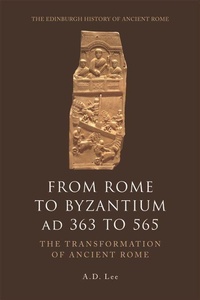
From Rome to Byzantium AD 363 to 565
The Transformation of Ancient Rome
Published on 15. January 2013
Book
Paperback/Softback
360 pages
978-0-7486-2791-2 (ISBN)
Description
The final dramatic centuries of Roman history
Between the deaths of the Emperors Julian (363) and Justinian (565), the Roman Empire underwent momentous changes. Most obviously, control of the west was lost to barbarian groups during the fifth century, and although parts were recovered by Justinian, the empire's centre of gravity shifted irrevocably to the east, with its focal point now the city of Constantinople. Equally important was the increasing dominance of Christianity not only in religious life, but also in politics, society and culture.
Doug Lee charts these and other significant developments which contributed to the transformation of ancient Rome and its empire into Byzantium and the early medieval west. By emphasising the resilience of the east during late antiquity and the continuing vitality of urban life and the economy, this volume offers an alternative perspective to the traditional paradigm of decline and fall.
Key features:* Provides a clear analytical narrative of pivotal political, military, and religious developments* Complements this with an examination of overarching trends in urban life and the economy* Gives particular attention to the dynamics of political and religious power and of Roman-barbarian relations during the fifth century
Keywords: Late Antiquity, Late Roman Empire, Fall of the Empire, Early Byzantine Empire, barbarians, Goths, vandals, Theodosius, Justinian
Between the deaths of the Emperors Julian (363) and Justinian (565), the Roman Empire underwent momentous changes. Most obviously, control of the west was lost to barbarian groups during the fifth century, and although parts were recovered by Justinian, the empire's centre of gravity shifted irrevocably to the east, with its focal point now the city of Constantinople. Equally important was the increasing dominance of Christianity not only in religious life, but also in politics, society and culture.
Doug Lee charts these and other significant developments which contributed to the transformation of ancient Rome and its empire into Byzantium and the early medieval west. By emphasising the resilience of the east during late antiquity and the continuing vitality of urban life and the economy, this volume offers an alternative perspective to the traditional paradigm of decline and fall.
Key features:* Provides a clear analytical narrative of pivotal political, military, and religious developments* Complements this with an examination of overarching trends in urban life and the economy* Gives particular attention to the dynamics of political and religious power and of Roman-barbarian relations during the fifth century
Keywords: Late Antiquity, Late Roman Empire, Fall of the Empire, Early Byzantine Empire, barbarians, Goths, vandals, Theodosius, Justinian
Reviews / Votes
Lee not only provides his readers with the most up-to-date Anglophone scholarship, but also takes note of key publications in French, German and Italian, thus transcending this book's primary target audience of students - many of whom will rarely have mastered all relevant languages - and making it just as valuable for scholars... As it stands, this is the most thorough yet accessible overview of Imperial Rome's twilight centuries since Ernst Stein's Histoire du Bas-Empire. The present reviewer could think of no higher endorsement. -- Jeroen Wijnendaele, Ghent University * Acta Classica * The book has many virtues. Accuracy, as Housman remarked, is a duty not a virtue, but Lee is extremely accurate in comparison to some of his competitors. University students must surely comprise the majority of the target audience and Lee does not forget the book's didactic purpose... A fine achievement. -- Gavin Kelly, University of Edinburgh * Bryn Mawr Classical Review * This rich, clear analytical narrative of two centuries of dramatic change unravels the complexities of seismic religious transformation, major cultural realignment as well as the political and military changes that shifted Europe's focus from Rome to Byzantium and that still influence the shape of Europe. An excellent overview of the period. -- Michael Whitby * University of Birmingham *More details
Series
Language
English
Place of publication
Edinburgh
United Kingdom
Target group
College/higher education
Product notice
Paperback (trade)
Unsewn / adhesive bound
Illustrations
40 black and white illustrations
Dimensions
Height: 154 mm
Width: 231 mm
Thickness: 22 mm
Weight
536 gr
ISBN-13
978-0-7486-2791-2 (9780748627912)
Copyright in bibliographic data and cover images is held by Nielsen Book Services Limited or by the publishers or by their respective licensors: all rights reserved.
Schweitzer Classification
Other editions
Additional editions
E-Book
01/2013
1st Edition
Edinburgh University Press
€0.00
Available for download
E-Book
01/2013
Edinburgh University Press
€32.99
Available for download
Person
Doug Lee is Associate Professor in the Department of Classics at the University of Nottingham. He is the author of Information and Frontiers: Late Roman Foreign Relations (1993), Pagans and Christians in Late Antiquity: A Sourcebook (2000), and War in Late Antiquity: A Social History (2007), as well as contributing chapters to the Cambridge Ancient History.
Content
List of Maps; List of Illustrations; Acknowledgements; Series Editor's Preface; Author's Preface; Abbreviations; 1. The Constantinian Inheritance; Part I: The Later Fourth Century; 2. Emperors, Usurpers and Frontiers; 3. Towards a Christian Empire; 4. Old Rome, New Rome; Part II: The Long Fifth Century; 5. Generalissimos and Imperial Courts; 6. Barbarians and Romans; 7. Church and State, Piety and Power; 8. Anastasius and the Resurrection of Imperial Power; 9. Rome's Heirs in the West; Part III: Longer-Term Trends; 10. Urban Continuity and Change; 11. Economic Patterns; Part IV: The Age of Justinian; 12. Justinian and the Roman Past; 13. Justinian and the Christian Present; 14. Justinian and the End of Antiquity; Chronology; Lists of rulers; List of bishops of Rome; A guide to further reading; Select bibliography of modern works; Index.