

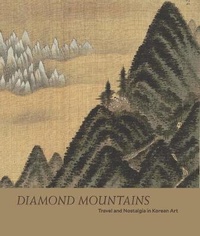
Diamond Mountains
Travel and Nostalgia in Korean Art
Published on 27. February 2018
Book
Hardback
164 pages
978-1-58839-653-2 (ISBN)
Description
A dazzling exploration of the pictorial traditions inspired by Korea's legendary Diamond Mountains
The Diamond Mountains, known in Korea as Mount Geumgang, are perhaps the most famous and emotionally resonant site on the Korean Peninsula, a breathtaking range of rocky peaks, waterfalls, lagoons, and manmade pavilions. For centuries the range has inspired cultural pride and a vast outpouring of creative expression. Yet since the partition of Korea in the 1940s, situating them in the North, the Diamond Mountains have remained largely inaccessible to visitors, shrouding the site in legend, loss, and longing.
This book examines the visual representation of this remarkable landscape from the 18th century to the present day. It explores how Jeong Seon (1676-1759) revolutionized Korean painting with his Diamond Mountains landscapes, replacing conventional generic imagery with specific detail and indelibly influencing generations of artists in his wake. It also discusses the potency of these mountains as an emblem of Korean cultural identity, as reflected in literature and in exquisitely detailed album leaves, handscrolls, hanging scrolls, and screens. This magnificent volume is the first in English to survey this rich artistic tradition and bring these distant mountains into view.
Published by The Metropolitan Museum of Art/Distributed by Yale University Press
Exhibition Schedule:
The Metropolitan Museum of Art
(02/06/18-05/20/18)
The Diamond Mountains, known in Korea as Mount Geumgang, are perhaps the most famous and emotionally resonant site on the Korean Peninsula, a breathtaking range of rocky peaks, waterfalls, lagoons, and manmade pavilions. For centuries the range has inspired cultural pride and a vast outpouring of creative expression. Yet since the partition of Korea in the 1940s, situating them in the North, the Diamond Mountains have remained largely inaccessible to visitors, shrouding the site in legend, loss, and longing.
This book examines the visual representation of this remarkable landscape from the 18th century to the present day. It explores how Jeong Seon (1676-1759) revolutionized Korean painting with his Diamond Mountains landscapes, replacing conventional generic imagery with specific detail and indelibly influencing generations of artists in his wake. It also discusses the potency of these mountains as an emblem of Korean cultural identity, as reflected in literature and in exquisitely detailed album leaves, handscrolls, hanging scrolls, and screens. This magnificent volume is the first in English to survey this rich artistic tradition and bring these distant mountains into view.
Published by The Metropolitan Museum of Art/Distributed by Yale University Press
Exhibition Schedule:
The Metropolitan Museum of Art
(02/06/18-05/20/18)
Reviews / Votes
"The Diamond Mountains, known in Korea as Mount Geumgang, are perhaps the most famous and emotionally resonant site on the Korean Peninsula, a breathtaking range of rocky peaks, waterfalls, lagoons, and manmade pavilions. This book examines the visual representation of this remarkable landscape from the 18th century to the present day." - Asian Art NewspaperMore details
Language
English
Place of publication
New York
United States
Product notice
Cloth over boards
Illustrations
209 color illus.
Dimensions
Height: 254 mm
Width: 229 mm
Weight
971 gr
ISBN-13
978-1-58839-653-2 (9781588396532)
Copyright in bibliographic data and cover images is held by Nielsen Book Services Limited or by the publishers or by their respective licensors: all rights reserved.
Schweitzer Classification
Persons
Soyoung Lee is curator in the Department of Asian Art at The Metropolitan Museum of Art. Ahn Daehoe is professor of Korean and classical Chinese literature at Sungkyunkwan University, Seoul. Chin-Sung Chang is professor of East Asian art history at Seoul National University. Lee Soomi is executive curator at the National Museum of Korea, Seoul.