

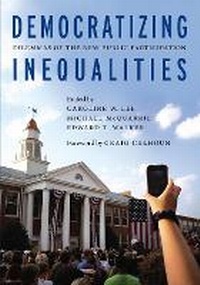
Democratizing Inequalities
Dilemmas of the New Public Participation
Published on 30. January 2015
Book
Hardback
320 pages
978-1-4798-4727-3 (ISBN)
Description
Opportunities to "have your say," "get involved," and "join the
conversation" are everywhere in public life. From crowdsourcing and town hall
meetings to government experiments with social media, participatory politics increasingly
seem like a revolutionary antidote to the decline of civic engagement and the
thinning of the contemporary public sphere. Many argue that, with new
technologies, flexible organizational cultures, and a supportive policymaking
context, we now hold the keys to large-scale democratic revitalization.
Democratizing Inequalities shows that the equation may not be so
simple. Modern societies face a variety of structural problems that limit
potentials for true democratization, as well as vast inequalities in political
action and voice that are not easily resolved by participatory solutions. Popular
participation may even reinforce elite power in unexpected ways. Resisting an
oversimplified account of participation as empowerment, this collection of
essays brings together a diverse range of leading scholars to reveal surprising
insights into how dilemmas of the new public participation play out in politics
and organizations. Through investigations including fights over the
authenticity of business-sponsored public participation, the surge of the Tea
Party, the role of corporations in electoral campaigns, and participatory
budgeting practices in Brazil, Democratizing
Inequalities seeks to refresh our understanding of public participation and
trace the reshaping of authority in today's political environment.
conversation" are everywhere in public life. From crowdsourcing and town hall
meetings to government experiments with social media, participatory politics increasingly
seem like a revolutionary antidote to the decline of civic engagement and the
thinning of the contemporary public sphere. Many argue that, with new
technologies, flexible organizational cultures, and a supportive policymaking
context, we now hold the keys to large-scale democratic revitalization.
Democratizing Inequalities shows that the equation may not be so
simple. Modern societies face a variety of structural problems that limit
potentials for true democratization, as well as vast inequalities in political
action and voice that are not easily resolved by participatory solutions. Popular
participation may even reinforce elite power in unexpected ways. Resisting an
oversimplified account of participation as empowerment, this collection of
essays brings together a diverse range of leading scholars to reveal surprising
insights into how dilemmas of the new public participation play out in politics
and organizations. Through investigations including fights over the
authenticity of business-sponsored public participation, the surge of the Tea
Party, the role of corporations in electoral campaigns, and participatory
budgeting practices in Brazil, Democratizing
Inequalities seeks to refresh our understanding of public participation and
trace the reshaping of authority in today's political environment.
Reviews / Votes
"Democratizing Inequalities is a timely and provocative compilation that demonstrates how participatory practices across a range of expected and unexpected locations cut both waysopening up avenues for citizen engagement while also limiting the democratic potential assumed to follow. The chapters in this volume are a welcome empirical corrective to celebratory discourses of citizen participation, and the book is certain to be an important resource for researchers and practitioners interested in the democratic possibilities of the 'new public participation.'" - Debra Minkoff,author of Organizing for Equality "The authors of Democratizing Inequalities set out to problematize the belief in public participation as a simplistic social good. With this collection of research-based studies and theoretical assessments of the field of participation and democracy studies they have thoughtfully and thoroughly achieved their goal." - Lynne M. Woehrle ,Mount Mary University (Mobilization) "The book is incredibly timely and deserves attention for its quality of scholarship and for its subject matter. It is an example of how research can both be scholarly and have uses for actors outside of academia." (Contemporary Sociology) "This is an exceptionally timely volume, consistently strong in its individual contributions and coherent in its collective analysis. Democratizing Inequalities both defines a major question for contemporary politicshow and why does political participation matterand advances a convincing contrarian argument. This volume and the questions raised within highlight a vital conversation about political theory and policy that is likely to be with us for many years." - Elisabeth Clemens,author of The People's Lobby "The volume clearly illustrates the complexities of democracy and deliberative politics. It shows us that, despite participatory processes, we have yet to perfect democracy. The book challenges us to consider whether deliberative processes achieve what we want them to." (Mobilization)More details
Language
English
Place of publication
New York
United States
Target group
Professional and scholarly
Dimensions
Height: 254 mm
Width: 178 mm
ISBN-13
978-1-4798-4727-3 (9781479847273)
Copyright in bibliographic data and cover images is held by Nielsen Book Services Limited or by the publishers or by their respective licensors: all rights reserved.
Schweitzer Classification
Other editions
Additional editions
Caroline W. Lee | Michael McQuarrie | Edward T. Walker
Democratizing Inequalities
Dilemmas of the New Public Participation
E-Book
01/2015
1st Edition
New York University Press
€141.99
Available for download
Persons
Caroline W. Lee is Associate Professor of Sociology at Lafayette College. Her research explores the intersection of social movements, business, and democracy in American politics. She is the author of Do-It-Yourself Democracy: The Rise of the Public Engagement Industry.
Michael McQuarrie is Associate Professor of Sociology at the London School of Economics and Political Science and a Poiesis Fellow at New York University's Institute for Public Knowledge. His work has been published in venues such as: Politics and Society, Public Culture, City and Community, Annals,and Research in Political Sociology. He recently edited Remaking Urban Citizenship with Michael Peter Smith.
Edward T. Walker is Associate Professor and Vice Chair in the Department of Sociology at the University of California, Los Angeles. His research examines how organizations and institutional contexts shape public participation. His research has appeared in the American Sociological Review, American Journal of Sociology, Public Opinion Quarterly, and Social Problems. He is the author of Grassroots for Hire: Public Affairs Consultants in American Democracy.
Craig Calhoun is Director of the London School of Economics and Global Distinguished Professor of Sociology at New York University. His most recent book is The Roots of Radicalism: Tradition, the Public Sphere, and Early Nineteenth-Century Social Movements.
Michael McQuarrie is Associate Professor of Sociology at the London School of Economics and Political Science and a Poiesis Fellow at New York University's Institute for Public Knowledge. His work has been published in venues such as: Politics and Society, Public Culture, City and Community, Annals,and Research in Political Sociology. He recently edited Remaking Urban Citizenship with Michael Peter Smith.
Edward T. Walker is Associate Professor and Vice Chair in the Department of Sociology at the University of California, Los Angeles. His research examines how organizations and institutional contexts shape public participation. His research has appeared in the American Sociological Review, American Journal of Sociology, Public Opinion Quarterly, and Social Problems. He is the author of Grassroots for Hire: Public Affairs Consultants in American Democracy.
Craig Calhoun is Director of the London School of Economics and Global Distinguished Professor of Sociology at New York University. His most recent book is The Roots of Radicalism: Tradition, the Public Sphere, and Early Nineteenth-Century Social Movements.
Content
Contents Part II Participation and the Reproduction of Inequality 2 Civic-izing Markets: Selling Social Profits in Public Deliberation 27 3 Workers' Rights as Human Rights? Solidarity Campaigns and the Anti-Sweatshop Movement 46 4 Legitimating the Corporation through Public Participation 66 Part III The Production of Authority and Legitimacy 5 No Contest: Participatory Technologies and the Transformation of Urban Authority 83 6 The Fiscal Sociology of Public Consultation 102 7 Structuring Electoral Participation: The Formalization of Democratic New Media Campaigning, 2000 - 2008 125 8 Patient, Parent, Advocate, Investor: Entrepreneurial Health Activism from Research to Reimbursement 143 Part IV Unintended Consequences and New Opportunities 9 Spirals of Perpetual Potential: How Empowerment Projects' Noble Missions Tangle in Everyday Interaction 165 10 Becoming a Best Practice: Neoliberalism and the Curious Case of Participatory Budgeting 187 11 The Social Movement Society, the Tea Party, and the Democratic Deficit 204 12 Public Deliberation and Political Contention 222 Part V Conclusion 13 Realizing the Promise of Public Participation in an Age of Inequality 247